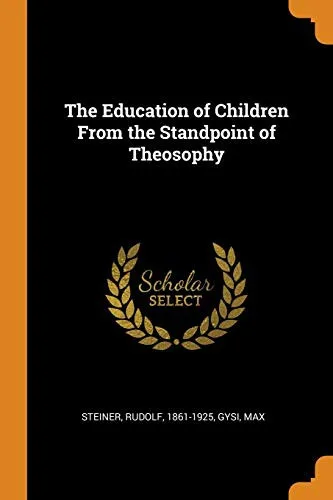
The education of children from the standpoint of theosophy
 83
83

The education of children from the standpoint of theosophy
Steiner's approach to child-rearing, as documented in "The Education of Children from the Standpoint of Theosophy," is less a practical guide and more a philosophical treatise on the spiritual underpinnings of human development. His insistence on viewing the child as an evolving spiritual entity is a challenging but potentially rewarding perspective for parents and educators disillusioned with purely materialistic educational models. The strength lies in its radical departure from conventional thinking, urging a consideration of the child's etheric and astral bodies. However, the inherent abstraction and reliance on Theosophical concepts can make direct application difficult for readers unfamiliar with Steiner's extensive cosmology. A passage discussing the 'seven-year cycles' of development, while conceptually rich, demands significant interpretive effort to translate into actionable parenting strategies. It's a work that provokes deep reflection rather than offering straightforward solutions.
📝 Description
83
Rudolf Steiner delivered lectures in the early 1900s on child development from a theosophical perspective.
This collection presents Rudolf Steiner's lectures on the development of children, viewed through the lens of Theosophy. It addresses the spiritual and developmental needs of the growing individual, proposing an educational approach that aligns with a child's inner evolution. The book does not offer conventional pedagogical methods but rather a spiritual-scientific perspective on learning and character formation.
Educators, parents, and spiritual seekers interested in anthroposophy and Theosophy will find this text relevant. It is particularly suited for those looking to understand child development from a metaphysical viewpoint, moving beyond purely materialist or psychological frameworks. Those familiar with Rudolf Steiner's broader work will recognize the consistent application of his core principles to the field of education. First published in German, this collection of lectures, compiled and later edited by Gysi Max, emerged from a period of intense spiritual and intellectual activity in the early 20th century.
Rudolf Steiner was a prominent figure within Theosophy, a movement that sought to synthesize Eastern and Western esoteric traditions. His lectures on education, delivered around the turn of the 20th century, represent a foundational aspect of what would later develop into Waldorf education. This work applies theosophical principles to understanding the stages of a child's growth and the spiritual underpinnings of learning.
💡 Why Read This Book?
• Gain insight into Steiner's view of the child's etheric and astral bodies, understanding how these spiritual components influence learning and behavior, a concept central to anthroposophical pedagogy. • Explore the Theosophical perspective on the seven-year cycles of child development, providing a framework for understanding developmental stages beyond conventional psychological models. • Discover the emphasis on imitation and rhythmic repetition as crucial educational tools, as presented by Steiner, offering alternative methods for fostering growth and learning.
⭐ Reader Reviews
Honest opinions from readers who have explored this book.
❓ Frequently Asked Questions
What is the core Theosophical principle behind Steiner's educational ideas?
The core Theosophical principle is the view of the human being as a spiritual entity with evolving bodies (physical, etheric, astral, and ego). Steiner applied this to education, seeing childhood as a critical phase for nurturing these spiritual aspects alongside physical and mental development.
When did Rudolf Steiner first lecture on these educational topics?
Rudolf Steiner delivered lectures on education from the early 1900s onwards, with many foundational talks occurring between 1904 and the establishment of the first Waldorf school in 1919.
How does this book differ from modern educational psychology?
This book differs by prioritizing a spiritual-scientific perspective over empirical psychological observation. It posits that understanding a child's spiritual nature and development is paramount, influencing curriculum and pedagogical methods in ways distinct from secular approaches.
Who was Gysi Max in relation to this work?
Gysi Max was instrumental in compiling and editing Rudolf Steiner's lectures on education. His work ensured the preservation and dissemination of Steiner's ideas, making them accessible in published form for later generations.
What are the 'seven-year cycles' Steiner discusses?
Steiner identified distinct developmental phases occurring in approximately seven-year intervals, each characterized by specific physical, emotional, and spiritual needs and capacities. These cycles inform his approach to curriculum and teaching methods.
Is this book suitable for parents without prior knowledge of Theosophy?
While accessible, prior familiarity with basic Theosophical concepts or Rudolf Steiner's work can enhance understanding. The book introduces complex metaphysical ideas that may require some background context for full appreciation.
🔮 Key Themes & Symbolism
Spiritual Anatomy of Childhood
The work posits that a child is not merely a physical and psychological being but possesses distinct spiritual components: the etheric, astral, and ego bodies. Understanding the development and interplay of these bodies, as viewed through Theosophy, is presented as fundamental to effective education. Steiner argues that pedagogical practices must be attuned to the evolving needs of these subtle bodies, influencing everything from curriculum design to the teacher's inner disposition.
The Rhythm of Development
A central theme is the concept of developmental cycles, particularly the seven-year phases. Steiner suggests that each cycle presents unique challenges and opportunities for the child's spiritual, etheric, astral, and egoic development. This rhythmic progression necessitates a corresponding rhythm in education, emphasizing the importance of imitation in early years and the cultivation of imagination and feeling in later stages of childhood.
The Teacher as Spiritual Guide
This text frames the educator's role as far more than instruction; it is a spiritual vocation. Teachers are urged to cultivate their own spiritual perception and inner development to meet the needs of the children. The book emphasizes that the teacher's spiritual authority and understanding are paramount in guiding the child through their developmental journey, fostering their true potential.
Imagination and Imitation
Steiner highlights the distinct roles of imitation and imagination in a child's education. In the early years, imitation is presented as the primary mode of learning, where the child unconsciously absorbs the world through the teacher and environment. As the child matures, the capacity for imaginative thinking becomes crucial, requiring educational methods that nurture creative faculties rather than rote memorization.
💬 Memorable Quotes
Direct passages from the work, attributed to the author.
“The child must be educated by imitation in the first seven years.”
— This statement underscores Steiner's belief that early childhood learning is fundamentally unconscious and absorbed. It suggests that the environment and the actions of adults are the most potent educational tools, shaping the child's etheric and astral bodies through direct example.
“The seven-year periods are significant for the development of the child's being.”
— This highlights Steiner's structured view of human development. It suggests that distinct phases, marked by approximately seven-year intervals, require specific pedagogical approaches tailored to the evolving spiritual and physical needs of the child during each period.
“The teacher's task is to perceive the spiritual needs of the child.”
— This points to the elevated role of the educator in Steiner's system. It implies that teachers must develop clairvoyant or intuitive faculties to understand the deeper, spiritual requirements of each child, going beyond observable behavior.
“Imagination is essential for the development of the child's soul.”
— This emphasizes the importance of creative and imaginative thinking in Steiner's pedagogy, particularly for older children. It suggests that fostering imagination is crucial for the healthy development of the child's inner life and spiritual evolution.
💡 Key Ideas
Editorial paraphrase of the work's core concepts — not direct quotes.
True education is the art of awakening the child's inner capacities.
This paraphrased concept emphasizes that Steiner's educational philosophy is not about filling a child with knowledge but about nurturing their innate spiritual and intellectual potential. It frames teaching as a process of spiritual cultivation and guidance.
🌙 Esoteric Significance
Tradition
This work is firmly rooted in the Theosophical tradition, as articulated by Helena Blavatsky and further developed by Rudolf Steiner. It extends Theosophical cosmology and anthropology into the practical domain of child-rearing and education. Steiner's unique contribution was his method of 'spiritual science,' aiming for a verifiable, observational approach to the spiritual world, which he applied here to understanding the child's developmental trajectory from a soul and spirit perspective.
Symbolism
Key symbolic concepts include the 'seven-year cycles,' representing distinct phases of human development influenced by cosmic rhythms and the evolution of the child's subtle bodies (etheric, astral). The 'etheric body' itself is symbolic of life forces and formative energies, while the 'astral body' represents consciousness, feeling, and soul activity. The teacher's 'spiritual perception' acts as a symbolic bridge, enabling them to 'see' and respond to these non-physical aspects of the child.
Modern Relevance
Steiner's ideas continue to influence contemporary alternative education movements, most notably Waldorf (Steiner) schools worldwide. His holistic approach, emphasizing creativity, imagination, and the spiritual dimensions of learning, appeals to parents and educators seeking alternatives to standardized testing and purely academic focuses. Thinkers in consciousness studies and integral psychology also engage with his concepts of human development.
👥 Who Should Read This Book
• Parents and guardians seeking a spiritual framework for understanding their children's development beyond conventional psychology. • Educators, particularly those interested in Anthroposophy, Waldorf education, or holistic pedagogical approaches. • Students of Theosophy and Rudolf Steiner's broader philosophical and spiritual works looking to understand his specific applications to education.
📜 Historical Context
Rudolf Steiner delivered these lectures during a vibrant period for esoteric thought in Europe, a time when movements like Theosophy, founded by Helena Blavatsky in 1875, sought to synthesize Eastern and Western spiritual traditions and explore the hidden nature of reality. Steiner himself was a prominent figure within the Theosophical Society before breaking away to found his own movement, Anthroposophy, in 1913. His lectures on education, given in the early 20th century (many around 1904-1910), were radical departures from the prevailing pedagogical theories of the era, which were increasingly influenced by scientific psychology and positivism. While figures like John Dewey were advocating for progressive education rooted in experience and democracy, Steiner proposed a spiritual-scientific approach. His ideas were met with both fervent interest and skepticism, laying the groundwork for the first Waldorf school established in Stuttgart in 1919, a unique response to the post-WWI educational landscape.
📔 Journal Prompts
The role of imitation in the first seven years of a child's life.
Consider the concept of the etheric body's influence on a child's learning.
Reflect on the teacher's responsibility in perceiving the child's spiritual needs.
How can the principle of rhythm be applied to daily family life?
The development of imagination as a spiritual faculty.
🗂️ Glossary
Etheric Body
In Steiner's Theosophy, this is the 'life body' or 'formative forces' body, responsible for growth, reproduction, and healing. It is considered more subtle than the physical body and is active throughout life.
Astral Body
Referred to as the 'sentient body,' it is associated with consciousness, feelings, desires, and instincts. Its development is central to the child's inner emotional and psychological life according to Steiner.
Ego (or I)
The spiritual core of the human being, representing individuality, self-awareness, and the capacity for free thought and action. Its full manifestation is considered a later developmental stage.
Spiritual Science (Anthroposophy)
Rudolf Steiner's term for his philosophical and psychological system, which seeks to apply scientific methods to the investigation of spiritual phenomena and realities.
Seven-Year Cycles
Steiner's concept of distinct developmental phases in human life, occurring in approximately seven-year intervals, each with unique characteristics and needs for education and inner development.
Imitation
In Steiner's pedagogy, the primary mode of learning for young children (birth to approx. 7 years), where they unconsciously absorb and replicate the environment and actions around them.
Imagination
A crucial faculty for older children, seen not just as fantasy but as a creative and formative power essential for intellectual and spiritual development.
🔮 Readers Also Liked
Browse all →




More by Rudolf Steiner, Gysi Max
All books →
More Free Theosophy & Anthroposophy Books
View all →