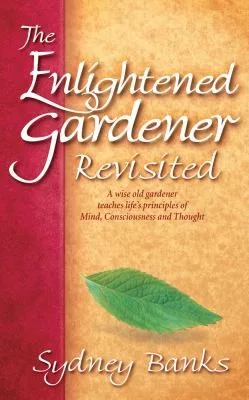
The enlightened gardener revisited
 72
72

The enlightened gardener revisited
Sydney Banks' "The Enlightened Gardener Revisited" offers a deceptively simple yet potent model for understanding mental well-being. Unlike many self-help texts that focus on techniques, Banks points to an underlying structure of the human mind. The strength of the work lies in its elegant articulation of the "Three Principles" – Mind, Consciousness, and Thought – suggesting that our perceived reality is a direct product of our thinking, not external events. This perspective, if genuinely grasped, can dissolve significant emotional distress. A notable passage explains how "Thought" is transient, like clouds passing across the sky of "Consciousness," which itself is the awareness of the boundless "Mind." A potential limitation is that the simplicity can be initially perplexing, requiring a leap of faith for those accustomed to more analytical approaches. The book's insistence on an internal "state of mind" as the sole determinant of experience might also feel dismissive to those facing severe external hardships, though Banks would argue the *experience* of those hardships is still internally generated. It provides a refreshing, almost radical, alternative to conventional psychological paradigms.
📝 Description
72
Sydney Banks' The Enlightened Gardener Revisited, first published in 2016, proposes that inner peace stems from a shift in perspective, not external changes.
This book presents a framework for understanding the human mind, suggesting that our experience of life is shaped by our internal state rather than external circumstances. Banks argues that a change in perspective, not a change in conditions, leads to a more fulfilling existence. The work is suited for those experiencing stress, anxiety, or dissatisfaction, especially if conventional self-help methods have fallen short. It appeals to readers interested in the connection between psychology and spirituality who seek an inwardly focused path to mental clarity and emotional resilience. Those familiar with spiritual traditions emphasizing the power of thought and consciousness will find resonance with its non-dogmatic approach.
The core ideas rest on understanding innate psychological health. Banks introduces "Thought" as a temporary mental event, separate from "Mind," which is the source of intelligence and creativity. "Consciousness" is described as the awareness of our thoughts and feelings. The book asserts that by recognizing these principles, individuals can access their natural state of well-being.
Sydney Banks' work, often referred to as "The Three Principles," shares common ground with spiritual traditions that emphasize the mind's role in creating reality. While predating some mainstream mindfulness and CBT applications, its focus on "Mind," "Consciousness," and "Thought" as fundamental forces aligns with philosophical and spiritual concepts found in various traditions that highlight thought as a primary generator of experience. This approach offers a non-dogmatic, inwardly directed path to mental clarity and emotional resilience.
💡 Why Read This Book?
• Understand the foundational "Three Principles" (Mind, Consciousness, Thought) as presented by Sydney Banks, which offers a unique lens on psychological experience distinct from therapeutic techniques. • Gain insight into how your internal state of mind, rather than external circumstances, generates your feelings, a concept central to Banks' teachings since the early 2000s. • Discover a pathway to innate well-being by recognizing the transient nature of "Thought," potentially leading to a more peaceful and resilient approach to life's challenges.
⭐ Reader Reviews
Honest opinions from readers who have explored this book.
❓ Frequently Asked Questions
What is the core message of Sydney Banks' 'The Enlightened Gardener Revisited'?
The book's core message is that our experience of life is generated from within, by the principles of Mind, Consciousness, and Thought, rather than by external circumstances. It suggests innate psychological health is accessible to everyone.
When was 'The Enlightened Gardener Revisited' first published?
'The Enlightened Gardener Revisited' was first published in 2016, building upon Sydney Banks' earlier work and teachings.
How does Banks' approach differ from traditional self-help or psychology?
Unlike methods focused on changing behaviors or external conditions, Banks' approach emphasizes understanding the fundamental workings of the mind, positing that a shift in inner awareness is the key to well-being.
What are the 'Three Principles' mentioned in the book?
The Three Principles are Mind (the creative source), Consciousness (awareness), and Thought (the content of our thinking). Banks posits these are the fundamental building blocks of our reality.
Is this book suitable for beginners in spiritual or psychological exploration?
Yes, while profound, the book's concepts are presented in a way that can be grasped by beginners. It offers a foundational understanding that can inform further exploration into psychological and spiritual concepts.
What does 'The Enlightened Gardener' metaphor represent?
The metaphor suggests that our minds, like a garden, can be cultivated not by constantly tending to weeds (problems), but by understanding the underlying soil and conditions (our inner state) to allow natural growth and peace.
🔮 Key Themes & Symbolism
The Three Principles
The central theme revolves around Sydney Banks' "Three Principles": Mind, Consciousness, and Thought. Mind is presented as the universal, creative intelligence; Consciousness is the awareness of our experience; and Thought is the transient mental content that shapes our perception. The work argues that understanding the distinct nature and function of these principles is key to unlocking innate psychological health and resilience. It suggests that our problems arise not from circumstances, but from mistaking transient thoughts for reality, a concept explored by Banks starting around the early 2000s.
Innate Psychological Health
A core tenet is the existence of an inherent, natural well-being within every individual. This is not something to be achieved or earned, but rather something that is always present, obscured only by our misunderstanding of how our minds work. The book posits that by seeing through the illusion of negative thinking and recognizing the power of our underlying Mind, we can naturally access this state of peace and clarity. This contrasts with many psychological models that focus on pathology and remediation.
The Nature of Thought
The book emphasizes the transient and subjective nature of thought. Thoughts are presented as mental events that arise and pass, not as direct reflections of reality. The "enlightened gardener" metaphor implies that one doesn't need to meticulously pull every weed (negative thought) but rather understand the conditions that allow for healthy growth, thereby minimizing the impact of undesirable thoughts. This perspective encourages a detachment from distressing thoughts, seeing them for what they are: temporary mental phenomena.
Experiencing Reality Internally
Banks strongly advocates that our subjective experience of the world is created from within. External events themselves are neutral; it is our thinking about these events that determines our emotional response and perception. This internal creation of reality is a direct consequence of the interplay between Mind, Consciousness, and Thought. By shifting our internal state, we can change how we experience any external situation, a concept that gained considerable attention in personal development circles.
💬 Memorable Quotes
Direct passages from the work, attributed to the author.
“Your thinking is what creates your feelings.”
— This highlights the fundamental principle that our emotional responses are not directly caused by external events, but by the thoughts we have about those events. It points to the internal origin of our psychological states.
“Thought is like a cloud passing through the sky of Consciousness.”
— This metaphor illustrates the transient nature of thoughts. They appear, change, and disappear within the broader awareness (Consciousness), suggesting we are not our thoughts and they do not define our fundamental being.
“The only thing that separates you from your innate well-being is your thinking.”
— This suggests that psychological health is our natural state, and it is only our patterns of thinking that create the illusion of suffering or unhappiness. Accessing well-being involves seeing through these thought patterns.
“Mind is the source of all intelligence and creativity.”
— This positions Mind not just as personal intellect, but as a universal, boundless intelligence from which all insight, creativity, and wisdom originate. It encourages tapping into this deeper resource.
💡 Key Ideas
Editorial paraphrase of the work's core concepts — not direct quotes.
When you change your thinking, you change your feelings.
A practical implication of the core message, this quote emphasizes that altering one's thought processes can directly lead to a different emotional experience, offering a pathway to managing one's state.
🌙 Esoteric Significance
Tradition
Banks' work draws implicitly from non-dualistic spiritual traditions and philosophical idealism, echoing concepts found in certain schools of Advaita Vedanta, Taoism, and Christian Science. While not explicitly aligning with a single esoteric lineage like Hermeticism or Kabbalah, it shares a foundational belief in an underlying reality (Mind) and the power of consciousness to shape subjective experience. It departs from many Western esoteric traditions by offering a secularized, principle-based framework that avoids specific ritual, dogma, or complex symbolic systems, making it accessible outside traditional esoteric circles.
Symbolism
The title itself, "The Enlightened Gardener," serves as a central symbol. The gardener represents the individual tending to their inner world. Enlightenment, in this context, is not about achieving a perfect state, but about understanding the fundamental principles that govern mental growth, much like a gardener understands soil, water, and sunlight. The "garden" symbolizes the mind, capable of producing beautiful "flowers" (positive experiences) or "weeds" (negative ones), with the key being the gardener's understanding of the underlying conditions rather than just battling the visible elements.
Modern Relevance
Banks' teachings, particularly the "Three Principles," continue to influence contemporary coaching, therapy, and personal development. Thinkers and practitioners in fields like positive psychology, trauma-informed care, and consciousness studies often reference or are inspired by his model. His work provides a foundational understanding for those exploring the mind-body connection and the potential for radical inner transformation, resonating with modern interests in neuroscience and the subjective nature of reality.
👥 Who Should Read This Book
['• Individuals seeking a fundamental shift in their understanding of anxiety and stress, moving beyond symptom management to address root causes.', '• Students of consciousness and psychology interested in alternative models that explain subjective experience and innate well-being.', '• Coaches, therapists, and counselors looking for a simple yet powerful framework to help clients access their own inner resources and resilience.']
📜 Historical Context
Sydney Banks' ideas, particularly the "Three Principles" model, gained significant traction in the early 21st century, a period marked by a growing interest in mindfulness, positive psychology, and Eastern spiritual philosophies entering Western discourse. While concepts like "mindfulness" and "cognitive restructuring" were becoming mainstream through avenues like mindfulness-based stress reduction (MBSR) and CBT, Banks offered a more foundational, principle-based understanding of consciousness and thought. His work often positioned itself as a precursor or underlying explanation for the effectiveness of various therapeutic and spiritual modalities, rather than a competing school. Contemporary authors like Eckhart Tolle were also exploring the power of presence and the nature of thought during this era, though Banks' specific framework focused on the distinct roles of Mind, Consciousness, and Thought. The reception of Banks' work was largely within personal development and coaching communities, with many practitioners reporting profound shifts in understanding and well-being.
📔 Journal Prompts
The interplay of "Mind," "Consciousness," and "Thought" in shaping your daily experience.
Recognizing "Thought" as transient, like clouds in the sky.
The nature of "innate well-being" versus achieved happiness.
Identifying moments when external circumstances felt overwhelming, yet your internal state remained peaceful.
Exploring the "gardener" within: what are you cultivating in your mental landscape?
🗂️ Glossary
Mind
In Banks' model, Mind is the universal, formless intelligence and consciousness that is the source of all creation, wisdom, and understanding. It is the fundamental basis of our existence and potential.
Consciousness
The awareness of our experience. It is the capacity to feel, sense, and be aware of our thoughts, feelings, and the external world. It is the 'space' in which thoughts appear.
Thought
A transient mental event or idea that arises within Consciousness. Thoughts are the content of our thinking and are seen as the direct creators of our feelings and subjective reality.
Innate Well-being
The natural state of psychological health, peace, and resilience that exists within every individual, independent of external circumstances. It is the default state when the mind is not clouded by misunderstanding.
The Three Principles
The foundational concepts of Mind, Consciousness, and Thought as presented by Sydney Banks, believed to be the operating system of all human experience.
State of Mind
The subjective psychological and emotional condition of an individual at any given moment, understood in Banks' work to be a direct product of their thinking.
Enlightened Gardener
A metaphor for the individual who understands the principles of their mind and cultivates inner peace and well-being, not by controlling external factors, but by understanding internal dynamics.
🔮 Readers Also Liked
Browse all →








More by Sydney Banks
All books →
More Free Theosophy & Anthroposophy Books
View all →