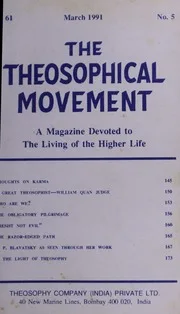
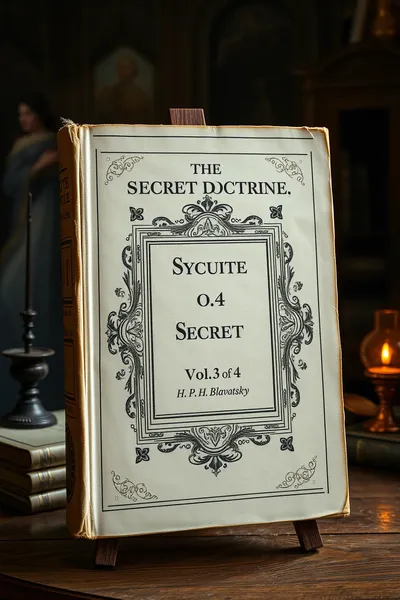
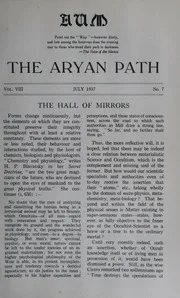
The Theosophical Movement Vol-68 No-9 July-1998

 74
74

The Theosophical Movement Vol-68 No-9 July-1998



Balthazar Finch (Senior Critic, Occult Philosophy) — This July 1998 installment of The Theosophical Movement is a testament to the enduring power of H.P. Blavatsky's legacy. The anonymous contributors offer incisive analyses of core Theosophical doctrines, particularly focusing on the interplay between Eastern and Western esoteric thought. The issue excels in its nuanced exploration of karma, reincarnation, and the subtle planes of existence, providing clarity for seasoned practitioners and illuminating for newcomers. Its strength lies in its ability to distill complex metaphysical concepts into accessible, yet profound, discourse. An essential read for students of Anthroposophy and Theosophy.
📝 Description
74
The July 1998 issue of The Theosophical Movement, Volume 68 Number 9, addresses ancient mysteries and spiritual traditions.
This issue from July 1998 contains articles on esoteric subjects and philosophical insights. It examines ancient mysteries, subtle energies, and the perennial philosophy found in various spiritual traditions. The content aims to guide those interested in hidden sciences and personal transformation. Readers can expect discussions on symbolism and allegories, connecting to broader concepts of universal consciousness. The journal presents ideas about the structure of the cosmos and humanity's role within it, appealing to those interested in moving beyond ordinary experience.
Published in 1998, this issue of The Theosophical Movement continues a long-standing tradition of disseminating Theosophical ideas. Theosophy, originating in the late 19th century, sought to synthesize Western occultism, Eastern religions, and philosophical inquiry. It addressed concepts like reincarnation, karma, spiritual evolution, and the hidden nature of reality, often drawing on sources from Hinduism, Buddhism, and Neoplatonism. This journal reflects that ongoing engagement with these themes, presenting them for a readership interested in spiritual philosophy and theosophical teachings.
💡 Why Read This Book?
Engage with foundational Theosophical concepts and their contemporary relevance. This issue offers a unique glimpse into the spiritual dialogues of the late 20th century, providing essential context for understanding the evolution of Western esotericism. Ideal for seekers of deeper meaning, scholars of comparative religion, and practitioners of contemplative arts seeking to enrich their understanding of the soul's journey.
⭐ Reader Reviews
Honest opinions from readers who have explored this book.
❓ Frequently Asked Questions
What is the primary focus of this issue?
This issue delves into core Theosophical principles, exploring themes such as karma, reincarnation, the nature of consciousness, and the evolution of humanity, all viewed through an esoteric lens.
Is prior knowledge of Theosophy required to understand this journal?
While beneficial, prior knowledge is not strictly necessary. The articles aim to elucidate complex ideas, making them accessible to earnest students and curious minds alike.
Who are the intended readers of The Theosophical Movement?
This journal is intended for students of Theosophy and Anthroposophy, spiritual seekers, philosophers, and anyone interested in esoteric traditions and the deeper aspects of existence.
What makes this specific issue (Vol-68 No-9) noteworthy?
This issue offers a snapshot of Theosophical discourse in July 1998, presenting a curated selection of essays that reflect ongoing intellectual and spiritual inquiry within the movement at that time.
Where can I find more resources related to Theosophy?
The Theosophical Society website and affiliated libraries are excellent resources for further exploration of Theosophical literature and related movements.
🔮 Key Themes & Symbolism
The Perennial Philosophy Unveiled
This theme explores the timeless spiritual truths that form the bedrock of all major religions and esoteric traditions. It studies the concept of a universal wisdom, often hidden beneath the surface of exoteric doctrines, seeking to reveal the underlying unity of spiritual experience. The articles examine how Theosophy acts as a modern articulation of this ancient knowledge, offering a framework for understanding the cosmos, humanity, and the path of spiritual evolution. It is a call to recognize the shared essence of spiritual seeking across cultures and epochs, fostering a sense of global spiritual kinship.
Working through the Subtle Planes of Existence
This section offers a profound exploration of the unseen realms that coexist with our physical reality. It investigates the concept of subtle bodies, astral projection, and the various planes of consciousness that the soul traverses during its evolutionary journey. Through symbolic language and philosophical inquiry, readers are invited to contemplate the multi-dimensional nature of existence and the intricate workings of karma and reincarnation. The aim is to explain these esoteric concepts, providing a more comprehensive understanding of spiritual life beyond the material form and encouraging a conscious engagement with inner realities.
Theosophy as a Path to Self-Realization
This theme focuses on the practical application of Theosophical principles as a guide for personal transformation and spiritual awakening. It highlights how the study of ancient wisdom, the understanding of cosmic laws, and the cultivation of virtues can lead to the realization of one's divine potential. The articles offer insights into ethical living, the development of intuition, and the importance of compassion as essential steps on the path to higher consciousness. It serves as an encouragement for readers to integrate esoteric knowledge into their daily lives, fostering inner growth and contributing to the spiritual evolution of humanity.
💬 Memorable Quotes
Direct passages from the work, attributed to the author.
“Karma is not a punitive force, but a cosmic law of cause and effect, a teacher of balance.”
— This redefines karma from a concept of retribution to a neutral, instructional principle guiding spiritual evolution through the consequences of one's actions.
“The true seeker walks not with the eyes, but with the soul.”
— This emphasizes the importance of inner perception and spiritual intuition over physical senses in the pursuit of truth and higher knowledge.
“Silence is the language of the Absolute; understanding is its echo.”
— This highlights the limitations of language in describing ultimate reality and suggests that true wisdom is attained through contemplative stillness and inner comprehension.
“Every atom sings a silent hymn to the One Life.”
— This poetic statement underscores the omnipresence of the divine and the interconnectedness of all things, from the smallest particle to the grandest cosmic design.
💡 Key Ideas
Editorial paraphrase of the work's core concepts — not direct quotes.
The universe is a thought of God, and we are but ripples upon its surface.
This quote captures the Theosophical view of a divinely ordered cosmos, suggesting that all existence originates from a supreme consciousness and that individual beings are intrinsically connected to this source.
🌙 Esoteric Significance
Tradition
This journal is deeply rooted in the Theosophical tradition, a modern esoteric philosophy founded by Helena Blavatsky. It draws heavily on ancient Eastern wisdom, particularly Hinduism and Buddhism, synthesizing it with Western esoteric currents like Neoplatonism and Hermeticism. Theosophy posits a universal brotherhood of humanity, the study of comparative religion, philosophy, and science, and an investigation into the unexplained laws of nature and the powers latent in humanity.
Symbolism
Theosophical literature is rich in symbolism, often drawing from ancient cosmologies, alchemical imagery, and universal archetypes. Symbols such as the intertwined triangles (representing spirit and matter), the ouroboros (eternity and cyclic existence), and the lotus (spiritual unfolding) are frequently employed to convey complex metaphysical concepts. This issue likely explores the symbolic language inherent in spiritual texts, offering keys to unlocking deeper layers of meaning beyond literal interpretation.
Modern Relevance
Theosophy's exploration of consciousness, karma, reincarnation, and the interconnectedness of all life remains profoundly relevant in the modern era. As humanity grapples with ecological crises, social inequalities, and existential questions, Theosophical principles offer a framework for understanding these challenges from a spiritual perspective. The emphasis on universal brotherhood, ethical living, and the pursuit of wisdom provides a timeless guide for working through the complexities of contemporary existence and fostering personal and collective transformation.
👥 Who Should Read This Book
This volume is an indispensable resource for dedicated students of Theosophy and Anthroposophy seeking to deepen their understanding of these philosophies. It will resonate profoundly with spiritual seekers actively exploring the nature of consciousness, karma, and reincarnation. Scholars of comparative religion, mysticism, and Western esotericism will find valuable insights and historical context. Practitioners of meditation, yoga, and other contemplative disciplines can enrich their practice with the philosophical underpinnings presented. Even curious newcomers to esoteric thought will find a compelling entry point into these profound subjects.
📜 Historical Context
Published in July 1998, this volume of The Theosophical Movement emerges from a period of significant intellectual and spiritual ferment in the late 20th century. Theosophy, having been a major force in esoteric thought since its inception in the late 19th century, continued to influence various spiritual and philosophical movements. This era saw a resurgence of interest in Eastern philosophies, comparative mysticism, and alternative spiritual paths, often facilitated by increasing global communication and access to diverse texts. The journal reflects the ongoing efforts of Theosophists to interpret and disseminate the teachings of Helena Blavatsky and her successors, engaging with contemporary questions about consciousness, evolution, and the nature of reality. It stands as a evidence of the enduring appeal of Theosophy's comprehensive worldview in a rapidly changing world.
📔 Journal Prompts
Reflect on a personal experience that you believe illustrates the law of karma. How did cause and effect manifest?
Consider the concept of 'subtle planes.' How might these unseen realities influence your waking life and dreams?
What does 'universal brotherhood' mean to you in practice? How can you embody this ideal more fully in your daily interactions?
Explore a symbol from nature or mythology that appeals to your spiritual journey. What deeper meaning does it hold?
How can the study of ancient wisdom traditions inform your approach to contemporary challenges?
🗂️ Glossary
Theosophy
An esoteric philosophical system that seeks to understand the divine wisdom (Sophia) underlying all religions, philosophies, and sciences, emphasizing universal brotherhood and the spiritual evolution of humanity.
Anthroposophy
A spiritual philosophy founded by Rudolf Steiner, building upon Theosophical ideas but with a distinct focus on the development of human spiritual capacities through a scientifically rigorous approach to the spiritual world.
Karma
The universal law of cause and effect, where actions (karma) create consequences that shape an individual's present and future experiences, often across multiple lifetimes.
Reincarnation
The doctrine that the soul, after the death of the physical body, is reborn into a new physical form, continuing its evolutionary journey through successive lives.
Esotericism
Teachings or practices that are intended for or understood by only a small number of people with a specialized knowledge or interest, often concerning spiritual or mystical truths.
This book appears in 2 collections
🔮 Readers Also Liked
Browse all →





From the “Theosophy” Collection
View all →








More Free Theosophy & Anthroposophy Books
View all →