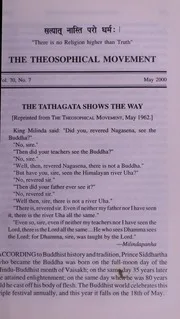
Meditations
 76
76

Meditations
Rudolf Steiner's "Meditations" offers verses that function less as literary pieces and more as spiritual exercises. Their power lies in their direct address to the inner life, aiming to evoke specific states of consciousness. The collection excels in providing concise, potent imagery that can anchor a meditative practice, particularly for those familiar with Steiner's broader philosophical framework. However, for the uninitiated, the verses may appear abstract or disconnected without the accompanying explanatory context Steiner often provided in his lectures. A notable strength is the sheer density of spiritual vision contained within each short piece; a passage like the one describing the "Guardian of the Threshold" (though not quoted directly here) powerfully conveys the challenges of inner development. The limitation is precisely this density, which can be overwhelming. The work succeeds as a tool for experienced practitioners seeking refined meditative aids.
📝 Description
76
Rudolf Steiner published 'Meditations' in October 2018, collecting spiritual verses for inner development.
Rudolf Steiner's "Meditations" is a collection of spiritual verses and poetic contemplations, not narrative prose. These texts are concentrated expressions of spiritual insight intended as focal points for inner development. They aim to guide the practitioner toward an experience of higher realities and archetypal spiritual beings.
This work is for individuals engaged in contemplative spiritual practice, especially those seeking to deepen their connection to the spiritual world through focused meditation. It appeals to students of Anthroposophy, esoteric philosophy, and anyone interested in Steiner's approach to understanding the cosmos and humanity's place within it. Those who find value in verse and imagery as aids to inner vision will find this collection particularly useful.
Steiner developed his spiritual science, Anthroposophy, in the early 20th century. "Meditations" draws from his extensive lecture cycle and written works, which sought to provide a scientifically verifiable path to spiritual knowledge. Published posthumously in its collected form, these verses reflect the spiritual currents of his time, often contrasting with materialistic viewpoints.
Rudolf Steiner, an Austrian philosopher, developed Anthroposophy in the early 20th century as a spiritual science. His work sought a verifiable path to spiritual knowledge, distinct from purely materialistic viewpoints. "Meditations" draws from this extensive body of work, aiming to facilitate direct spiritual experience through focused contemplation. The verses are intended as keys to unlock specific states of consciousness and foster an apprehension of spiritual truths.
💡 Why Read This Book?
• Gain access to verses specifically crafted by Rudolf Steiner to facilitate inner development and connection with spiritual archetypes, offering a unique approach not found in secular mindfulness texts. • Experience the power of concentrated spiritual language designed to evoke specific states of consciousness, as Steiner intended for his students in the early 20th century. • Utilize concrete meditative aids that engage with concepts like spiritual hierarchies, providing a practical method for exploring esoteric cosmology beyond mere intellectual study.
⭐ Reader Reviews
Honest opinions from readers who have explored this book.
❓ Frequently Asked Questions
When was Rudolf Steiner's "Meditations" first published?
Rudolf Steiner's "Meditations" was first published in its collected form on October 15, 2018, though the individual verses may have originated earlier in his extensive work.
What is the primary purpose of the verses in "Meditations"?
The verses are designed to serve as focal points for meditation and spiritual development, aiming to connect the practitioner with spiritual archetypes and foster inner experience.
Who is Rudolf Steiner?
Rudolf Steiner (1861-1925) was an Austrian philosopher, esotericist, and founder of Anthroposophy, a spiritual philosophy that seeks to provide a path to spiritual knowledge through a scientifically rigorous approach.
Are these meditations suitable for beginners in meditation?
While the verses can be used by anyone, their depth and specific esoteric references may be best appreciated by those with some background in Steiner's philosophy or contemplative practices.
What kind of spiritual concepts does "Meditations" explore?
The collection engages with concepts such as spiritual hierarchies, the evolution of consciousness, and the nature of the soul, aiming to facilitate direct experience of these realities.
Can I find these verses online for free?
While some of Steiner's works are in the public domain and available online, the specific collection "Meditations" may be subject to copyright depending on the edition and publisher.
🔮 Key Themes & Symbolism
Spiritual Archetypes
The verses in "Meditations" are crafted to act as conduits to spiritual archetypes, which Steiner described as fundamental spiritual beings or patterns influencing the cosmos and human existence. These are not mere abstract ideas but living spiritual realities. The collection aims to help the practitioner perceive and connect with these archetypal forces, thereby gaining insight into the underlying structure of the spiritual world and its relationship to the earthly realm.
Inner Development
Central to Steiner's work is the concept of human spiritual evolution. These meditations are presented as tools to actively participate in this process. By focusing on specific verses, individuals can cultivate inner faculties, purify their thinking and feeling, and develop a more conscious relationship with their own spiritual nature. This inward journey is seen as essential for understanding the wider spiritual cosmos.
Meditative Practice
The book provides practical exercises for contemplative practice. Unlike purely psychological relaxation techniques, Steiner's meditations are designed to engage the spiritual capacities of the human being. The verses serve as anchors for consciousness, guiding attention away from the mundane and towards subtler realities. This focused attention is intended to prepare the soul for direct spiritual perception.
Consciousness States
Steiner posited that different states of consciousness are accessible through specific inner work. The verses in "Meditations" are formulated to evoke these particular states, allowing the practitioner to experience spiritual realities directly. This goes beyond intellectual assent, aiming for a lived apprehension of truths that are otherwise imperceptible to ordinary sensory awareness.
💬 Memorable Quotes
Direct passages from the work, attributed to the author.
“Verses given to assist in the process of meditation.”
— This concise statement clarifies the book's function. It highlights that the verses are not mere poetry but active tools intended to support and guide the practitioner's inner work during meditative states.
“Ability to connect the meditating individual with spiritual archetypes.”
— This points to the core efficacy of Steiner's verses. They are designed to bridge the gap between human consciousness and the higher spiritual beings or fundamental principles that govern existence.
“Inspired and beautifully-crafted verses.”
— This highlights the aesthetic and spiritual quality of the writing. The verses are presented not only as functional tools but also as expressions of profound spiritual beauty and insight.
“Often given in relation to specific situations or in response to individual requests.”
— This offers context for the origin of the verses, suggesting they arose organically from Steiner's work with individuals and groups, implying a deep practical relevance.
💡 Key Ideas
Editorial paraphrase of the work's core concepts — not direct quotes.
Develop experience and knowledge of subtle dimensions.
This paraphrase emphasizes the experiential goal. The meditations aim to cultivate a lived understanding of realities beyond the physical senses, fostering direct perception of subtle realms.
🌙 Esoteric Significance
Tradition
Steiner's work, including "Meditations," draws heavily from the Western esoteric tradition, particularly Hermeticism, Gnosticism, and Christian mysticism, but synthesizes them into a unique system he termed Anthroposophy. It departs from earlier forms by emphasizing a path of cognitive and moral development accessible through disciplined spiritual exercise and a form of spiritual science, rather than solely through initiation or inherited doctrine.
Symbolism
The verses often employ subtle symbolism related to cosmic and human evolution. For instance, references to light and darkness can symbolize spiritual knowledge versus ignorance, or the interplay between spiritual and material forces. Imagery of spiritual beings, like the 'Guardian of the Threshold,' represents archetypal challenges encountered on the path of inner development, symbolizing the tests one faces when seeking to access higher knowledge.
Modern Relevance
Modern practitioners of Anthroposophy, Waldorf education pioneers, and those involved in biodynamic agriculture often draw upon Steiner's corpus, including the principles behind these meditations. Contemporary esoteric thinkers exploring consciousness studies and transpersonal psychology may find Steiner's structured approach to inner development a valuable, albeit complex, resource for understanding the potential of the human psyche.
👥 Who Should Read This Book
• Students of Rudolf Steiner's Anthroposophy seeking direct aids for their contemplative practice, offering verses specifically designed to foster inner vision and spiritual perception. • Practitioners of esoteric meditation looking for texts that go beyond generic mindfulness, providing structured contemplative content rooted in a specific spiritual cosmology. • Scholars of 20th-century esoteric movements interested in primary source material from a key figure who shaped modern spiritual philosophy and its practical applications.
📜 Historical Context
Rudolf Steiner's "Meditations" emerges from the fertile ground of early 20th-century European esotericism, a period marked by a resurgence of interest in spiritual philosophies outside mainstream religion and science. Steiner, who founded Anthroposophy, was active during a time when figures like Annie Besant and C.W. Leadbeater were influential within the Theosophical Society, with which Steiner had a prior association. His work, however, sought a more individualized and psychologically grounded path compared to some of the more dogmatic or culturally specific approaches prevalent then. While the verses themselves may have been composed over a period of years, their collection and publication reflect the ongoing dissemination of Steiner's extensive lecture material. This era also saw the rise of scientific materialism, prompting figures like Steiner to develop esoteric systems that claimed a basis in spiritual research, offering an alternative worldview. Reception was often polarized, with followers embracing his ideas as profound revelation and critics dismissing them as pseudoscience.
📔 Journal Prompts
Contemplating the connection between specific verses and spiritual archetypes.
Reflecting on the 'process of meditation' as guided by Steiner's verses.
Considering the development of 'experience and knowledge of subtle dimensions' through these texts.
Analyzing the role of individual requests in the formation of Steiner's meditative verses.
Exploring the potential for inner development offered by the collection's poetic expressions.
🗂️ Glossary
Anthroposophy
A spiritual philosophy founded by Rudolf Steiner, aiming to investigate the spiritual world through methods analogous to those of natural science, focusing on human spiritual development.
Spiritual Archetypes
Fundamental spiritual beings or patterns described by Steiner, which serve as models or governing forces for cosmic and human phenomena. They are considered living spiritual realities.
Spiritual Hierarchies
In Anthroposophy, ranks of spiritual beings (e.g., Angels, Archangels, Thrones) who guide the evolution of the cosmos and humanity. Steiner's verses may allude to their influence.
Inner Development
The process of cultivating one's spiritual capacities, consciousness, and moral being through focused inner work, meditation, and ethical living, as outlined in Steiner's teachings.
Subtle Dimensions
Domains of existence beyond the purely physical, including etheric, astral, and spiritual planes, which Steiner taught can be perceived through developed inner senses.
Guardian of the Threshold
A symbolic spiritual being or challenge encountered during spiritual development, representing the tests and purification required to gain access to higher spiritual knowledge.
Spiritual Science
Steiner's term for the rigorous, experiential investigation of the spiritual world, intended to be as objective and verifiable as natural science.
This book appears in 1 collection
🔮 Readers Also Liked
Browse all →







From the “Anthroposophy” Collection
View all →







More Free Theosophy & Anthroposophy Books
View all →