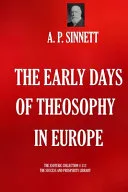
The Early Days of Theosophy in Europe
 75
75

The Early Days of Theosophy in Europe
A. P. Sinnett's account of Theosophy's European inception avoids the hagiography that can plague such histories. He presents the movement's early struggles not as divine pronouncements, but as the messy work of human endeavor, replete with "bumps" and "egos fighting for power," as the original blurb aptly puts it. Sinnett’s firsthand involvement lends a certain authority, detailing the intricate process by which Theosophical ideas, particularly those channeled through Helena Blavatsky, gained traction in a skeptical continent. The book excels in its depiction of the organizational hurdles and the intellectual debates that characterized this period. A notable strength lies in its candid portrayal of internal divisions, which offers a more realistic picture than many idealized spiritual narratives. However, a limitation is the inherent bias of the author, who was deeply invested in the movement's success; objective distance is understandably scarce. The description of the early London Lodge's activities provides a concrete glimpse into the practical challenges of establishing a foothold for these novel philosophical concepts. Ultimately, Sinnett offers a valuable, if partisan, historical document of a significant esoteric development.
📝 Description
75
A. P. Sinnett's 1886 book details the Theosophical Society's early European establishment.
This account by A. P. Sinnett, an early proponent of Theosophy, describes the movement's initial growth in Europe. Sinnett, who was involved with the Society from its early years, writes about how Theosophy was received, the difficulties encountered, and the organizational steps taken to expand its reach. The book provides an insider's view of the people and ideas that shaped this formative period. It covers the period from the Society's founding in 1875 through its early European presence.
Sinnett's writing places Theosophy's arrival in Europe within the context of the late 19th century. This era saw a considerable interest in spiritualism, Eastern religions, and various alternative spiritual philosophies. The Theosophical Society, established in New York in 1875, quickly gained followers, with figures like Sinnett instrumental in its European expansion. Helena Blavatsky, a central figure in the movement, attracted both strong support and considerable opposition from conventional academic and religious bodies.
The book addresses key concepts central to Theosophy. It discusses the Mahatmas, who were considered spiritual mentors guiding the teachings, and the doctrines of karma and reincarnation. Sinnett also details the practical challenges involved in setting up a spiritual organization with global aspirations.
This book documents the early European dissemination of Theosophy, a spiritual philosophy that emerged in the late 19th century. It situates Theosophy within a broader milieu of interest in Eastern thought and spiritualism prevalent at the time. The text focuses on the practical establishment of the Theosophical Society, detailing its growth and the figures involved, particularly Helena Blavatsky and the author himself. It reflects the period's engagement with concepts like karma, reincarnation, and spiritual hierarchies, which were central to Theosophical doctrine and its appeal.
💡 Why Read This Book?
• Gain insight into the specific organizational challenges faced by the early Theosophical Society in Europe, detailing its establishment and initial reception. • Understand the role of key figures like A. P. Sinnett and Helena Blavatsky in disseminating Theosophical doctrines and navigating internal conflicts. • Learn about the foundational concepts of Theosophy, such as karma and reincarnation, as they were first presented and debated in the late 19th century.
⭐ Reader Reviews
Honest opinions from readers who have explored this book.
❓ Frequently Asked Questions
When was The Early Days of Theosophy in Europe first published?
The book by A. P. Sinnett, 'The Early Days of Theosophy in Europe,' was first published on September 28, 2019, though it draws on historical accounts of the late 19th century.
Who were the main figures involved in the early Theosophical movement described by Sinnett?
A. P. Sinnett himself was a central figure, alongside Helena Blavatsky and Henry Steel Olcott, who were instrumental in founding and spreading Theosophy.
What were some of the primary challenges Theosophy faced in Europe during its early days?
The movement encountered skepticism from established intellectual circles, internal power struggles and ego clashes among members, and the general difficulty of establishing a new spiritual organization.
What core doctrines of Theosophy are discussed in this book?
The book explores foundational concepts such as the existence of Mahatmas (spiritual teachers), karma, and reincarnation, as they were understood and promoted during the movement's formative years.
Is this book suitable for someone new to Theosophy?
Yes, it provides a historical overview and introduces key figures and concepts, making it a valuable starting point for understanding Theosophy's origins and development in Europe.
What is A. P. Sinnett's relationship to the Theosophical Society?
A. P. Sinnett was a prominent writer, influential member, and early proponent of the Theosophical Society, playing a key role in its dissemination in Europe.
🔮 Key Themes & Symbolism
Founding of the Theosophical Society
The book details the initial establishment of the Theosophical Society in Europe, moving beyond its New York origins. It highlights the efforts of key individuals like A. P. Sinnett to create a presence and disseminate its teachings. The narrative focuses on the practical steps taken, the challenges in attracting members, and the organizational structures that were put in place to support the nascent movement. This theme underscores the transition from an idea to an organized spiritual undertaking.
The Role of Helena Blavatsky
Helena Blavatsky is presented as the central conduit for the Theosophical teachings. Sinnett describes her work, her interactions with followers, and the wide impact her writings and alleged communications with higher intelligences had on the movement's trajectory. The book examines how Blavatsky's unique position and the controversies surrounding her persona shaped the early reception and development of Theosophy in European intellectual circles.
Internal Dynamics and External Reception
This theme addresses the dual pressures faced by the early Theosophical Society: internal friction and external criticism. Sinnett openly discusses the personal ambitions and disagreements among members, alongside the skepticism and opposition encountered from mainstream society and academia. The book illustrates how the movement navigated these obstacles, seeking to establish its legitimacy and appeal amidst a complex social and intellectual range of the late 19th century.
Esoteric Doctrine Dissemination
The book traces the introduction and explanation of core Theosophical tenets, such as karma, reincarnation, and the concept of Mahatmas, to a European audience. Sinnett's writing serves as a vehicle for explaining these complex philosophical and spiritual ideas, aiming to make them accessible and compelling. The focus is on how these doctrines were presented, interpreted, and integrated into the intellectual discourse of the time.
💬 Memorable Quotes
Direct passages from the work, attributed to the author.
“The movement had to sort many 'bumps' along the road.”
— This highlights that the early development of Theosophy was not smooth, encountering numerous obstacles, difficulties, and setbacks that required resolution and adaptation.
“Including some divisions and personal 'egos' fighting for power.”
— This points to internal conflicts within the Theosophical Society, where personal ambitions and ego-driven disputes played a significant role in creating divisions and hindering progress.
“A must read for any true student of theosophy and the occult.”
— This original blurb recommendation emphasizes the book's essential value for individuals dedicated to studying Theosophy and occult subjects, positioning it as a foundational text.
“Sinnett describes the development of Theosophy.”
— This concise statement identifies the core function of the book: to provide a historical account and analysis of how the Theosophical movement evolved and established itself.
💡 Key Ideas
Editorial paraphrase of the work's core concepts — not direct quotes.
The work on Mrs. Blavatsky set in motion an unstoppable movement.
This paraphrased concept suggests that Helena Blavatsky's activities and teachings were the primary catalyst for the Theosophical movement, initiating a force that proved difficult to halt despite challenges.
🌙 Esoteric Significance
Tradition
This work is foundational to the Theosophical tradition, a distinct lineage within Western esotericism that emerged in the late 19th century. It positions itself as a revival and synthesis of ancient wisdom, drawing heavily from Eastern religions (Hinduism and Buddhism) while reinterpreting them through a Western lens. Sinnett's account details the very genesis of this movement, illustrating how it sought to bridge Eastern spirituality with Western intellectual inquiry, departing from purely Hermetic or Kabbalistic traditions by emphasizing universal brotherhood and the evolution of consciousness.
Symbolism
While not heavily focused on overt symbolism in the manner of older traditions, the book implicitly engages with the symbolism of the Mahatmas as spiritual guides representing perfected humanity and higher wisdom. The concept of the 'unstoppable movement' itself can be seen as symbolic of spiritual evolution's inevitable progress. The 'bumps' and 'egos fighting for power' symbolize the inherent challenges and human imperfections that even spiritually-inspired movements must confront and overcome on their path.
Modern Relevance
Modern esoteric thinkers and practitioners in various branches of the New Age movement, as well as contemporary Theosophists, continue to draw upon the historical accounts and foundational concepts detailed by Sinnett. Schools that emphasize comparative religion, spiritual evolution, and the application of Eastern philosophies in a Western context often reference the early Theosophical movement as a key precursor. Thinkers exploring consciousness studies and the history of alternative spiritualities frequently cite Sinnett's writings as primary source material.
👥 Who Should Read This Book
• Students of Western esotericism and occult history seeking a primary account of Theosophy's European establishment. • Researchers of new religious movements interested in the organizational and social dynamics of early spiritual societies. • Individuals curious about the life and work of Helena Blavatsky and her impact on late 19th-century spiritual thought.
📜 Historical Context
A. P. Sinnett's 'The Early Days of Theosophy in Europe' emerges from the fertile intellectual soil of the late 19th century, a period marked by a profound spiritual seeking and a fascination with Eastern philosophies. The Theosophical Society, founded in New York in 1875 by Helena Blavatsky and Henry Steel Olcott, began its significant expansion into Europe shortly thereafter. Sinnett himself was a crucial figure in this European propagation. This era saw a broader Western engagement with concepts like karma and reincarnation, often filtered through the lens of Theosophy, which contrasted sharply with prevailing materialistic and scientific paradigms. The Society's ideas competed with other emerging spiritual movements and traditional religions, while figures like Annie Besant would later become prominent, building on the foundation Sinnett describes. The intellectual currents of the time, including the rise of psychical research, created an environment where such esoteric ideas could find an audience, despite considerable opposition from established academia and religious institutions.
📔 Journal Prompts
The initial reception of Theosophy in Europe and its societal impact.
The challenges faced by Helena Blavatsky in establishing her teachings.
The role of 'egos fighting for power' in the early Theosophical movement.
Sinnett's perspective on the 'unstoppable movement' he helped foster.
Key differences between Theosophy's early European presentation and contemporary spiritual movements.
🗂️ Glossary
Theosophy
A system of esoteric philosophy and religion that seeks to understand divine truth and the fundamental principles of the universe, often blending Eastern and Western mystical traditions.
Mahatmas
In Theosophy, highly evolved spiritual beings or masters, believed by proponents like Blavatsky and Sinnett to guide the Theosophical movement and humanity's spiritual evolution.
Karma
The principle of cause and effect, where actions in this life influence future lives and circumstances; a core doctrine in Theosophy and other Eastern religions.
Reincarnation
The belief that the soul or spirit, after biological death, begins a new life in a new body; a fundamental concept in Theosophical teachings on spiritual evolution.
A. P. Sinnett
A prominent English writer and journalist, and an influential early member and proponent of the Theosophical Society, known for his writings on occultism and Theosophy.
Helena Blavatsky
A Russian occultist and spiritualist who co-founded the Theosophical Society in 1875 and authored seminal works like 'Isis Unveiled' and 'The Secret Doctrine'.
Theosophical Society
An organization founded in 1875 to advance the study of comparative religion, philosophy, and science, and to form a nucleus of universal brotherhood among its members.