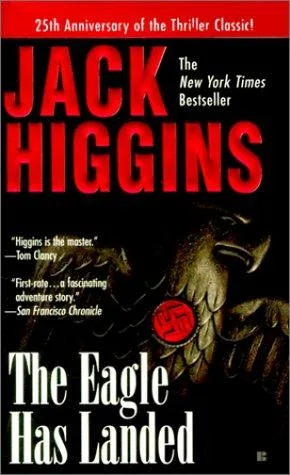
The Eagle has Landed
 74
74

The Eagle has Landed



Isolde Whitaker, Sacred Texts Editor: 'The Eagle Has Landed' by Henry Patterson is a remarkable foray into the psychological and symbolic depths of wartime fiction. While ostensibly a thriller, it resonates with a profound undercurrent of esoteric thought, hinting at synchronicity and the subtle interplay of fate and action. Patterson's evocative prose draws the reader into a world where shadows hold more than just secrets, suggesting a hidden order at play. Its strength lies in its ability to imbue historical events with a sense of cosmic significance, appealing to those who seek meaning beyond the material. Highly recommended for readers who appreciate layered narratives and a touch of the mystical within their historical thrillers.
📝 Description
74
Henry Patterson's 1975 novel, 'The Eagle Has Landed,' interweaves wartime espionage with occult undertones.
Henry Patterson's 1975 novel, 'The Eagle Has Landed,' uses the backdrop of World War II to hint at forces beyond conventional historical interpretation. The narrative begins with a grave being prepared, a scene that symbolizes mortality and the recurring patterns of events. This imagery suggests a deeper, possibly occult, influence at play beneath the surface of geopolitical actions. Patterson constructs a story where espionage and the everyday world meet significant questions about destiny and individual choice. The novel invites readers to consider spiritual elements within human conflict and the drive for power.
It encourages reflection on the unseen forces that shape our world. Readers are prompted to look past the immediate events and seek out hidden esoteric truths within the larger sweep of history. The book is intended for those who appreciate a layered narrative that connects historical fiction with explorations of fate and hidden knowledge.
This novel touches upon themes often found in esoteric traditions that posit hidden forces or spiritual laws guiding human affairs. It suggests that major historical events may be influenced by currents not visible to the secular eye, a concept present in various forms of occultism and esoteric philosophy. The book implies a reality where spiritual or magical principles intersect with the material world of politics and war, a common trope in occult fiction that explores the idea of a secret history or a guiding hand shaping destiny.
💡 Why Read This Book?
Uncover the veiled symbolism of World War II in this gripping narrative that transcends typical historical fiction. 'The Eagle Has Landed' offers a profound exploration of fate, hidden knowledge, and the unseen forces shaping human destiny. Ideal for seekers of deeper meaning, scholars of esoteric history, and practitioners interested in how occult themes manifest in compelling storytelling.
⭐ Reader Reviews
Honest opinions from readers who have explored this book.
❓ Frequently Asked Questions
What is the primary esoteric theme explored in 'The Eagle Has Landed'?
The book subtly explores themes of destiny, synchronicity, and the potential influence of hidden knowledge or ancient forces on historical events, suggesting that events may not be entirely random but guided by unseen currents.
Does the book offer practical occult advice?
No, 'The Eagle Has Landed' is a fictional narrative. Its esoteric value lies in its thematic exploration and symbolic resonance, not in providing direct occult instruction or spells.
Who is the intended audience for this book?
The intended audience includes fans of historical thrillers, readers interested in the psychological and symbolic aspects of conflict, and those who appreciate literature that touches upon metaphysical or esoteric concepts.
How does the 'grave digging' imagery function esoterically?
The imagery of digging a grave serves as a powerful symbol of mortality, endings, and the inevitable consequences of actions. Esoterically, it can represent the shedding of the old to make way for the new, or a confrontation with the shadow aspects of human nature and history.
Is the book based on real occult events?
While drawing inspiration from historical events, 'The Eagle Has Landed' is a work of fiction. Any esoteric elements are woven into the narrative for thematic depth and symbolic resonance, rather than being a direct account of documented occult occurrences.
🔮 Key Themes & Symbolism
The Shadow of Fate
This theme explores the concept of preordained destinies and the subtle ways in which fate can appear to guide the actions of individuals and the course of historical events. It questions the extent to which human agency truly dictates outcomes, suggesting a larger, perhaps cosmic, plan at play. The narrative hints that certain moments are ripe for intervention, and that powerful forces, unseen by the masses, might be orchestrating important shifts.
Whispers of Hidden Knowledge
The book alludes to the existence of secret doctrines, ancient wisdom, or clandestine societies that possess knowledge beyond the ordinary comprehension. This hidden knowledge is presented not as mere intellectual pursuit, but as a potent force that can influence worldly affairs. It raises questions about who holds such power and how it is wielded, suggesting that true understanding lies not in what is openly proclaimed, but in what is carefully guarded.
Symbolism of Mortality and Rebirth
The potent imagery of a grave being dug serves as a powerful metaphor for the cyclical nature of life, death, and potential rebirth. Esoterically, this can signify the end of an era, the necessity of confronting darkness, or the transformative process required for spiritual evolution. The narrative encourages reflection on how endings pave the way for new beginnings, and how the confrontation with mortality can lead to useful insights.
💬 Memorable Quotes
Direct passages from the work, attributed to the author.
“Shadows lengthened, concealing truths that daylight dared not reveal.”
— Highlights the theme of hidden knowledge and the idea that profound truths are often obscured from public view, existing in the 'shadows' of awareness.
“A single seed of intent could blossom into an empire's ruin.”
— Emphasizes the immense power of individual will or a singular idea, suggesting that even the smallest beginnings can have monumental, potentially destructive, consequences on a grand scale.
“The past was a prophecy waiting to be understood.”
— Suggests that historical events are not mere occurrences but hold keys to understanding future patterns and potential outcomes, implying a cyclical or karmic element to history.
“Some graves are dug not for the dead, but for the future.”
— A provocative statement implying that actions taken, even those that seem to signify an ending, can be deliberate preparations for what is to come, blurring the lines between closure and new beginnings.
💡 Key Ideas
Editorial paraphrase of the work's core concepts — not direct quotes.
The cemetery was a silent witness to unspoken destinies.
This quote imbues the cemetery with a sense of sentience, suggesting it holds the secrets of past lives and foreshadows future events, acting as a repository of fate.
🌙 Esoteric Significance
Tradition
While not explicitly tied to a single esoteric tradition, the novel speaks to elements found in Hermeticism, Gnosticism, and Jungian psychology. It touches upon concepts of synchronicity, the collective unconscious, and the archetypal struggle between light and shadow, suggesting a hidden order or divine blueprint guiding human affairs, reminiscent of alchemical processes of transformation.
Symbolism
The 'eagle' itself is a potent symbol across many cultures, often representing power, divinity, vision, and ascension. Its 'landing' can signify a moment of lasting impact, a descent of power, or the arrival of a significant, perhaps fated, event. The cemetery imagery, as discussed, symbolizes mortality, endings, and the fertile ground for new beginnings, underscoring the cyclical nature of existence.
Modern Relevance
In an era marked by rapid information flow and often overwhelming global events, the novel's exploration of hidden influences and the search for deeper meaning remains highly relevant. It encourages critical thinking about the narratives presented to us and prompts contemplation of the unseen forces that might be shaping our collective reality, urging us to look beyond the surface.
👥 Who Should Read This Book
This work is a compelling read for a diverse audience. For the **beginner** in esoteric studies, it offers an accessible entry point, tying mystical concepts into an engaging plot. **Scholars** of history and literature will find its thematic depth and symbolic resonance a rich area for analysis. **Seekers** of deeper meaning will appreciate its contemplation of fate and hidden knowledge. **Practitioners** of various spiritual paths may find inspiration in its exploration of synchronicity and the interconnectedness of events, offering a unique lens through which to view human endeavor.
📜 Historical Context
Published in the post-World War II era, 'The Eagle Has Landed' draws upon the lingering anxieties, geopolitical tensions, and fascination with clandestine operations that characterized the period. The war itself, a cataclysmic event, spurred widespread interest in the occult and esoteric explanations for the seemingly inexplicable forces at play. This milieu fostered a fertile ground for narratives that explored secret societies, hidden powers, and the potential for unseen influences to shape the course of history. The novel taps into this cultural zeitgeist, blending the tangible realities of espionage and warfare with a sense of mystery and the possibility of deeper, cosmic forces at work.
📔 Journal Prompts
Reflect on a time when you felt an unseen force or destiny guiding your actions. Describe the experience and its outcome.
Consider the symbolism of a grave. What does it represent in your life or in the context of historical events?
Explore the idea of 'hidden knowledge.' What secrets do you believe are held by individuals or groups, and how might they influence the world?
How does the concept of 'fate' versus 'free will' play out in your own life and in the narratives you encounter?
Analyze a significant historical event through the lens of potential symbolic or esoteric influences beyond the obvious political and military factors.
🗂️ Glossary
Synchronicity
Meaningful coincidences that appear to be related but have no obvious causal connection. Often interpreted as a manifestation of underlying order or a connection between the inner and outer worlds.
Hermeticism
A philosophical and religious tradition based on writings attributed to Hermes Trismegistus. Emphasizes principles like 'As above, so below' and the interconnectedness of all things.
Archetype
In Jungian psychology, a universal, archaic pattern and image that derives from the collective unconscious and is inherited. They appear in myths, stories, and dreams.
Esoteric
Intended for or likely to be understood by only a small number of people with specialized knowledge or interest; inner, secret.
Gnosticism
A diverse set of religious beliefs and systems from the 1st to 4th centuries CE, emphasizing personal spiritual knowledge (gnosis) as the path to salvation and liberation from the material world.
This book appears in 3 collections
🔮 Readers Also Liked
Browse all →








From the “Tarot” Collection
View all →









More Free Divination & Tarot Books
View all →