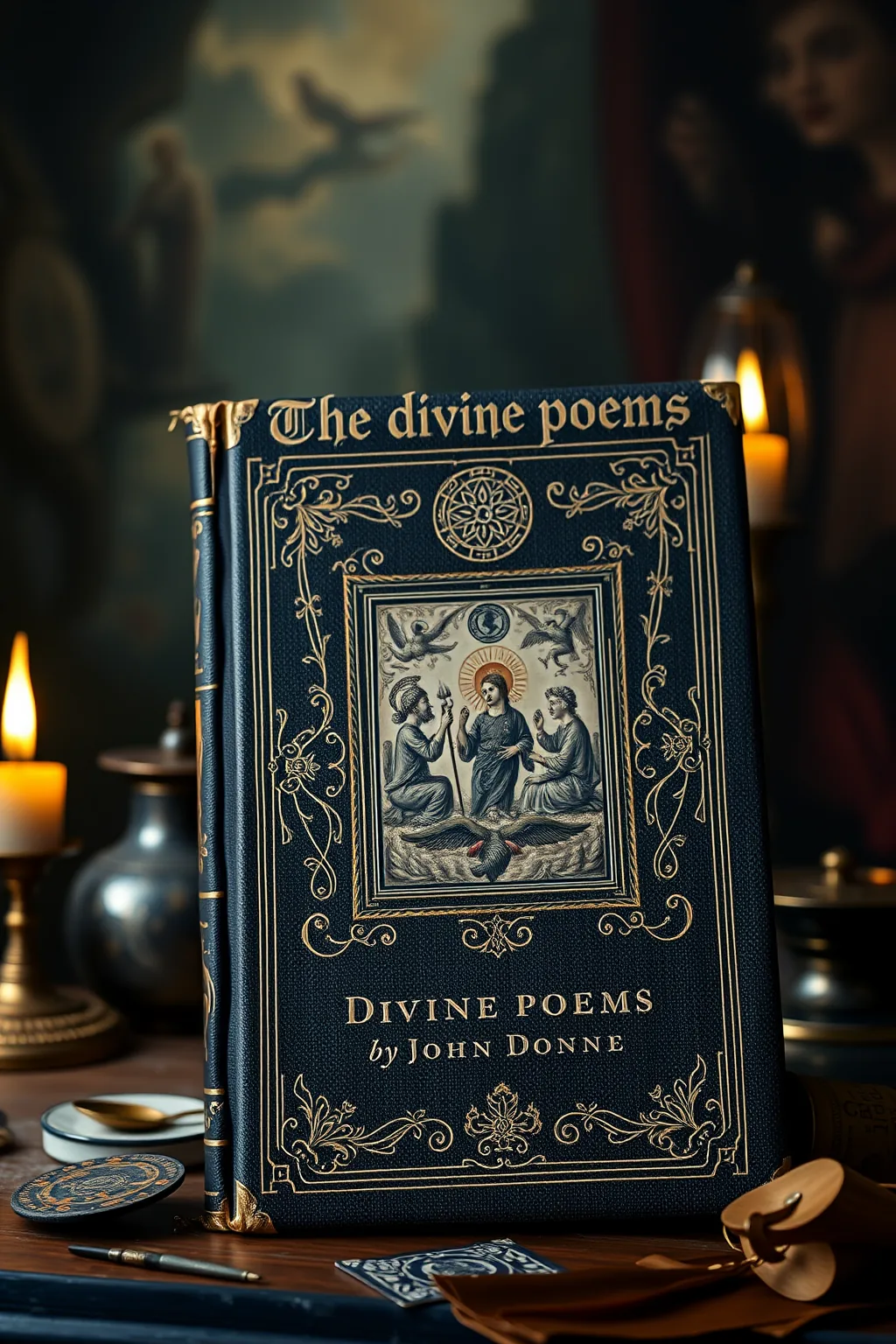
The divine poems
 63
63

The divine poems



Sophia Crane (Associate Editor) — John Donne's "The Divine Poems" stands as a monumental testament to the power of faith expressed through incandescent language. More than just religious verse, these poems are profound explorations of spiritual warfare, divine love, and the soul's journey towards redemption. Donne's characteristic intellectual rigor is infused with a palpable mystical fervor, offering esoteric insights into the nature of sin, salvation, and the intricate relationship between humanity and the divine. The strength lies in his ability to render abstract theological concepts into visceral, emotionally resonant imagery. This collection is essential for scholars of English literature, theologians, and anyone seeking a deeper, more nuanced understanding of Christian mysticism and its poetic articulation.
📝 Description
63
John Donne published "The Divine Poems" in 1633, exploring his complex relationship with faith and mortality.
John Donne's "The Divine Poems," published posthumously in 1633, brings together some of his most intense religious meditations. These works are not simple praise; they wrestle with doubt, sin, and the fear of death. Donne uses striking metaphors drawn from his metaphysical style to articulate spiritual crises and moments of ecstatic grace. He grapples with God's will, his own unworthiness, and the difficult path to salvation.
The collection reflects Donne's personal struggles and his profound engagement with Christian theology. The poems reveal a mind constantly questioning, seeking, and ultimately, finding solace in divine love. They capture the tension between the physical world and the spiritual, often through vivid imagery that mixes the sacred and the secular.
Donne's "The Divine Poems" engage with a Christian tradition that, while orthodox, often touched upon mystical and devotional practices that could be considered esoteric. His intense personal introspection, use of paradoxical language, and focus on the soul's direct encounter with the divine echo certain strains of medieval and early modern Christian mysticism. While not overtly occult, the poems' deep psychological and theological probing into the nature of faith and salvation can appeal to readers interested in the inner life and the more obscure aspects of religious experience.
💡 Why Read This Book?
Uncover the potent alchemy of faith and language in John Donne's "The Divine Poems." This collection offers profound spiritual insights, exploring the soul's inner landscape with raw honesty and sublime imagery. Ideal for seekers of divine truth, scholars of metaphysical poetry, and practitioners looking for contemplative depth. Experience a timeless dialogue with the sacred.
⭐ Reader Reviews
Honest opinions from readers who have explored this book.
❓ Frequently Asked Questions
What is the primary focus of John Donne's "The Divine Poems"?
The collection primarily focuses on themes of faith, sin, redemption, divine love, and the soul's journey towards spiritual union with God, expressed through Donne's unique metaphysical style.
Are these poems accessible to readers unfamiliar with Christian theology?
While rooted in Christian doctrine, Donne's profound use of universal human emotions and powerful symbolism makes them accessible to those seeking spiritual resonance, even without deep theological background.
How do these poems connect to esoteric or mystical traditions?
Donne's exploration of inner spiritual states, the paradoxes of faith, and the search for divine presence aligns with mystical traditions seeking direct experience of the divine, transcending dogma through personal encounter.
What makes Donne's poetry 'metaphysical'?
Metaphysical poetry is characterized by its intellectual complexity, use of 'conceits' (unusual comparisons), and exploration of abstract philosophical and spiritual themes with wit and analytical precision.
Can "The Divine Poems" be considered a form of spiritual guidance?
Yes, the poems offer a deeply personal and intellectually stimulating exploration of spiritual challenges and triumphs, serving as a powerful companion for those on their own faith journey.
🔮 Key Themes & Symbolism
The Soul's Struggle and Redemption
Donne masterfully navigates the turbulent inner range of the human soul, depicting its wrestling with sin, doubt, and the allure of worldly temptations. Yet, within this struggle, he reveals the unwavering presence of divine grace and the transformative power of redemption. His poems act as a spiritual crucible, where the soul is refined through trials, ultimately emerging purified and closer to its celestial origin. This theme resonates deeply with esoteric traditions that emphasize the arduous but rewarding path of spiritual purification.
Divine Love and Annihilation of Self
A central pillar of Donne's divine poetry is the exploration of God's boundless love for humanity, a love so potent it demands a reciprocal surrender of the self. The poems articulate a yearning for complete absorption into this divine essence, a mystical union where the individual ego dissolves into the divine will. This concept carries the esoteric ideal of 'deification' or 'unio mystica,' where the seeker seeks to become one with the Absolute through an act of profound spiritual love and self-abnegation.
The Paradoxes of Faith and Existence
Donne thrives on paradox, revealing the profound truths that lie within apparent contradictions. He explores the simultaneous existence of human imperfection and divine perfection, the earthly and the heavenly, death and eternal life. These poems are not afraid to question, to doubt, and to grapple with the mysteries of existence, mirroring the hermetic principle that 'as above, so below.' His intellectual agility in dissecting these paradoxes offers a unique lens through which to view the complex nature of spiritual reality.
💬 Memorable Quotes
Direct passages from the work, attributed to the author.
“Batter my heart, three-person'd God,”
— A powerful invocation demanding forceful divine intervention, highlighting the speaker's desperate desire for spiritual transformation, even if it means violent upheaval.
“I have no soul, but I am all soul,”
— Expresses a mystical state of being where the individual self dissolves into a higher, all-encompassing spiritual essence, transcending physical limitations.
“He that hath one love, hath none.”
— A paradoxical statement suggesting that true, singular devotion to the divine requires a relinquishing of all lesser affections, a complete spiritual focus.
“O! to vex me, contraries meet in one.”
— Reflects the speaker's internal conflict and the paradoxical nature of existence where opposing forces often converge, creating spiritual tension and growth.
💡 Key Ideas
Editorial paraphrase of the work's core concepts — not direct quotes.
For God doth not need
This line questions the transactional nature of human religious acts, suggesting God's inherent perfection and self-sufficiency, and the true nature of devotion.
🌙 Esoteric Significance
Tradition
Donne's "The Divine Poems" deeply appeals to the Hermetic and Neoplatonic traditions, which emphasize the soul's ascent towards the divine through inner contemplation and the recognition of a unified spiritual reality. His exploration of spiritual paradoxes and the yearning for mystical union aligns with alchemical processes of purification and transformation, where the soul is transmuted from its base earthly state to a higher, divine form. The poems can be seen as a spiritual grimoire, offering coded insights into the soul's journey.
Symbolism
The poems are rich with potent symbolism. The "heart" represents the core of one's being, the site of spiritual struggle and divine conquest. "Sin" and "death" are not merely abstract concepts but tangible forces to be overcome. "God" is depicted as a powerful, often paradoxical force – a lover, a conqueror, a physician – reflecting the complex nature of the divine. "Light" symbolizes divine revelation and understanding, while "darkness" signifies spiritual ignorance or the presence of evil, all employed to map the intricate terrain of the soul's spiritual landscape.
Modern Relevance
In an age often characterized by secularism and existential doubt, Donne's "The Divine Poems" offer a profound counterpoint, reminding us of the enduring power of faith and the human spirit's innate yearning for transcendence. His honest exploration of spiritual conflict and the search for meaning provides solace and intellectual stimulation for contemporary seekers. The poems' emphasis on inner transformation and the paradoxical nature of reality remains remarkably relevant for those working through the complexities of modern life and seeking a deeper, more meaningful connection to the spiritual dimension.
👥 Who Should Read This Book
This collection is a treasure for the discerning reader. **Beginners** seeking to understand the intersection of faith and profound poetry will find Donne's emotional honesty and vivid imagery compelling. **Scholars** of English literature and religious studies will appreciate the intellectual depth and historical context. **Spiritual seekers** yearning for a more intimate and challenging relationship with the divine will discover powerful meditations on faith, doubt, and redemption. **Practitioners** of contemplative arts may find the poems serve as potent prompts for introspection and spiritual growth, offering a unique lens through which to explore the inner life.
📜 Historical Context
John Donne penned "The Divine Poems" during a period of immense religious and intellectual upheaval in early 17th-century England. The Reformation had fractured Christendom, leading to fervent debates and intense spiritual introspection. This era saw the rise of the metaphysical poets, who, like Donne, embraced a more intellectual and often paradoxical approach to faith, blending theological discourse with personal experience and intricate imagery. His work emerged from a world where concepts of salvation, damnation, and the divine presence were not abstract theological exercises but immediate, visceral realities shaping daily life and individual consciousness. The scientific discoveries of the time also fueled a desire to reconcile faith with reason, a challenge Donne tackled with remarkable linguistic and philosophical prowess, influencing generations of poets and thinkers grappling with the eternal questions of existence.
📔 Journal Prompts
Reflect on a time you felt a strong pull between worldly desires and spiritual aspirations. How did you reconcile these forces?
Explore the concept of 'divine intervention' in your own life. When have you felt guided or acted upon by a force beyond your own will?
Consider a personal paradox you currently grapple with. How might viewing this paradox through a spiritual lens offer new understanding?
Write a prayer or meditation inspired by Donne's intense, often demanding, address to God. What would you ask for, and how would you ask?
How does the idea of the 'annihilation of self' resonate with your understanding of spiritual growth or enlightenment?
🗂️ Glossary
Conceit
An extended, often surprising or elaborate metaphor used in metaphysical poetry to compare two seemingly dissimilar things, revealing hidden connections and intellectual depth.
Metaphysical Poetry
A genre of poetry characterized by intellectual rigor, complex arguments, the use of conceits, and the exploration of philosophical and spiritual themes with wit and analytical precision.
Unio Mystica
A Latin term meaning 'mystical union,' referring to the state of profound spiritual oneness achieved between the individual soul and the divine, a central concept in many esoteric traditions.
Grace
In Christian theology, unmerited divine assistance given to humans for their regeneration or sanctification, often understood as God's benevolent favor and presence.
Redemption
The act of being saved from sin, error, or evil; in a spiritual context, it refers to the act of saving or being saved through divine intervention, often associated with the sacrifice of Christ.
This book appears in 3 collections
🔮 Readers Also Liked
Browse all →








More by John Donne
All books →

From the “Tarot” Collection
View all →






More Free Divination & Tarot Books
View all →