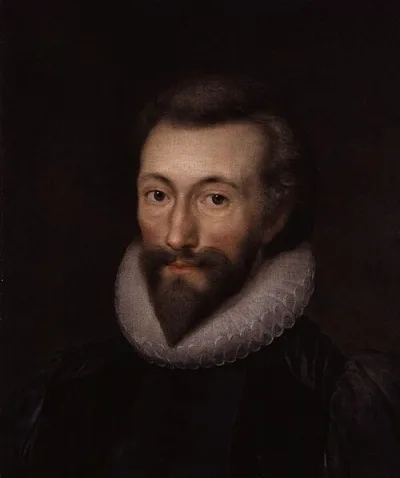
John Donne
John Donne was a 17th-century English poet and cleric known for his metaphysical poetry and influential sermons.
Born into a recusant Catholic family in the late 16th century, John Donne faced religious persecution and personal hardship throughout his early life. Despite his intellectual talents and privileged education, his adherence to Catholicism barred him from obtaining degrees from Oxford and Cambridge. He pursued legal studies and later served in Parliament and as a secretary to prominent figures. His life took a significant turn with his secret marriage to Anne More, which led to his dismissal from service and imprisonment. This period of financial insecurity and personal loss profoundly influenced his writing, which explored themes of love, religion, and mortality.
Donne eventually converted to the Church of England and was ordained as a priest at the insistence of King James I. He rose through the church hierarchy, eventually becoming Dean of St Paul's Cathedral. His literary output includes a wide range of poetry characterized by intricate metaphors, intellectual wit, and dramatic intensity, earning him recognition as a leading figure of metaphysical poetry. He is also celebrated for his powerful sermons, which demonstrated his profound theological understanding and rhetorical skill.
Early Life and Religious Background
John Donne was born in London around 1571 or 1572 into a devout Roman Catholic family during a time when practicing Catholicism in England was illegal. This recusancy deeply shaped his early experiences, including his education. He studied at Oxford and Cambridge but could not receive degrees due to his faith, as he refused to take the required Oath of Supremacy. He later pursued legal studies at Thavie's Inn and Lincoln's Inn. The arrest and death of his brother, Henry, for sheltering a priest, marked a turning point, prompting Donne to question his Catholic convictions. Despite his family's wealth, his father's early death and his mother's remarriage led to a life of financial precariousness for Donne.
Poetic Style and Themes
Donne is considered the foremost representative of the metaphysical poets, a style distinguished by its intellectual complexity, elaborate metaphors (conceits), and exploration of profound themes. His poetry often features abrupt beginnings, paradoxes, and dramatic speech rhythms, reacting against the more conventional Elizabethan poetic style. His works encompass a variety of forms, including sonnets, love poems, religious verses, elegies, and satires, noted for their passionate and often sensual language. A significant theme in his later poetry is the exploration of true religion and spiritual devotion, reflecting his personal journey and theological considerations.
Career, Marriage, and Ordination
Donne's early career aspirations in law and diplomacy were significantly impacted by his secret marriage in 1601 to Anne More, which led to his dismissal from his secretarial post and a brief imprisonment. This marriage, against the wishes of her family, resulted in years of financial struggle and a large family, with Anne bearing twelve children. Despite these hardships, Donne continued to write, producing both secular and religious works. In 1615, at the urging of King James I, Donne was ordained as a priest in the Church of England, a path he initially resisted. He subsequently held various church positions, culminating in his appointment as Dean of St Paul's Cathedral in 1621, a role he maintained until his death in 1631.
Later Life and Notable Writings
Following his ordination, Donne dedicated himself to his clerical duties and theological scholarship. He served as a chaplain and a reader of divinity, eventually becoming Dean of St Paul's in London. During a severe illness in 1623, he composed 'Devotions upon Emergent Occasions,' a series of meditations on sickness and recovery that includes the famous lines, 'No man is an Iland' and 'for whom the bell tolls.' His extensive sermons were also highly regarded, showcasing his oratorical skills and deep spiritual insights. Donne's life concluded with his death in 1631, having achieved significant recognition in both literary and religious spheres.
Key Ideas
- Metaphysical conceits: intricate and often surprising metaphors linking disparate ideas.
- Paradox and irony: use of contradictory statements and situations for intellectual effect.
- Spiritual and religious contemplation: exploration of faith, doubt, and divine love.
- The interconnectedness of humanity: expressed in the idea that 'no man is an island'.
Notable Quotes
“John Donne, Anne Donne, Un-done”
“No man is an Iland”
“for whom the bell tolls”
Books by John Donne
5 free public domain books · Read online or download