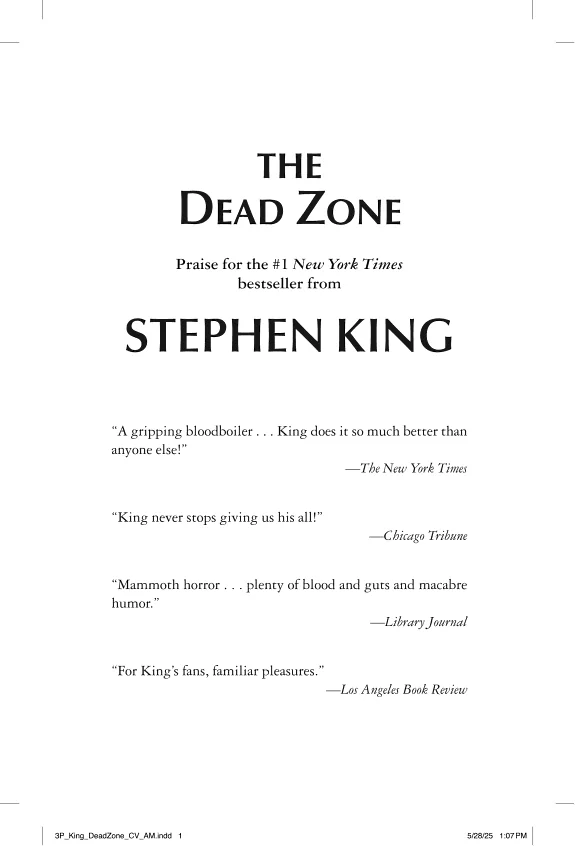
The Dead Zone
 79
79

The Dead Zone
Stephen King's "The Dead Zone" is more than a simple thriller; it's a profound examination of a man burdened by unwanted prescience. Johnny Smith’s awakening, post-coma, into a world where every touch reveals a chilling future is handled with King's signature blend of the uncanny and the deeply human. The novel’s strength lies in its exploration of Smith's internal struggle, particularly his agonizing decision regarding the future he foresees for Greg Stillson, a rising politician whose ascension portends catastrophe. The passage detailing Smith's reluctant journey toward confronting Stillson is particularly potent, showcasing the immense psychological toll of his gift. However, the narrative occasionally falters under the weight of its own existential dread, with some of the more speculative elements feeling less developed than Smith's personal crisis. Despite this, "The Dead Zone" remains a compelling study of destiny and the terrifying responsibility that comes with knowing what lies ahead.
📝 Description
79
Stephen King's 1979 novel, The Dead Zone, concerns a man who gains psychic abilities after a coma.
Johnny Smith awakens from a five-year coma with the ability to see the future of anyone he touches. This psychic gift, a form of precognition, allows him to glimpse specific events that will befall individuals or even entire communities. Initially, he uses this power sparingly, sometimes to help, but always with a growing sense of dread. As his visions become more potent and disturbing, Johnny grapples with the moral weight of his foreknowledge. He is forced to confront the potential consequences of altering fate or allowing it to unfold. The novel questions whether knowing the future is a blessing or a profound burden, especially when faced with catastrophic possibilities.
The central conflict arises when Johnny foresees a terrible future involving a charismatic, dangerous politician. He must decide if he has the right, or the ability, to intervene and change what seems to be an inevitable outcome. This decision places him at a crossroads, challenging his personal beliefs and the very nature of destiny. The narrative explores the psychological toll this takes on Johnny, isolating him as he carries the burden of his visions.
Published in 1979, "The Dead Zone" arrived during a period of popular fascination with parapsychology and psychic phenomena, evident in media of the era. King's novel engages with these interests not as pure fantasy, but by grounding them in a character's psychological struggle. The concept of precognition, central to the plot, touches upon ideas found in various occult traditions that posit a predetermined future or the ability to perceive it. The "dead zone" itself suggests a psychic void, a conceptual space where the veil between present and future thins, a trope that resonates with certain mystical or divinatory frameworks.
💡 Why Read This Book?
• Understand the psychological burden of precognition, as exemplified by Johnny Smith's struggle to reconcile his visions with his actions after his 1979 coma. • Explore the philosophical debate between free will and determinism through the lens of foreknowledge, particularly concerning Greg Stillson's projected future. • Experience a character-driven narrative that grounds supernatural abilities in relatable human emotion, making the chilling implications of "the dead zone" feel intensely personal.
⭐ Reader Reviews
Honest opinions from readers who have explored this book.
❓ Frequently Asked Questions
When was Stephen King's The Dead Zone first published?
Stephen King's "The Dead Zone" was first published on August 5, 1979, making it a significant work from the author's early career.
What is the 'dead zone' in Stephen King's novel?
The 'dead zone' in the novel refers to a psychic void or state of premonition Johnny Smith experiences, allowing him to foresee futures through touch.
Who is Greg Stillson in The Dead Zone?
Greg Stillson is a charismatic but dangerous politician whose future Johnny Smith foresees as leading to immense destruction, presenting a moral dilemma.
Does The Dead Zone explore supernatural or paranormal themes?
Yes, the novel prominently features paranormal themes, specifically precognition and psychic abilities, through the character of Johnny Smith.
Is The Dead Zone based on any real-life events or theories?
While not directly based on specific events, the novel taps into widespread cultural interest in parapsychology and psychic phenomena prevalent in the late 1970s.
What is the primary conflict Johnny Smith faces?
Johnny Smith's primary conflict is internal: grappling with his psychic gift, the moral implications of his visions, and deciding whether and how to act upon them.
🔮 Key Themes & Symbolism
Precognition and Moral Choice
The central theme revolves around Johnny Smith's precognitive ability, which manifests after a five-year coma. His gift forces him into agonizing moral quandaries, particularly when he foresees the catastrophic future of Greg Stillson. The narrative questions whether knowing the future grants one the right, or the obligation, to alter it, exploring the immense psychological toll such foresight exacts.
Determinism vs. Free Will
King masterfully interrogates the classic philosophical debate of whether our paths are predetermined or if individual choices can truly alter destiny. Johnny's visions present seemingly fixed outcomes, yet his own actions, and the actions he contemplates, become the very instruments that could either fulfill or defy these prophecies, blurring the lines between fate and agency.
The Burden of Knowledge
Unlike typical superpower narratives, "The Dead Zone" emphasizes the isolating and terrifying burden associated with Johnny Smith's psychic abilities. His ability to see futures, often grim ones, leads to social alienation and profound personal suffering. The 'dead zone' is not a place of power, but of chilling clarity that weighs heavily on his conscience.
The Nature of Evil
The novel presents a nuanced exploration of evil, embodied not just by potential dictators like Greg Stillson, but also by the everyday choices individuals make that contribute to larger societal ills. Johnny's struggle is to identify and confront evil in its nascent forms, often against the disbelief or apathy of others.
💬 Memorable Quotes
Direct passages from the work, attributed to the author.
“He woke up from a five-year coma able to see people's futures.”
— This concise statement introduces the core premise of Johnny Smith's condition, immediately establishing the supernatural element and the extraordinary circumstances he faces upon regaining consciousness.
“The dead zone was a place where the future was laid bare.”
— This phrase captures the psychic state Johnny enters, a chilling clarity where he perceives inevitable outcomes, highlighting the deterministic aspect of his visions.
“To see the future was one thing. To be able to change it was another.”
— This expresses the central ethical dilemma of the novel: the profound responsibility and difficulty associated with intervening in preordained events, especially when the consequences are unknown.
“He saw the path of destruction that lay ahead.”
— This refers to Johnny's vision of Greg Stillson's future, a specific, catastrophic outcome that fuels the novel's primary conflict and Johnny's moral struggle.
“Some futures were set in stone, others were fluid.”
— This interpretation suggests a key aspect of Johnny's evolving understanding of his gift, hinting that not all visions are absolute and that agency might still exist.
🌙 Esoteric Significance
Tradition
While not explicitly tied to a single esoteric tradition, "The Dead Zone" engages with themes common in Western esotericism, particularly the Gnostic and Hermetic traditions concerning fate, free will, and the burden of forbidden knowledge. Johnny Smith's precognitive ability can be seen as a form of gnosis—a direct, intuitive knowing—that separates him from ordinary humanity and places him in a position of unique, often agonizing, awareness.
Symbolism
The 'dead zone' itself functions as a potent symbol, representing a psychic void or a state of heightened, detached perception where the future is laid bare. The act of touch, through which Johnny receives his visions, symbolizes connection and the transference of information, but also vulnerability and the potential for psychic contamination. Greg Stillson, the politician, symbolizes the potential for unchecked ambition to lead to catastrophic societal outcomes, a figure embodying a dark archetype.
Modern Relevance
Contemporary thinkers and practitioners in fields like consciousness studies and transpersonal psychology continue to find relevance in King's portrayal of psychic phenomena. The novel's nuanced depiction of precognition and its psychological impact serves as a touchstone for discussions on intuition, determinism, and the ethical responsibilities that accompany extraordinary perception, resonating with modern explorations of human potential and its limitations.
👥 Who Should Read This Book
• Individuals fascinated by the philosophical implications of precognition and determinism, seeking a narrative that explores these concepts through a compelling human drama. • Readers interested in psychological thrillers that incorporate supernatural elements, particularly those who appreciate character development alongside suspense. • Students of speculative fiction who wish to examine how authors like Stephen King integrate paranormal abilities into grounded, character-driven narratives, moving beyond simple horror tropes.
📜 Historical Context
Published in 1979, "The Dead Zone" emerged during a period of heightened public fascination with parapsychology, fueled by phenomena like the Amityville Horror and widespread interest in psychic mediums. Stephen King, already a rising star with hits like "Carrie" (1974) and "The Shining" (1977), tapped into this cultural undercurrent. His narrative grounded the supernatural in a realistic, small-town New England setting, a characteristic that distinguished his work from more sensationalized paranormal accounts. The novel's exploration of precognition and its ethical weight resonated with a readership grappling with societal anxieties and the implications of technology. While King was establishing his unique voice, authors like Dean Koontz were also exploring darker, suspenseful themes, creating a landscape where King's blend of horror and human drama found a significant audience. The book's critical reception acknowledged its suspenseful plot and compelling character study, solidifying King's reputation beyond simple horror.
📔 Journal Prompts
Johnny Smith's visions of Greg Stillson's future and the potential catastrophe.
The nature of the 'dead zone' as a psychic state.
The ethical dilemma of intervening in a foreseen future.
The consequences of Johnny's touch-based precognition on his relationships.
Your personal interpretation of fate versus free will as presented in the novel.
🗂️ Glossary
Precognition
The ability to perceive or know future events before they happen, often through psychic means, as demonstrated by Johnny Smith in the novel.
The Dead Zone
A psychic state or void experienced by Johnny Smith, where he gains chilling clarity and foresight into the futures of those he encounters.
Greg Stillson
A key character in the novel, a politician whose future visions reveal a path of immense destruction, posing a significant moral challenge for Johnny.
Coma
A prolonged state of unconsciousness, in this case, lasting five years, from which Johnny Smith awakens with his newfound psychic abilities.
Determinism
The philosophical concept that all events, including human cognition, behavior, and decision, are causally determined by an unbroken chain of prior occurrences. This is a central theme explored through Johnny's visions.
Free Will
The capacity of agents to choose between different possible courses of action unimpeded. This contrasts with determinism and is a core philosophical question raised by Johnny's precognitive abilities.
Psychic Gift
An innate, supernatural ability related to the mind or consciousness, such as precognition, telepathy, or clairvoyance. Johnny's ability is considered a psychic gift.
This book appears in 1 collection
🔮 Readers Also Liked
Browse all →








From the “Precognition” Collection
View all →






More Free Occult Philosophy Books
View all →