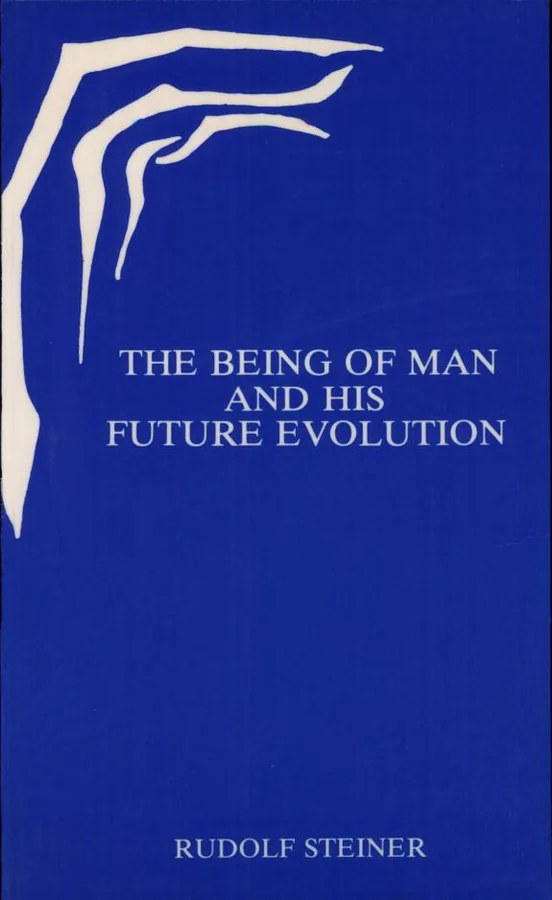
The Being of Man and His Future Evolution
 83
83

The Being of Man and His Future Evolution
Steiner’s lectures in "The Being of Man and His Future Evolution" offer a challenging, yet rewarding, exploration into the spiritual dimensions of human existence. He moves beyond the purely physical, examining phenomena like illness and memory through the lens of spiritual science. A particular strength lies in his detailed descriptions of the subtle bodies and their relationship to physical processes, offering a coherent, albeit complex, view of human constitution. However, the dense lecturing style, typical of Steiner, can make sustained engagement difficult for those unfamiliar with his terminology; concepts like 'etheric body' require significant prior knowledge or dedicated study. The section discussing the spiritual nature of weeping and laughter, while abstract, provides a fascinating example of how Steiner reinterprets everyday human expressions. Ultimately, this work is for the dedicated student of esoteric philosophy seeking a comprehensive, if demanding, spiritual anthropology.
📝 Description
83
Rudolf Steiner delivered lectures that became "The Being of Man and His Future Evolution" in 1916.
Rudolf Steiner's "The Being of Man and His Future Evolution" consists of lectures given in 1916. These talks address the spiritual nature of humanity and its potential for future development. Steiner proposes that human consciousness can perceive spiritual realities beyond conventional logic and empirical evidence. He examines the spiritual significance of everyday human experiences, including forgetting, laughter, and weeping, as well as the cyclical rhythms of the body.
The central idea is that humanity can consciously influence its own evolutionary path through engagement with the spiritual world. This work is for those who wish to comprehend human existence beyond materialistic or purely psychological viewpoints. It is especially relevant for students of esoteric philosophy, Anthroposophy, and spiritual science. Readers grappling with existential questions, the nature of consciousness, or hidden forces influencing human life will find valuable perspectives here. The book is particularly suited for those familiar with Steiner's other writings or interested in his distinct method for studying human evolution.
Rudolf Steiner developed Anthroposophy, a spiritual-scientific movement, after his early involvement with the Theosophical Society. His work aimed to connect scientific materialism with spiritual experience, creating a detailed cosmology and anthropology. This period in the early 20th century saw a rise in various spiritual movements that offered alternative worldviews to the dominant materialistic perspectives. Steiner's approach, presented in lectures like those collected in this volume, provided a structured method for spiritual research and understanding human development.
💡 Why Read This Book?
• Gain insight into the spiritual science of Anthroposophy, understanding how Rudolf Steiner posited a method for perceiving spiritual realities beyond the physical senses. • Explore the spiritual causality of everyday human experiences, such as understanding the deeper meaning behind forgetting, laughing, and weeping as presented in the lectures. • Grasp Steiner's perspective on future human evolution, learning how conscious spiritual activity, as discussed in the text, is believed to shape humanity's path.
⭐ Reader Reviews
Honest opinions from readers who have explored this book.
❓ Frequently Asked Questions
What is the primary focus of Rudolf Steiner's "The Being of Man and His Future Evolution"?
The book focuses on exploring the spiritual nature of humanity and its potential for future evolution, using spiritual science to understand everyday phenomena like illness, laughter, and memory.
Who was Rudolf Steiner and what is Anthroposophy?
Rudolf Steiner (1861-1925) was an Austrian esotericist and philosopher who founded Anthroposophy, a spiritual philosophy and practice that seeks to develop human faculties through a spiritual-scientific approach.
When were the lectures in "The Being of Man and His Future Evolution" originally given?
The lectures that form this book were originally delivered by Rudolf Steiner in the early 20th century, though the compilation was first published in 1981.
Does this book require prior knowledge of esoteric subjects?
While accessible to newcomers, prior familiarity with Steiner's work or basic esoteric concepts can enhance understanding, as the book introduces specialized terminology and frameworks.
What is 'spiritual science' according to Steiner?
For Steiner, spiritual science is a methodology for investigating the spiritual world through developed human consciousness, akin to how natural science investigates the physical world.
How does this book relate to human evolution?
It presents a view of human evolution not just as biological, but as a spiritual process that can be consciously influenced by human beings through inner development and understanding.
🔮 Key Themes & Symbolism
Spiritual Constitution of Man
Steiner posits that the human being is composed of physical, etheric, astral, and ego bodies, each with distinct functions and evolutionary stages. This book details how these non-physical aspects interact with and inform physical existence, explaining phenomena like illness, sleep, and consciousness as manifestations of these interconnected spiritual elements. Understanding this constitution is presented as key to comprehending human nature and its potential development.
Evolutionary Trajectory
The work addresses human evolution as a conscious, spiritual process rather than purely biological. Steiner suggests that humanity's future development hinges on cultivating spiritual perception and understanding. He outlines stages and potentials for this evolution, emphasizing that through inner work and grasping spiritual realities, humans can actively participate in shaping their own future and that of the planet.
Spiritual Perception
Central to Steiner's approach is the development of faculties for perceiving the spiritual world. He introduces 'spiritual science' as a rigorous method for this, distinct from mere belief or imagination. The book explores how ordinary human experiences, such as forgetting or joy, can be viewed as gateways to understanding these higher realities, offering a path to expand consciousness beyond the material realm.
Cosmic Rhythms and Life
Steiner connects human life and consciousness to the rhythms and forces of the cosmos. He explains how planetary movements, stellar influences, and earthly cycles manifest within the human being, affecting physical health, emotional states, and spiritual development. This perspective encourages a view of humanity as intrinsically linked to the wider universe, with an understanding of these rhythms offering a path to greater self-knowledge.
💬 Memorable Quotes
Direct passages from the work, attributed to the author.
“Spiritual science can help us penetrate to a realm where new possibilities open up.”
— This highlights Steiner's core assertion: that a disciplined approach to spiritual study provides access to understanding and solutions unavailable through ordinary sensory experience or intellect alone.
“We have to struggle with questions that cannot be answered on the basis of our experience or with our ordinary thinking.”
— This points to the limitations of a purely materialist or rationalist worldview when confronting fundamental existential and spiritual questions, underscoring the need for alternative modes of knowing.
“Lectures offer fascinating insights into the spiritual nature of everyday matters such as forgetting, laughing and weeping.”
— This emphasizes Steiner's unique method of revealing the hidden spiritual dimensions within common human experiences, suggesting they are not merely psychological or physiological events.
“The human being's future evolution is intricately linked to cultivating inner spiritual capacities.”
— This interprets Steiner's view that conscious development of spiritual awareness is the primary driver for humanity's progression, moving beyond purely physical or social change.
💡 Key Ideas
Editorial paraphrase of the work's core concepts — not direct quotes.
Steiner shows how we can become, through [conscious spiritual work], masters of our own development.
This paraphrased concept suggests that human evolution is not a passive process but one that individuals can actively influence and direct through dedicated inner spiritual effort and understanding.
🌙 Esoteric Significance
Tradition
The work is foundational to Anthroposophy, a spiritual philosophy developed by Rudolf Steiner. While drawing inspiration from Theosophy and Western esoteric traditions like Gnosticism and Hermeticism, Anthroposophy distinguishes itself through its emphasis on a rigorous, repeatable method for spiritual cognition and its detailed, systematic cosmology and anthropology.
Symbolism
While not heavily reliant on traditional symbols, Steiner's work often uses the human being itself as a central symbol. Concepts like the 'etheric body' (representing life forces) and 'astral body' (representing consciousness and feeling) function symbolically, representing distinct layers of reality and human constitution that mediate between the physical and the purely spiritual.
Modern Relevance
Anthroposophy continues to influence various contemporary fields, including Waldorf education, biodynamic agriculture, and anthroposophical medicine. Thinkers and practitioners in these areas often reference Steiner's core concepts, including those discussed in "The Being of Man," seeking to apply his spiritual-scientific principles to modern life and challenges.
👥 Who Should Read This Book
• Students of Anthroposophy seeking foundational texts on Steiner's view of human nature and its spiritual evolution. • Individuals interested in comparative spirituality looking to understand a major 20th-century esoteric movement and its unique methodology. • Those grappling with existential questions about consciousness, human purpose, and the future of humanity, seeking perspectives beyond conventional science and religion.
📜 Historical Context
Rudolf Steiner's "The Being of Man and His Future Evolution" originates from lectures delivered in the early 20th century, a period of intense spiritual exploration and the rise of various esoteric movements. Steiner, having broken with the Theosophical Society, developed his own distinct path known as Anthroposophy. This movement sought to offer a 'spiritual-scientific' understanding of the world, positioning itself against the prevailing materialistic scientific outlook and also diverging from more mystical or purely devotional approaches. Other spiritual thinkers and movements of the era, such as those influenced by Helena Blavatsky or the burgeoning New Thought movement, offered different frameworks for understanding consciousness and the human condition. Steiner's work, with its detailed cosmology and anthropology, provided a unique, highly structured alternative, emphasizing the potential for direct spiritual perception and the conscious evolution of humanity.
📔 Journal Prompts
The spiritual nature of forgetting, as presented in the lectures.
Humanity's future evolution through conscious spiritual activity.
The connection between cosmic rhythms and the human being.
The faculty of spiritual perception described by Steiner.
The spiritual forces underlying everyday human experiences like weeping and laughing.
🗂️ Glossary
Anthroposophy
A spiritual philosophy founded by Rudolf Steiner, aiming to develop human faculties through a spiritual-scientific approach to understanding the world and humanity's place within it.
Spiritual Science
Rudolf Steiner's term for a rigorous, methodical approach to investigating the spiritual world, analogous to natural science's investigation of the physical world.
Etheric Body
In Anthroposophy, the subtle body responsible for life forces, growth, and reproduction; it is considered the bearer of formative and healing processes.
Astral Body
In Anthroposophy, the subtle body associated with consciousness, feeling, instinct, and desire; it is the seat of the soul's experiences.
Ego
In Steiner's system, the highest spiritual principle in the human being, the center of individuality, self-awareness, and spiritual freedom.
Physical Body
The material, observable body composed of elements and subject to the laws of physics and chemistry.
Cosmic Rhythms
The cyclical patterns and influences originating from celestial bodies and universal processes that Steiner believed directly impact human life and development.
This book appears in 1 collection
🔮 Readers Also Liked
Browse all →








From the “Karma” Collection
View all →









More Free Occult Philosophy Books
View all →