The Aryan Path Vol-I No-6
 82
82

The Aryan Path Vol-I No-6



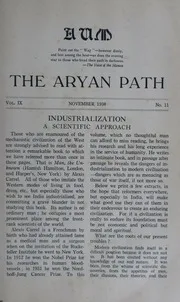
The Aryan Path Vol-I No-6 (1930) stands as a testament to Shri B.P Wadia's commitment to preserving and propagating the unaltered teachings of Theosophy. The journal's eclectic mix of articles, penned by some of the most influential thinkers of the time, offers a rich tapestry of esoteric knowledge. Each piece is thoughtfully curated and reviewed, ensuring that it adheres to the core principles of Theosophy as laid out by Madame Blavatsky and William Q Judge. For modern esoteric seekers, this volume serves as a valuable resource, providing insights into ancient spiritual practices and philosophies that remain relevant today. The depth and breadth of the topics covered make it an essential read for anyone interested in the occult and spiritual development.
📝 Description
82
The Aryan Path Vol-I No-6, published in 1935, contains essays on Theosophy and symbolism.
This issue of The Aryan Path, edited by B.P. Wadia, brings together various writers discussing Theosophical concepts and their application to modern life. The articles focus on understanding hidden meanings within symbols and philosophical ideas. Readers will find examinations of esoteric thought designed to encourage personal reflection and spiritual growth.
The journal aims to make complex philosophical ideas accessible. It addresses themes of inner knowledge and the search for deeper understanding. The contributors approach these subjects with a focus on intellectual engagement and spiritual inquiry, reflecting the broader aims of the Theosophical movement.
Published during a period of significant interest in Eastern philosophies and occult studies in the West, The Aryan Path served as a platform for disseminating Theosophical ideas. It connected with a broader movement that sought to reconcile ancient spiritual teachings with contemporary thought. The journal's focus on symbolism and inner development aligns with core tenets found in various esoteric schools, including those influenced by Helena Blavatsky and later Theosophists.
💡 Why Read This Book?
Reading The Aryan Path Vol-I No-6 (1930) today offers a unique opportunity to connect with ancient esoteric wisdom in a modern context. This journal provides readers with a comprehensive understanding of Theosophy and Anthroposophy, helping them to explore spiritual practices and philosophies that have stood the test of time. Whether you are a seasoned esoteric seeker or a curious beginner, this volume offers valuable insights and knowledge that can enrich your spiritual journey.
⭐ Reader Reviews
Honest opinions from readers who have explored this book.
❓ Frequently Asked Questions
What is the main focus of The Aryan Path Vol-I No-6?
The main focus is on preserving and disseminating the original teachings of Theosophy and Anthroposophy, as inspired by Madame H.P. Blavatsky and William Q Judge.
Who should read this journal?
This journal is ideal for anyone interested in esoteric knowledge, Theosophy, Anthroposophy, and spiritual development.
What makes this journal unique?
The journal's uniqueness lies in its eclectic mix of articles from eminent thinkers, reviewed from a universal Theosophical perspective, making it a valuable resource for modern esoteric seekers.
🔮 Key Themes & Symbolism
Theosophical Wisdom
The Aryan Path Vol-I No-6 studies the profound teachings of Theosophy, offering readers a chance to explore the hidden knowledge and symbolism that underpin our existence. The journal features articles that reflect the original and unaltered teachings of H.P. Blavatsky and William Q. Judge, providing a body of mystical and philosophical insights.
Ancient Symbolism
This journal is a rich source of ancient symbolism, with articles that unravel the mysteries hidden within the symbols of various cultures and traditions. Readers are invited to explore the deeper meanings behind these symbols and their relevance in the modern world.
Philosophical Contemplations
The Aryan Path Vol-I No-6 features philosophical contemplations on the nature of existence and the human experience. The articles, contributed by eminent thinkers and philosophers, offer a unique perspective on ancient wisdom and its relevance in the contemporary era.
💬 Memorable Quotes
Direct passages from the work, attributed to the author.
“The universal perspective of Theosophical philosophy.”
— The journal's articles are reviewed from a universal perspective, making them accessible to a wide audience.
“A sanctuary for thinkers, artists, and philosophers.”
— The Aryan Path Vol-I No-6 invites readers to explore the deeper meanings behind ancient symbols and their relevance today.
“The profound teachings of Theosophy.”
— The journal studies the profound teachings of Theosophy, offering readers a chance to explore hidden knowledge and symbolism.
💡 Key Ideas
Editorial paraphrase of the work's core concepts — not direct quotes.
The great truths of the Ancient Records are repeated for the modern era.
This quote emphasizes the journal's mission to bridge ancient wisdom with modern understanding.
The mystical and philosophical depths of Theosophy.
This quote highlights the journal's role in preserving and promoting the original teachings of Theosophy.
🌙 Esoteric Significance
Tradition
The Aryan Path Vol-I No-6 belongs to the Theosophical tradition, which draws from various esoteric and mystical teachings. It emphasizes the study of ancient wisdom and its relevance in the modern world, making it a valuable resource for those interested in Hermetic, Gnostic, and Kabbalistic traditions.
Symbolism
The journal features articles that explore ancient symbolism and its deeper meanings. Key symbols discussed include those from various cultures and traditions, offering readers a body of mystical and philosophical insights.
Modern Relevance
The Aryan Path Vol-I No-6 is relevant today for its ability to bridge ancient wisdom with modern thought. Modern practitioners of esoteric arts and spiritual seekers find this journal useful for its deep philosophical contemplations and universal perspectives.
👥 Who Should Read This Book
Beginners in Theosophy will find this journal a gateway to the profound teachings of ancient wisdom. Scholars of esoteric studies will appreciate the depth of philosophical contemplations and the journal's role in preserving original Theosophical teachings. Spiritual seekers and practitioners of mystical arts will find the journal's exploration of hidden knowledge and symbolism particularly enlightening. Overall, this publication is ideal for anyone interested in the mystical and philosophical depths of Theosophy.
📜 Historical Context
The Aryan Path Vol-I No-6 was published during a time when interest in esoteric and mystical studies was on the rise. Edited by Shri B.P. Wadia, the journal aimed to repeat the great truths of the Ancient Records for the modern era. It featured contributions from eminent thinkers, artists, and philosophers who sought to unravel the mysteries of ancient wisdom and present them in a contemporary context. The journal's influence can be seen in the preservation and promotion of original Theosophical teachings, making it an important resource for scholars and practitioners of esoteric arts.
📔 Journal Prompts
Reflect on the significance of ancient symbolism in your spiritual journey.
How does the journal's exploration of Theosophical teachings resonate with your personal beliefs?
Consider the universal perspectives offered in the journal and their relevance in your life.
Explore the deeper meanings behind the symbols discussed in the journal.
How does the journal's mission to bridge ancient wisdom with modern thought influence your understanding of Theosophy?
🗂️ Glossary
Theosophy
The study of the divine and its relationship to the human experience, often involving esoteric and mystical teachings.
Anthroposophy
A spiritual science that seeks to understand the nature of the human being and the cosmos through spiritual research.
Esoteric
Relating to knowledge that is understood by a small group of people, often involving hidden or mystical teachings.
Symbolism
The use of symbols to represent ideas or qualities, often involving hidden meanings and esoteric insights.
Ancient Records
The ancient wisdom and teachings that form the foundation of Theosophical and esoteric studies.
This book appears in 2 collections
🔮 Readers Also Liked
Browse all →






From the “Theosophy” Collection
View all →





More Free Theosophy & Anthroposophy Books
View all →