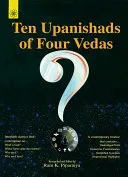
Ten Upanishads of Four Vedas
 71
71

Ten Upanishads of Four Vedas
Ram K. Piparaiya's "Ten Upanishads of Four Vedas" tackles the monumental task of presenting these ancient philosophical dialogues with a commendable breadth of material. The inclusion of original Sanskrit, English translations, and multiple commentaries is a significant strength, offering a multi-layered understanding. Piparaiya’s effort to simplify synopses and provide inspirational highlights is particularly useful for readers new to the dense philosophical terrain. However, while the "simplified synopses" aim for accessibility, some sections could still benefit from further contextualization within broader Indian philosophical debates to fully grasp their nuances. The discussion around the concept of 'neti neti' (not this, not this) in relation to Brahman, while present, could be more extensively elaborated to truly capture its paradoxical nature. This work serves as a valuable, if sometimes dense, resource for those dedicated to exploring the Upanishadic core.
📝 Description
71
Ram K. Piparaiya's 2003 book presents ten Upanishads from the four Vedas with Sanskrit verses and English translations.
Published in 2003, Ram K. Piparaiya's "Ten Upanishads of Four Vedas" offers the Sanskrit verses of ten key Upanishads alongside their English translations. The book aims to maintain textual accuracy while making these ancient texts accessible. It includes detailed commentaries designed to clarify the original philosophical meanings. Simplified summaries and highlighted passages are also present, intended to bridge the gap between the Upanishads' profound ideas and modern readers.
The compendium is suited for those studying Vedanta and comparative religion, particularly individuals seeking a scholarly yet understandable introduction to the Upanishadic tradition. It covers topics such as the origins of metaphysical thought, the nature of consciousness, and the connection between the individual and the universe. Scholars and practitioners will find this a useful collection of primary Upanishadic texts and their interpretive approaches.
The Upanishads, originating between 1500 and 500 BCE, are the philosophical conclusions of the Vedic period in ancient India. They represent a shift from Vedic ritual to the contemplation of reality, the self, and the divine. These texts formed the basis for later Indian philosophical systems, notably Vedanta, and have had a global spiritual influence for centuries. Piparaiya's work places these dialogues within a contemporary academic framework, connecting ancient thought to present-day understanding.
💡 Why Read This Book?
• Gain a consolidated understanding of ten principal Upanishads, including the *Brihadaranyaka Upanishad*, allowing for focused study of key Vedantic concepts that underpin much of Eastern philosophy. • Access unabridged Sanskrit texts alongside English translations and commentaries, enabling direct engagement with the source material and its interpretive history, as presented in Piparaiya's 2003 compilation. • Explore foundational questions like "Who am I?" and "Where from came the cosmos?" through the lens of the earliest Indian contemplatives, fostering a deeper personal inquiry into self and reality.
⭐ Reader Reviews
Honest opinions from readers who have explored this book.
❓ Frequently Asked Questions
What is the primary focus of "Ten Upanishads of Four Vedas"?
The book focuses on presenting ten principal Upanishads from the four Vedas, offering unabridged Sanskrit texts, English translations, extensive commentaries, simplified synopses, and inspirational highlights for a comprehensive understanding of these foundational Hindu philosophical texts.
Who is the author of "Ten Upanishads of Four Vedas"?
The author is Ram K. Piparaiya. The work was first published on January 1, 2003.
What are the main philosophical questions addressed in the Upanishads as presented in this book?
The book addresses fundamental existential questions such as 'What is God?', 'Where from came the cosmos?', 'Who am I?', and 'Why am I here?', reflecting the contemplative flights of ancient Indian thinkers.
Is this book suitable for beginners in Vedanta?
Yes, while it contains original texts and scholarly commentaries, the inclusion of simplified synopses and inspirational highlights makes it accessible for beginners interested in exploring the core ideas of Vedanta.
What is the historical period of the Upanishads?
The Upanishads are ancient texts, with their composition generally dated between 1500 and 500 BCE, representing the philosophical conclusion of the Vedic period in India.
What does 'Upanishad' mean?
The term 'Upanishad' is derived from Sanskrit and generally translates to 'sitting near' or 'sitting down close by,' referring to the tradition of receiving esoteric teachings from a guru.
🔮 Key Themes & Symbolism
The Nature of Reality
The Upanishads, as presented in Piparaiya's work, grapple with the ultimate nature of existence, distinguishing between the phenomenal world (Maya) and the underlying absolute reality (Brahman). They posit that this ultimate reality is the source and sustainer of all that is. The texts explore the concept of 'neti neti' (not this, not this) as a way to approach an ineffable truth that transcends conceptualization. The work aims to make these profound metaphysical explorations accessible, revealing the Upanishads as early human attempts to understand the fundamental fabric of the cosmos and our place within it.
The Self and Liberation
A central theme is the identity of the individual soul (Atman) with the universal consciousness (Brahman). Piparaiya's edition highlights how the Upanishads guide seekers to realize their true nature, transcending the limitations of the ego and the cycle of rebirth (samsara). The ultimate goal, Moksha, or liberation, is presented not as an afterlife reward but as a realization achievable in this life through self-knowledge. The book emphasizes the Upanishads' role in recording the mind's earliest flights towards understanding the divine within.
Cosmogenesis and Divine Inquiry
The Upanishads tackle the perennial question of creation: 'Where from came the cosmos?' Piparaiya's compilation includes commentaries that explore various creation myths and philosophical explanations found within these texts. These ancient contemplatives sought to understand the origin of the universe and the nature of the divine. The book frames this inquiry as a record of the human mind's profound desire to connect with the unknown, presenting the Upanishads as seminal texts in the history of spiritual and philosophical thought.
The Path of Knowledge
Piparaiya's "Ten Upanishads of Four Vedas" emphasizes the Upanishadic path to truth through Jnana Yoga, the yoga of knowledge. The texts advocate for deep contemplation, meditation, and the study of scriptures to attain self-realization. The book presents these teachings not merely as historical documents but as practical guides for inner transformation. The integration of commentaries and simplified synopses serves to explain the often-abstruse language of the Upanishads, making their profound wisdom available to contemporary seekers.
💬 Memorable Quotes
Direct passages from the work, attributed to the author.
“What is God? Where from came the cosmos? Who am I? Why am I here?”
— This captures the core existential inquiries that propelled the ancient Upanishadic sages. Piparaiya's work presents these questions as the impetus for the profound philosophical explorations found within the texts.
“Upanishads are a record of human mind's earliest contemplatives flights to the unknown.”
— This highlights the pioneering nature of the Upanishads, positioning them as some of the earliest documented attempts by humans to systematically explore consciousness, reality, and the divine through introspection.
“The book is a useful compendium of original Upanishadic texts and commentaries.”
— This statement underscores the practical value of Piparaiya's work for scholars and students, emphasizing its role as a consolidated resource for studying these complex ancient scriptures.
“Simplified synopses and inspirational highlights.”
— This refers to Piparaiya's pedagogical approach, designed to make the dense philosophical content of the Upanishads more digestible and personally relevant for a modern readership.
“Interfaith classics that contemplate on...”
— This positions the Upanishads within a broader spiritual and philosophical context, recognizing their influence and resonance across different religious and intellectual traditions.
🌙 Esoteric Significance
Tradition
The Upanishads are central to the Advaita Vedanta tradition, a major school of Hindu philosophy often considered esoteric due to its non-dualistic teachings on Brahman and Atman. This tradition emphasizes direct experience of reality over dogma. Piparaiya's work facilitates access to these core texts, aligning with the Esoteric Library's mission to present profound spiritual literature. The Upanishads represent an indigenous esoteric lineage focused on inner realization rather than external rituals or magical practices.
Symbolism
Key symbols include the 'Om' (AUM) mantra, representing the primordial sound and the totality of existence, encompassing past, present, and future. The 'cave of the heart' symbolizes the inner sanctuary where the Atman resides, the seat of consciousness. The 'chariot analogy' from the Katha Upanishad, with the body as the chariot, the intellect as the driver, and the senses as horses, illustrates the control needed to steer towards liberation from illusion.
Modern Relevance
Contemporary thinkers and spiritual practitioners in fields like transpersonal psychology, mindfulness, and non-dual spiritual movements draw heavily on Upanishadic concepts. Figures like Swami Vivekananda, who introduced Vedanta to the West in the late 19th century, and modern spiritual teachers who emphasize self-inquiry and the illusory nature of the ego, continue to propagate Upanishadic wisdom. Its teachings on consciousness and interconnectedness remain highly relevant for understanding subjective experience and the nature of reality.
👥 Who Should Read This Book
• Advanced students of comparative religion and philosophy seeking primary source material on the origins of Indian metaphysical thought. • Spiritual seekers interested in understanding the concept of Brahman and Atman, the core tenets of Vedanta, and paths to self-realization. • Scholars of ancient Indian texts and intellectual history requiring a comprehensive edition with multiple layers of commentary and translation.
📜 Historical Context
The Upanishads, emerging between 1500 and 500 BCE, represent the philosophical apex of the Vedic period in India. They mark a transition from the ritualistic focus of the earlier Vedas to profound introspective inquiry into metaphysics and the nature of consciousness. These texts became the bedrock of Vedanta philosophy, influencing schools like Advaita, Vishishtadvaita, and Dvaita. While distinct from the Abrahamic traditions, their explorations of ultimate reality and the inner self have found resonance in comparative religious studies globally. Piparaiya's 2003 publication makes these ancient dialogues accessible, bridging millennia. The intellectual climate of ancient India was characterized by vibrant philosophical debates, with various schools of thought emerging, though the Upanishads stand as a foundational canonical source for much of Hindu philosophy, predating systematic Western philosophical inquiry.
📔 Journal Prompts
The concept of Brahman as the ultimate reality.
The meaning of 'neti neti' in understanding the ineffable.
The relationship between Atman and Brahman.
The role of Maya in obscuring true knowledge.
The significance of the 'cave of the heart' as a spiritual locus.
🗂️ Glossary
Brahman
The ultimate, unchanging reality that underlies all phenomena in the universe. It is the absolute consciousness and the source from which everything emanates and to which everything returns.
Atman
The individual soul or self. In Upanishadic thought, particularly Advaita Vedanta, Atman is identical with Brahman, representing the true, eternal essence of a being.
Maya
Illusion or cosmic deception. It refers to the power that conceals the true nature of reality (Brahman) and creates the appearance of a diverse, material world.
Samsara
The cycle of birth, death, and rebirth, driven by karma. It is the continuous process of reincarnation that sentient beings undergo until liberation is achieved.
Moksha
Liberation or release from the cycle of samsara. It is the ultimate spiritual goal, characterized by the realization of one's true nature and union with Brahman.
Jnana Yoga
The yoga or path of knowledge. It involves the pursuit of wisdom and self-understanding through study, contemplation, and discrimination to realize the truth of reality.
Vedas
The most ancient scriptures of Hinduism, considered divine revelations. The Upanishads form the concluding part of the Vedas, known as the Vedanta ('end of the Vedas').