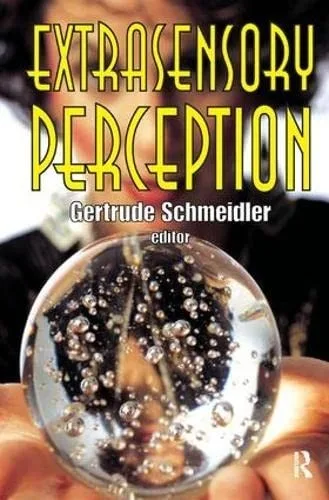
Extrasensory Perception
 77
77

Extrasensory Perception
Gertrude Schmeidler's "Extrasensory Perception" is a commendable effort to contextualize the persistent enigma of psychic abilities within psychological frameworks. The strength of the book lies in its structured approach, presenting a series of essays that dissect the research landscape of ESP. The editor's introduction, as noted, sets a clear analytical tone. A particular strength is the detailed consideration of experimental failures, which are often as illuminating as successes. For instance, the discussion surrounding participant expectation and its impact on test results offers a concrete example of psychological influence. However, the book occasionally suffers from a certain academic dryness, which, while appropriate for its scholarly intent, might alienate readers seeking more experiential accounts. The essays, while informative, could benefit from more direct engagement with the most recent advancements in cognitive science that might offer new lenses for interpreting parapsychological findings. Ultimately, "Extrasensory Perception" serves as a valuable, if somewhat dense, compendium for understanding the psychological barriers and facilitators in the study of ESP.
📝 Description
77
Gertrude Schmeidler's 2017 book examines why consistent high performance in ESP tests remains elusive.
Gertrude Schmeidler's "Extrasensory Perception" scrutinizes psychic abilities, moving beyond simple anecdotes to analyze the psychological factors influencing success and failure in ESP experiments. The volume contains nine essays, introduced by the editor, that detail research into extrasensory perception and the ongoing debates surrounding it. Schmeidler addresses why ESP, despite its potential to be a common human faculty, does not yield consistently high results for most individuals in testing scenarios.
This work is for serious students of parapsychology, psychology, and consciousness studies who approach ESP with a critical, research-oriented perspective. It is particularly suited for those interested in the empirical investigation of anomalous mental phenomena and the theoretical and methodological challenges inherent in studying ESP. The book revisits foundational research and discussions within parapsychology, engaging with decades of inquiry into psychic phenomena.
This book engages with the tradition of psychical research, a field that has sought to apply scientific methods to investigate phenomena traditionally relegated to spiritualism or occultism. It situates itself within a history of attempts to understand and quantify consciousness beyond its conventional biological and psychological frameworks. The focus on empirical testing, however, marks a departure from purely speculative or faith-based approaches, aligning it with a more scientifically minded, though still unconventional, branch of inquiry into the nature of mind and reality.
💡 Why Read This Book?
• Understand the psychological factors influencing ESP test results, as detailed in the essays building upon the editor's introduction, offering insights beyond mere belief or disbelief. • Gain a clearer picture of the research into ESP and its surrounding debates, as presented in the nine essays, which critically examine experimental methodologies and outcomes since the early 20th century. • Explore the concept of psychological determinants of success and failure in extrasensory perception, a core theme that reframes the discussion from inherent ability to nuanced cognitive processes.
⭐ Reader Reviews
Honest opinions from readers who have explored this book.
❓ Frequently Asked Questions
What is the primary focus of Gertrude Schmeidler's "Extrasensory Perception"?
The book primarily focuses on the psychological determinants of success and failure in extrasensory perception (ESP) tests, examining why consistent high performance is not universally achieved.
When was Gertrude Schmeidler's "Extrasensory Perception" first published?
The work was first published on July 12, 2017, bringing together research and discussion from various stages of ESP inquiry.
Who would benefit most from reading "Extrasensory Perception"?
Students of parapsychology, psychology, and consciousness studies, particularly those interested in the empirical investigation and psychological underpinnings of psychic phenomena, would find this book beneficial.
Does the book offer practical techniques for developing ESP?
No, the book's focus is on the psychological factors influencing test results and the research surrounding ESP, rather than providing direct methods for developing psychic abilities.
What kind of essays are included in the book?
The book includes nine essays that elaborate on the editor's introduction, offering detailed statements on research into ESP and the debates that surround it.
What is the main question the book attempts to answer?
The central question is: If extrasensory perception is a common human ability, why can't we all score high on ESP tests?
🔮 Key Themes & Symbolism
Psychological Determinants
This theme explores how internal mental states, cognitive processes, and attitudes significantly influence an individual's ability to perform well on extrasensory perception tests. Schmeidler examines factors such as belief systems, motivation levels, and the psychological impact of experimental conditions. The book posits that understanding these psychological barriers and facilitators is crucial for interpreting ESP research findings, moving beyond a simple dichotomy of presence or absence of psychic ability.
Research and Debate in Parapsychology
The book provides a structured overview of the historical and ongoing research into ESP, highlighting the methodological challenges and the resulting scholarly debates. It situates the essays within the broader context of parapsychological inquiry, acknowledging the skepticism and the rigorous empirical approaches employed. The aim is to present a clear picture of the scientific investigation into psychic phenomena, rather than sensationalized claims.
The Nature of Human Potential
By questioning why not everyone excels at ESP tests, the work examines the potential for extrasensory perception as a common human ability. It suggests that the variability in performance is not necessarily due to a lack of inherent capacity but rather to complex psychological and environmental interactions. This perspective encourages a more nuanced understanding of human consciousness and its potential anomalous capabilities.
Experimental Design and Interpretation
A significant focus is placed on the critical evaluation of experimental designs used in ESP research. The essays discuss how flaws in methodology, data analysis, and interpretation can lead to inconclusive or misleading results. This theme underscores the importance of rigorous scientific practice when investigating phenomena that lie outside conventional understanding, emphasizing precision in measurement and reporting.
💬 Memorable Quotes
Direct passages from the work, attributed to the author.
“If extrasensory perception is a common human ability, why can't we all score high on ESP tests?”
— This central question frames the entire work, setting the stage for an exploration into the psychological and contextual factors that mediate the expression of potential extrasensory abilities, rather than their mere existence.
“The psychological determinants of success and failure in extrasensory perception.”
— This phrase expresses the core thesis of the book, pointing towards internal mental states and processes as key variables in understanding performance on ESP tasks, shifting focus from innate psychic gifts to complex human psychology.
“Nine essays that build upon the editor's introduction.”
— This indicates the structured nature of the book, where foundational ideas presented in an introduction are systematically expanded upon and supported by detailed arguments and evidence within the subsequent chapters.
“Giving a clear picture of research into ESP and the debate that surrounds it.”
— This statement highlights the book's objective: to provide an organized and comprehensible overview of the scientific efforts to study extrasensory perception and the significant controversies and discussions within the field.
“Important statements giving a clear picture of research into ESP.”
— This emphasizes the scholarly weight and significance of the essays presented, suggesting they offer substantial contributions to understanding the current state of ESP research and its associated academic discourse.
🌙 Esoteric Significance
Tradition
While not overtly aligned with a specific esoteric lineage like Hermeticism or Theosophy, "Extrasensory Perception" intersects with esoteric traditions by investigating phenomena often explored within them, such as clairvoyance and telepathy. It approaches these subjects through a psychological and scientific lens, which can be seen as a modern, secularized interpretation of abilities once solely relegated to mystical or occult practices. The work provides a framework for understanding these potentials through empirical inquiry, rather than solely through faith or tradition.
Symbolism
The book's primary focus is not on symbolic interpretation in the traditional esoteric sense. Instead, the 'symbols' it engages with are experimental data, statistical anomalies, and psychological profiles. The 'symbolism' lies in what these data points represent: the potential for consciousness to operate beyond known physical constraints. The 'failure' on tests can be seen as a symbolic representation of how our current understanding of psychology and consciousness is incomplete.
Modern Relevance
Contemporary thinkers in fields such as consciousness studies, cognitive psychology, and even some branches of transpersonal psychology draw upon the kind of empirical investigation championed in works like Schmeidler's. Researchers exploring the limits of human perception and cognition, or those investigating altered states of consciousness, can find value in the detailed examination of ESP research methodologies and the psychological factors discussed. The work informs modern debates about the mind-body problem and the potential for non-local consciousness.
👥 Who Should Read This Book
• Students of parapsychology and consciousness studies seeking a research-focused examination of ESP. • Psychologists interested in the interplay between cognitive factors and anomalous mental phenomena. • Skeptics and researchers who want to understand the empirical challenges and debates surrounding extrasensory perception.
📜 Historical Context
Published in 2017, Gertrude Schmeidler's "Extrasensory Perception" engages with a field that has a long and often contentious history. The mid-20th century, particularly the post-World War II era, was a period of significant interest in parapsychology, with researchers like J.B. Rhine at Duke University popularizing concepts like ESP. However, this period also saw intense scrutiny and debate from the scientific establishment, with critics often highlighting methodological flaws in experiments. Schmeidler's work, while contemporary, reflects on these historical investigations and the enduring questions they raised. It acknowledges the broader intellectual climate that oscillated between fascination with the paranormal and a demand for stringent empirical validation, a tension that defined much of the research into subjects like telepathy and clairvoyance.
📔 Journal Prompts
The psychological determinants of ESP success and failure.
Variability in performance on extrasensory perception tests.
The editor's introduction and its subsequent essay developments.
Research into ESP and the surrounding debate.
The concept of extrasensory perception as a common human ability.
🗂️ Glossary
Extrasensory Perception (ESP)
The purported ability to acquire information or influence events through psychic means, bypassing the known sensory channels. This includes phenomena like telepathy, clairvoyance, and precognition.
Psychological Determinants
Factors related to an individual's mental state, personality, beliefs, motivation, and cognitive processes that influence behavior or performance, in this context, on ESP tests.
Parapsychology
The branch of psychology that studies alleged psychic phenomena, including ESP and psychokinesis, using scientific methodologies.
Experimental Design
The specific plan or structure of a scientific experiment, detailing the procedures, variables, controls, and measurements to be used, crucial for valid results in ESP research.
Telepathy
The direct communication of thoughts or feelings from one person's mind to another's without using the known senses.
Clairvoyance
The alleged ability to perceive objects, events, or information that is not accessible through the normal senses, often involving distant locations or hidden objects.
Precognition
The claimed ability to foresee future events, often through psychic means, beyond the normal course of time.