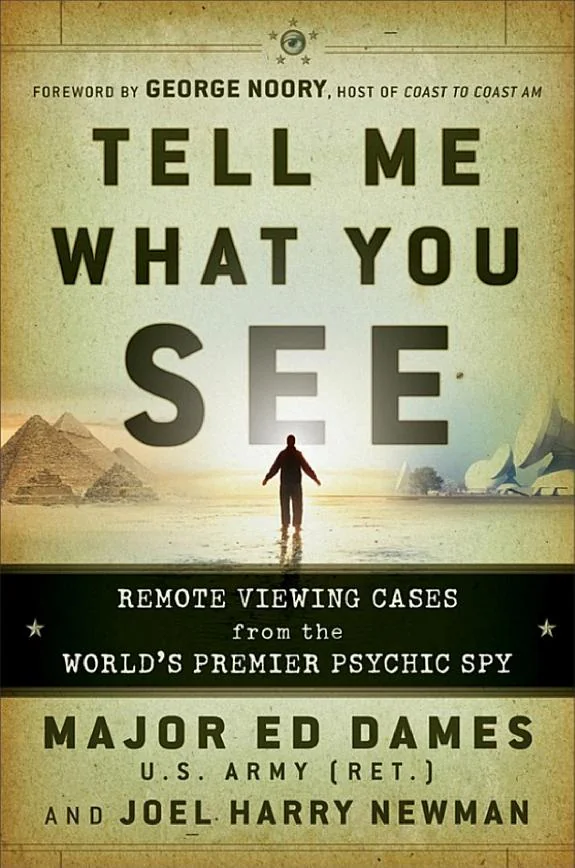
Tell Me What You See
 77
77

Tell Me What You See
Major Ed Dames’s "Tell Me What You See" offers a fascinating, if occasionally uneven, account of applying remote viewing for intelligence and investigation. The strength lies in Dames’s direct, unvarnished narration of his experiences within the DIA’s Psychic Intelligence Unit, providing a rare glimpse into a clandestine world. His subsequent work on missing persons cases, like the search for Steve Fossett, grounds the more speculative aspects of remote viewing in tangible outcomes. However, the narrative sometimes strains under the weight of its own extraordinary claims, and a more thorough examination of the scientific critiques or alternative explanations might have added depth. The passage detailing the protocols for psychic intelligence gathering is particularly compelling. Ultimately, the book serves as a compelling, if one-sided, testament to the author's belief in the power of focused consciousness.
📝 Description
77
Major Ed Dames detailed his remote viewing work for the DIA in his 2010 book, Tell Me What You See.
Tell Me What You See documents Major Ed Dames's application of remote viewing, a psychic perception technique, during his time with the Defense Intelligence Agency. The book outlines how this controlled psychic process was used for military intelligence. After his military service, Dames continued this work, turning his attention to paranormal investigation. This included efforts on high-profile missing person cases, moving beyond the confines of classified operations.
The book is intended for those interested in the practical uses of psychic abilities, especially remote viewing. It will interest readers curious about intelligence gathering methods outside conventional channels, as well as those who follow paranormal investigation and the resolution of cold cases. Anyone seeking to understand how consciousness might connect with empirical data will find value here.
Published in 2010, the book sits within the broader historical interest in parapsychology and government research into psychic phenomena, such as the Stargate Project. Dames's background in military psychic intelligence places "Tell Me What You See" within a tradition of exploring consciousness for information acquisition. The work discusses remote viewing as a trainable skill for data collection, touching on the ethics and challenges of its application, from national security to locating individuals.
💡 Why Read This Book?
• Gain insight into the practical application of remote viewing as a military intelligence tool, as detailed in Dames's experiences with the DIA's Psychic Intelligence Unit. • Understand the methodology and challenges of applying remote viewing to real-world investigations, exemplified by the search for missing pilot Steve Fossett. • Explore the concept of psychic perception as a data-gathering discipline, moving beyond theoretical speculation to operational accounts.
⭐ Reader Reviews
Honest opinions from readers who have explored this book.
❓ Frequently Asked Questions
What is remote viewing as described in Major Ed Dames's 'Tell Me What You See'?
Remote viewing, according to Major Ed Dames, is a disciplined mental technique to perceive information about a distant or unseen target using psychic perception, trained and utilized by the DIA's Psychic Intelligence Unit.
Did Major Ed Dames use remote viewing to find Steve Fossett?
The book 'Tell Me What You See' states that Major Ed Dames applied his paranormal detective skills, including remote viewing, in the search for millionaire pilot Steve Fossett after his plane vanished.
What was the Psychic Intelligence Unit?
The Psychic Intelligence Unit was an operational and training branch within the Defense Intelligence Agency (DIA) where Major Ed Dames served, focusing on using psychic abilities like remote viewing for intelligence gathering.
When was 'Tell Me What You See' by Major Ed Dames first published?
'Tell Me What You See' by Major Ed Dames and Joel Harry Newman was first published on November 19, 2010.
What kind of intelligence did the DIA's Psychic Intelligence Unit aim to uncover?
The DIA's Psychic Intelligence Unit, as described by Major Ed Dames, aimed to uncover accurate military intelligence by utilizing the practice of remote viewing on specific targets.
Does the book discuss the training involved in remote viewing?
Yes, 'Tell Me What You See' elaborates on the rigorous training protocols and analytical methods employed by Major Ed Dames and his team to develop and utilize remote viewing skills.
🔮 Key Themes & Symbolism
Remote Viewing Protocols
The book meticulously details the structured methodologies Major Ed Dames and his team employed for remote viewing. This involves specific stages, analytical frameworks, and the disciplined mental focus required to translate psychic impressions into actionable intelligence. The emphasis is on the operational, rather than purely theoretical, aspects of this controversial practice, highlighting its utility for gathering precise data from inaccessible locations or about unknown targets.
Paranormal Investigation
Beyond military applications, Dames recounts his post-service work as a paranormal detective. This section showcases the adaptability of remote viewing skills to civilian challenges, most notably in high-profile missing person cases like that of millionaire pilot Steve Fossett. It illustrates the potential of consciousness-based investigation to provide leads and information where conventional methods fall short, bridging the gap between the unknown and the verifiable.
Intelligence Gathering
Fundamentally, , 'Tell Me What You See' is about the unconventional methods of intelligence acquisition. Dames positions remote viewing as a viable, albeit esoteric, tool within the intelligence community, particularly during his tenure with the Defense Intelligence Agency. The work explores how disciplined psychic perception could yield accurate military intelligence, challenging traditional notions of espionage and information warfare.
Consciousness and Perception
The book probes the nature of human consciousness and its capacity for perception beyond the physical senses. Dames’s narrative suggests that the mind possesses latent abilities that, when properly trained and directed, can access information not normally available through ordinary sensory input. This exploration touches upon the philosophical implications of consciousness as an active agent in information acquisition.
💬 Memorable Quotes
Direct passages from the work, attributed to the author.
“As the operations and training officer for the Defense Intelligence Agency's Psychic Intelligence Unit, Major Dames, with his team, used the practice of remote viewing to uncover accurate military intelligence.”
— This statement highlights the core premise of the book: the practical, verifiable application of remote viewing for national security purposes within a formal governmental structure.
“After retiring from the military, Dames turned his paranormal detective skills to finding missing persons, such as millionaire pilot Steve Fossett, whose plane vanished in Nevada.”
— This demonstrates the extension of remote viewing capabilities from military intelligence to civilian investigative work, using a specific, widely known case to illustrate the book's broader themes.
“The book details how this controlled process of psychic perception was utilized for military intelligence gathering.”
— This emphasizes that remote viewing, as presented by Dames, is not chaotic or random but a structured, disciplined method for acquiring specific information.
“It moves beyond classified operations to explore Dames's post-military work in paranormal investigation.”
— This points to the dual focus of the book, covering both the author's government service and his subsequent career applying similar skills to broader investigative challenges.
💡 Key Ideas
Editorial paraphrase of the work's core concepts — not direct quotes.
The unknown isn't so unbelievable in Dames’s hands.
This quote suggests that Major Ed Dames possesses a unique ability to make extraordinary phenomena, like psychic intelligence gathering, seem plausible and manageable through his expertise and experience.
🌙 Esoteric Significance
Tradition
While not strictly aligned with a singular esoteric tradition like Hermeticism or Kabbalah, Dames's work on remote viewing can be seen as a practical, modern manifestation of scrying and clairvoyant practices found across various mystical traditions. It reinterprets ancient methods of accessing hidden knowledge through a lens of scientific protocol and intelligence applications, departing from purely spiritual or divinatory aims.
Symbolism
The core 'symbol' is the 'target' itself – the unseen information that remote viewing seeks to access. In this context, the target represents the veil between the known and unknown, the physical and the informational realms. The act of 'viewing' becomes a symbolic crossing of this threshold, transforming abstract potential into concrete data, akin to the alchemical process of transmutation.
Modern Relevance
Dames's work continues to influence contemporary remote viewing practitioners and researchers who seek to legitimize and expand its applications. His methodology informs training programs and investigative techniques in the burgeoning field of applied consciousness studies and has been referenced by independent researchers exploring psi phenomena in the 21st century.
👥 Who Should Read This Book
• Individuals intrigued by the practical applications of remote viewing, seeking to understand its operational use within government intelligence agencies like the DIA. • Paranormal investigators and researchers interested in techniques for gathering information on missing persons cases or unexplained phenomena, as exemplified by the search for Steve Fossett. • Students of consciousness studies and parapsychology looking for firsthand accounts that bridge theoretical concepts of psychic perception with real-world application and analysis.
📜 Historical Context
Published in 2010, "Tell Me What You See" arrives in an era marked by a renewed, albeit often skeptical, public fascination with the paranormal and government research into psychic phenomena. Major Ed Dames’s background as operations and training officer for the DIA's Psychic Intelligence Unit places him within the lineage of programs like the Stargate Project, which officially ran until 1995. The book’s emergence coincided with ongoing discussions in parapsychology and consciousness studies, influenced by thinkers and researchers who continued to explore anomalous mental phenomena. While Dames presents his work as fact, it exists in contrast to mainstream scientific paradigms and the persistent skepticism from institutions like the American Physical Society, which has historically questioned the validity of such research, particularly in the absence of reproducible, independently verifiable results.
📔 Journal Prompts
Remote viewing protocols as described by Major Ed Dames: how might these structured perceptions differ from everyday intuition?
The challenge of applying psychic intelligence to missing person cases like Christina: what ethical considerations arise?
Reflecting on the DIA's Psychic Intelligence Unit: how does this operational context shape the perception of remote viewing?
The concept of the 'unknown' not being 'unbelievable': explore instances where extraordinary claims require extraordinary evidence.
Dames's transition from military intelligence to paranormal detective: what skills are transferable across these domains?
🗂️ Glossary
Remote Viewing
A disciplined mental process of perceiving information about a distant or unseen target using psychic abilities, developed and utilized as a technique for intelligence gathering.
Psychic Intelligence Unit
An operational branch within the Defense Intelligence Agency (DIA) where Major Ed Dames served, dedicated to the study and application of psychic phenomena for intelligence purposes.
Paranormal Detective
An individual who applies skills, often including psychic abilities like remote viewing, to investigate unexplained phenomena or locate missing persons outside conventional investigative methods.
Target
In the context of remote viewing, the specific person, place, object, or event that the viewer is attempting to perceive information about.
Controlled Process
Refers to the structured methodologies and protocols used in remote viewing to ensure the accuracy and reliability of the perceived information, distinguishing it from random psychic impressions.
Defense Intelligence Agency (DIA)
A United States intelligence agency responsible for providing military intelligence to the nation's armed forces and policymakers.
Steve Fossett
A millionaire adventurer and pilot whose disappearance in 2007 was one of the high-profile missing person cases mentioned in the book where Dames applied his investigative skills.
This book appears in 1 collection
🔮 Readers Also Liked
Browse all →









From the “Remote Viewing” Collection
View all →







More Free Occult Philosophy Books
View all →