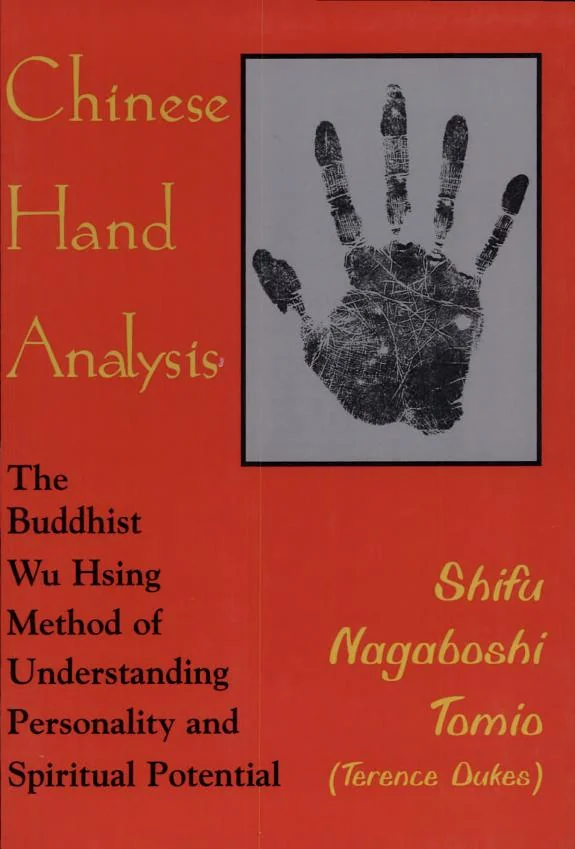
Chinese Hand Analysis
 71
71

Chinese Hand Analysis
Terence Dukes and Shifu Nagaboshi Tomio's Chinese Hand Analysis offers a refreshing departure from the deterministic pronouncements often found in Western palmistry. Its strength lies in its grounding within the Buddhist Wu Hsing framework, providing a more dynamic and holistic view of the hand as a map of energetic states rather than fixed destinies. The integration of Five Elements theory with palm reading is particularly compelling, as seen in the detailed correlations between hand features and elemental energies. However, the text occasionally assumes a familiarity with Buddhist concepts that may leave absolute beginners slightly adrift. A particular passage detailing the "Metal" element's connection to the lungs and the metal ridge on the hand offers a concrete, actionable example of the system's potential. It is a valuable, if sometimes dense, contribution to comparative esoteric studies.
📝 Description
71
Published in 1996, Chinese Hand Analysis presents a Buddhist interpretation of palmistry for Western readers.
Chinese Hand Analysis details a system of palmistry rooted in the Buddhist Wu Hsing, or Five Elements, philosophy. This approach differs from Western palmistry by focusing on the energetic and elemental correspondences within the hand. The authors view the hand as a reflection of the body and mind, indicating not only potential life paths but also the practitioner's current energetic state and capacity for integration.
The text is aimed at Western students interested in mind-body integration through esoteric studies. It holds particular relevance for practitioners of traditional Chinese medicine, comparative philosophy scholars, and individuals curious about the intersection of Buddhist thought and physiognomy. Anyone seeking to understand the body's energetic channels or a more comprehensive method of self-awareness will find practical insights within its pages.
This book introduces a specific Buddhist interpretation of hand analysis to Western audiences, moving beyond the Greco-Roman and generalized esoteric traditions often found in the West. It builds upon ancient Indian and Chinese monastic practices, connecting them with the Wu Hsing system. The work aims to bridge Eastern philosophical frameworks, particularly the Five Elements, with a Western student's understanding, highlighting a cross-cultural exchange of esoteric knowledge.
💡 Why Read This Book?
• Gain insight into the Buddhist Wu Hsing (Five Elements) system as applied to palmistry, moving beyond typical Western interpretations. Understanding the Wood, Fire, Earth, Metal, and Water correspondences in the hand offers a unique diagnostic tool. • Explore the concept of mind-body integration through the lens of hand analysis, as presented in the book's focus on energetic channels and their physical manifestations. This offers a different perspective than standard physiological texts. • Learn about an ancient art developed in Indian and Chinese monasteries, providing a historical and cultural anchor for the esoteric principles discussed. This context enriches the practice beyond mere fortune-telling.
⭐ Reader Reviews
Honest opinions from readers who have explored this book.
❓ Frequently Asked Questions
What is the core philosophy behind Chinese Hand Analysis as presented in the book?
The book's core philosophy is the Buddhist Wu Hsing (Five Elements) teaching, which views the hand as a microcosm reflecting energetic states. It links elements like Wood, Fire, Earth, Metal, and Water to specific hand features, offering insights into mind-body integration.
How does Chinese Hand Analysis differ from Western palmistry?
Unlike many Western systems focused on predicting fate, Chinese Hand Analysis emphasizes the dynamic interplay of energetic elements (Wu Hsing) within the hand. It's presented as a tool for understanding current states and potential for balance, rather than a fixed destiny.
Who are the authors of Chinese Hand Analysis?
The book was authored by Terence Dukes, with contributions from Shifu Nagaboshi Tomio. Shifu Nagaboshi Tomio is recognized for his expertise in Eastern esoteric traditions, bringing authentic lineage to the work.
What is the significance of the Wu Hsing in this system?
The Wu Hsing, or Five Elements (Wood, Fire, Earth, Metal, Water), are central. They are mapped onto different aspects of the hand—lines, mounts, and shapes—to interpret personality, health, and energetic balance.
Is this book suitable for beginners in esoteric studies?
Yes, it is written especially for the Western student. While it assumes some interest in mind-body integration, the principles of Wu Hsing are explained in relation to hand analysis, making it accessible.
What kind of practical applications does the book suggest?
The book suggests practical applications for self-understanding and energetic assessment. By analyzing hand features through the Wu Hsing lens, individuals can gain awareness of their current energetic patterns and potential imbalances.
🔮 Key Themes & Symbolism
Wu Hsing Integration
The book's foundational concept is the application of the Buddhist Wu Hsing (Five Elements: Wood, Fire, Earth, Metal, Water) to the physical structure of the hand. Each element is correlated with specific lines, mounts (eminences), and finger proportions, providing a detailed framework for understanding personality traits, energetic tendencies, and potential health correlations. This system offers a holistic view, suggesting how imbalances in one element manifest physically and energetically through the palm, serving as a diagnostic and self-awareness tool.
Mind-Body Energetics
Central to Chinese Hand Analysis is the principle of mind-body integration. The hand is presented not merely as a predictor of fate but as a living map reflecting the subtle energetic currents flowing through the body and mind. The book explores how the lines and features on the palm can indicate energetic blockages or harmonious flow, aligning with concepts found in Traditional Chinese Medicine (TCM) and Buddhist meditative practices. This perspective encourages a deeper connection between one's physical state and mental disposition.
Monastic Esoteric Lineage
The work traces its roots to ancient monastic traditions in India and China, specifically highlighting Buddhist adaptations of hand analysis. This lineage provides an esoteric foundation distinct from Greco-Roman or modern Western approaches. The book emphasizes a scholarly and practical transmission of knowledge developed within these sacred contexts, offering readers access to a preserved system of spiritual and physiological insight that has been cultivated over centuries within cloistered communities.
Western Adaptation
Written 'especially for the Western student,' Chinese Hand Analysis aims to bridge cultural and philosophical divides. It translates complex Eastern esoteric concepts, particularly the Wu Hsing system, into a format accessible to a Western audience unfamiliar with its original context. The revised edition seeks to provide an important reference work for Westerners interested in comparative esoteric studies, mind-body integration, and alternative systems of physiognomy, making it a valuable resource for cross-cultural understanding.
💬 Memorable Quotes
Direct passages from the work, attributed to the author.
“The hand is a microcosm of the body and mind.”
— This statement captures the book's core premise: that the physical features of the palm offer a detailed reflection of an individual's internal energetic landscape, psychological tendencies, and overall state of being.
“Wu Hsing principles map energetic states onto hand morphology.”
— This highlights the unique methodology of the text, where the Five Elements (Wood, Fire, Earth, Metal, Water) are not just abstract concepts but are directly correlated with observable lines, mounts, and shapes on the hand.
“Understanding the hand aids in mind-body integration.”
— This points to the practical application of the system, suggesting that by interpreting the energetic messages conveyed through the hand, one can achieve greater harmony and balance between their physical and mental states.
“This system was developed in the monasteries of India and China.”
— This emphasizes the ancient and spiritual lineage of the hand analysis presented, distinguishing it from more contemporary or Westernized forms and grounding it in centuries of monastic esoteric practice.
“The work is an important reference for Western students.”
— This indicates the book's intended audience and purpose: to serve as a comprehensive guide for those in the West seeking to understand and apply this specific Eastern esoteric discipline.
🌙 Esoteric Significance
Tradition
This work fits within the broader tradition of physiognomy and esoteric diagnosis, specifically drawing from Buddhist adaptations of ancient Indian and Chinese systems. It departs from purely materialistic or predictive forms of palmistry by embedding analysis within a framework of energetic cultivation and mind-body harmony, aligned with Buddhist principles of impermanence and skillful means. It functions as a practical tool for self-observation and energetic awareness, resonating with practices found in Taoism and other internal alchemy traditions.
Symbolism
The primary symbolism revolves around the Wu Hsing (Five Elements: Wood, Fire, Earth, Metal, Water). Each element is a symbolic representation of distinct energetic qualities and their interactions. For instance, 'Wood' might symbolize growth and flexibility, 'Fire' passion and transformation, 'Earth' stability and nourishment, 'Metal' structure and clarity, and 'Water' flow and intuition. These elements are symbolically mapped onto the hand's physical features, transforming lines and mounts into visual metaphors for these fundamental cosmic forces within the individual.
Modern Relevance
Contemporary practitioners of Traditional Chinese Medicine (TCM), Five Element acupuncture, and Qigong find resonance in the book's Wu Hsing framework, as it offers a complementary physiognomic perspective. Modern thinkers in holistic health, integrative psychology, and somatic awareness also draw upon its principles for understanding the body's energetic landscape. The book's emphasis on self-awareness through subtle energetic observation aligns with current trends in mindfulness and personalized wellness approaches, making its ancient wisdom applicable to contemporary life.
👥 Who Should Read This Book
• Students of Traditional Chinese Medicine and Five Element theory seeking a physiognomic correlation for energetic patterns. • Comparative religion and philosophy scholars interested in the intersection of Buddhist thought, esoteric practices, and somatic analysis. • Individuals exploring mind-body integration techniques and seeking practical tools for self-awareness and energetic assessment. • Practitioners of Western esoteric arts looking to expand their understanding with Eastern-derived systems of divination and self-knowledge.
📜 Historical Context
Published in its revised form in 1996, Chinese Hand Analysis emerged during a period of increasing Western interest in Eastern philosophies and esoteric practices, fueled partly by the New Age movement and a broader academic curiosity in comparative religion and psychology. The work's specific contribution was to introduce the Buddhist Wu Hsing (Five Elements) system of palmistry, a tradition distinct from the more prevalent Greco-Roman or Indian Vedic palmistry systems often encountered in the West. Authors Terence Dukes and Shifu Nagaboshi Tomio aimed to provide an accessible yet authentic interpretation for Western students. This era saw figures like Fritjof Capra popularizing the 'Tao of Physics,' indicating a cultural openness to integrating Eastern spiritual concepts with Western scientific and philosophical frameworks. The book mattered by offering a specific, monastic-derived system that prioritized mind-body integration and energetic balance over mere fortune-telling, providing a unique reference point in the field of esoteric literature.
📔 Journal Prompts
The Wu Hsing correspondences to hand features.
Energetic blockages indicated by specific palm lines.
The relationship between hand mounts and elemental energies.
Monastic origins of hand analysis in India and China.
Personal interpretation of the hand as a map of mind-body integration.
🗂️ Glossary
Wu Hsing
The Chinese concept of Five Elements (Wood, Fire, Earth, Metal, Water), a fundamental philosophy used in Taoism, traditional Chinese medicine, and various esoteric practices to explain interactions and relationships between phenomena.
Shifu
A term of respect in Chinese, often translated as 'master' or 'teacher,' typically used for someone skilled in martial arts, crafts, or academic disciplines, implying a high level of attainment and mentorship.
Mounts (of the hand)
The fleshy, raised areas on the palm, located beneath the fingers and at the base of the palm, each associated with a planet and certain character traits or life potentials in palmistry.
Physiognomy
A field that relates physical appearance, particularly facial features and body structure, to character, personality, and temperament. Hand analysis is a form of physiognomy focused on the palm.
Mind-body integration
The concept that the mind and body are not separate entities but are interconnected and influence each other. Esoteric systems often seek to harmonize this connection.
Energetic channels
In esoteric and traditional medicine systems, these are pathways through which vital energy (like Qi or Prana) flows throughout the body. The hand is seen as a nexus for these channels.
Microcosm
A miniature representation of a larger system. In this context, the hand is seen as a small-scale reflection of the entire human being (body and mind) and even the cosmos.
This book appears in 1 collection
🔮 Readers Also Liked
Browse all →








From the “Palmistry” Collection
View all →









More Free Occult Philosophy Books
View all →