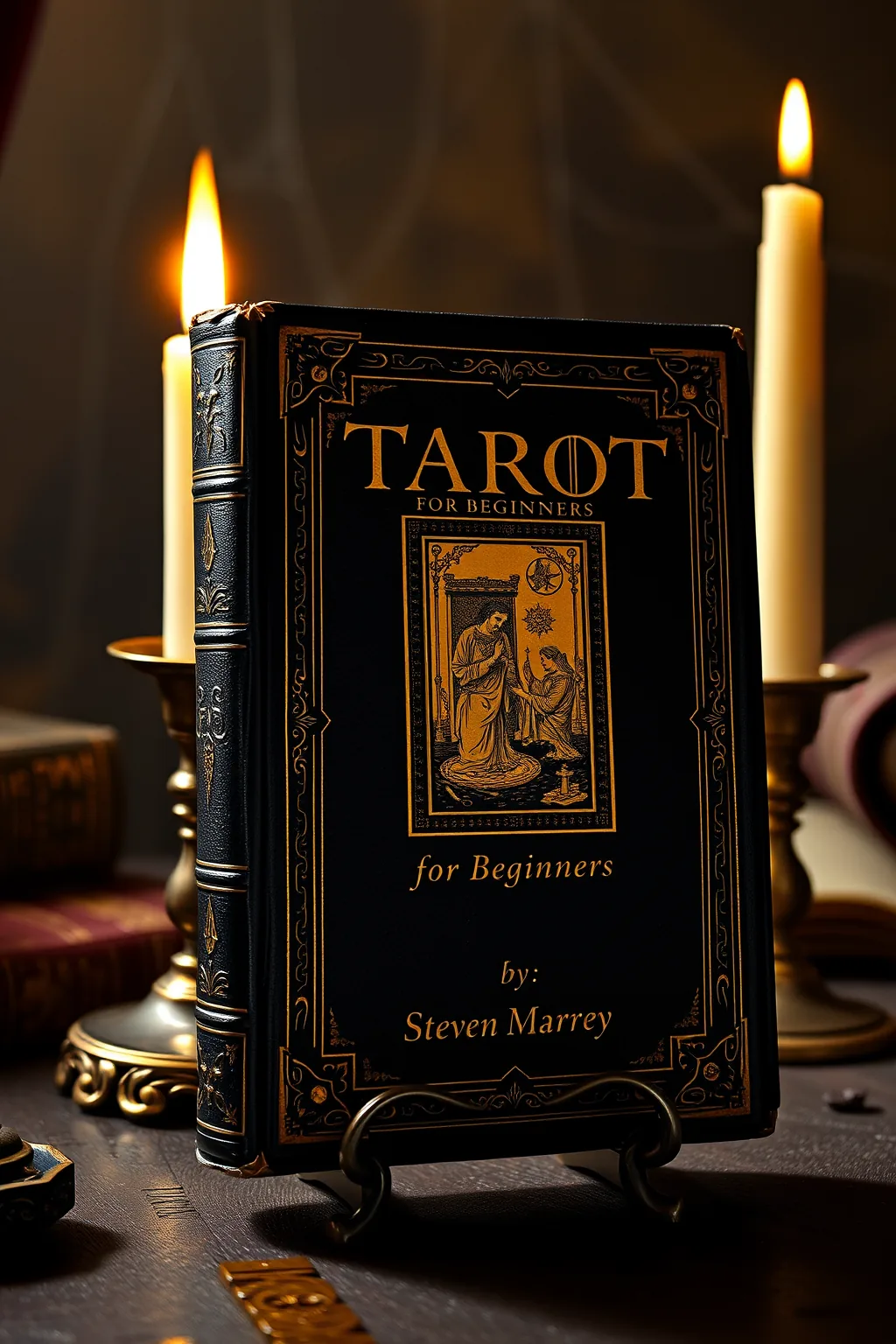
Tarot for Beginners
 80
80

Tarot for Beginners
Steven Marrey’s "Tarot for Beginners" offers a straightforward introduction to a practice often shrouded in mystique. Its primary strength lies in its clarity; Marrey avoids the overly academic or excessively mystical language that can alienate novices. The section on choosing a deck, for instance, is practical and encouraging. However, the book occasionally feels a bit too streamlined, perhaps sacrificing some of the deeper symbolic nuances for the sake of accessibility. For example, while the Major Arcana are explained, the depth of their archetypal significance, as explored by figures like Carl Jung in his work on the collective unconscious, is only briefly touched upon. The book successfully breaks down the mechanics of reading, but the spiritual or psychological underpinnings could be more thoroughly explored. It serves well as a first step, but dedicated students will likely need to seek further texts for a comprehensive understanding.
📝 Description
80
Steven Marrey's 2020 guide, "Tarot for Beginners," aims to demystify Tarot card reading for newcomers.
Published in 2020, "Tarot for Beginners" by Steven Marrey serves as an introductory text for those new to Tarot. The book breaks down the process of understanding the meanings of individual cards and how they function within different spreads. It also offers guidance on selecting a deck that resonates with the reader. Marrey explains how to interpret the positions of cards in layouts, ranging from simple three-card arrangements to more involved spreads.
The work also briefly covers the historical background of Tarot, noting its long use for guidance and self-understanding. It presents Tarot as a tool for introspection, not solely for fortune-telling. The author's aim is to give readers the confidence to start practicing Tarot readings for themselves and others. This involves cultivating a personal connection with the cards and their symbolic representations.
This book enters the tradition of Western esoteric practices that utilize Tarot for divination and personal insight. Within this lineage, which includes figures like A.E. Waite and Pamela Colman Smith, Tarot is seen as a system of archetypes and symbols that can reveal subconscious patterns and guide decision-making. Marrey's approach focuses on making these symbolic interpretations accessible, framing Tarot as a practical tool for self-discovery rather than purely a predictive mechanism.
💡 Why Read This Book?
• Learn to select a Tarot deck that aligns with your personal energy, a crucial first step detailed in the book's early chapters, ensuring a more intuitive connection. • Understand the foundational meanings of both the Major and Minor Arcana, as presented in the book's structured card-by-card analysis, enabling basic interpretations. • Grasp the basics of common Tarot spreads, like the three-card spread, which the book explains with practical examples for immediate application in your readings.
⭐ Reader Reviews
Honest opinions from readers who have explored this book.
❓ Frequently Asked Questions
What is the best way to start learning Tarot according to Steven Marrey?
Steven Marrey suggests starting by choosing a Tarot deck that visually appeals to you and feels right. The book then guides you through understanding the basic meanings of the cards and simple spreads for practice.
How does "Tarot for Beginners" explain the difference between Major and Minor Arcana?
The book differentiates the Major Arcana as representing significant life events and spiritual lessons, while the Minor Arcana are explained as reflecting day-to-day situations and challenges, each with unique symbolic systems.
Can I use any Tarot deck with this book?
While the book advises on selecting a deck, its core teachings on card meanings and spreads are generally applicable to most Rider-Waite-Smith-based Tarot decks, which are common for beginners.
Does this book cover advanced Tarot techniques?
No, "Tarot for Beginners" is specifically designed for newcomers. It focuses on establishing a solid understanding of the fundamentals rather than delving into complex or advanced divination methods.
What historical context is provided for Tarot in the book?
The book briefly touches upon the historical use of Tarot for divination and decision-making over centuries, positioning it as an ancient tool for insight and guidance.
Is "Tarot for Beginners" suitable for someone with no prior knowledge?
Yes, the book is explicitly written for beginners with no prior knowledge. It breaks down concepts step-by-step, making the Tarot accessible and understandable for absolute novices.
🔮 Key Themes & Symbolism
Foundational Card Meanings
The book systematically breaks down the symbolism and interpretations of the 78 Tarot cards, distinguishing between the 22 Major Arcana and the 56 Minor Arcana. It provides clear, concise explanations for each card, illustrating how their imagery relates to core concepts like journeys, challenges, and personal growth. This section is crucial for building a vocabulary of symbols necessary for any meaningful reading.
Practical Application Through Spreads
Beyond individual card meanings, "Tarot for Beginners" focuses on how to arrange cards into meaningful patterns known as spreads. It introduces readers to fundamental layouts, such as the three-card spread for past-present-future readings, and explains the significance of each position within the spread. This practical aspect empowers readers to move from theoretical knowledge to actual divination.
The Tarot Reading Process
This theme encompasses the entire arc of performing a Tarot reading. It covers advice on choosing a deck that appeals to the user, preparing oneself mentally and energetically for a reading, formulating clear questions, and interpreting the combined message of the cards. The emphasis is on developing an intuitive connection and ethical practice.
Historical and Esoteric Context
While primarily practical, the book situates Tarot within its historical context, acknowledging its long-standing use as a tool for insight and guidance. It touches upon the esoteric traditions that have employed Tarot, framing it as more than just a game but as a symbolic language connected to deeper psychological and spiritual principles.
💬 Memorable Quotes
Direct passages from the work, attributed to the author.
“Pick a Tarot deck that speaks to you.”
— This highlights the importance of personal connection and intuition in choosing a Tarot deck, suggesting that the physical form and imagery should resonate with the user's own energy for effective communication.
“The Major Arcana represent life's big lessons.”
— This concisely explains the role of the Major Arcana as archetypal forces and significant turning points in one's life journey, distinct from the more mundane concerns of the Minor Arcana.
“Each position in a spread has a specific meaning.”
— This emphasizes that the placement of a card within a Tarot spread is as crucial as the card's inherent meaning, guiding the interpretation of how energies and influences interact.
“Tarot can help you make difficult decisions.”
— This points to the practical application of Tarot as a tool for clarity and guidance when faced with choices, suggesting it offers perspective rather than dictating outcomes.
“Start with simple spreads to build confidence.”
— This advises a gradual learning approach, recommending that beginners focus on basic spreads like the three-card layout before attempting more complex configurations to foster a solid foundation.
🌙 Esoteric Significance
Tradition
This work aligns broadly with the Western esoteric tradition, particularly its modern manifestations focused on practical divination and psychological insight. While not strictly Hermetic or Kabbalistic, it draws from the common understanding of Tarot as a symbolic language that can reveal hidden correspondences and facilitate self-awareness, a concept explored in various occult orders since the late 19th century.
Symbolism
Key symbols include the Fool's Journey, representing the archetypal path of initiation and growth through the Major Arcana, and the four suits of the Minor Arcana (Wands, Cups, Swords, Pentacles), each symbolizing different elements and aspects of human experience – creativity, emotion, intellect, and the material world, respectively.
Modern Relevance
The book speaks directly to contemporary interests in mindfulness, self-discovery, and practical spirituality. Its accessible format makes it relevant for individuals exploring personal development, intuitive practices, and alternative methods of guidance, echoing trends seen in popular psychology and wellness movements.
👥 Who Should Read This Book
• Absolute beginners curious about Tarot who want a clear, step-by-step guide without overwhelming jargon. • Individuals seeking a practical tool for self-reflection and decision-making, looking for accessible methods to gain personal insight. • Those interested in the basic principles of divination and symbolism, wanting to understand how Tarot cards can be used for guidance.
📜 Historical Context
Published in 2020, Steven Marrey's "Tarot for Beginners" enters a field with a long and varied history, particularly since the late 18th century when occultists like Antoine Court de Gébelin first linked Tarot to ancient Egyptian mysteries. The book’s practical, step-by-step approach contrasts with the more academic or intensely esoteric studies of Tarot prevalent in some circles. While Marrey doesn't explicitly engage with contemporaries, his work implicitly addresses the modern resurgence of interest in divination and self-help spirituality, a trend amplified by online communities and accessible resources. This accessibility was not always the case; earlier in the 20th century, figures like A.E. Waite, co-creator of the iconic Rider-Waite deck in 1909, produced more complex interpretive systems. Marrey's 2020 publication aims to democratize this knowledge, making foundational Tarot principles available to a broad audience.
📔 Journal Prompts
Reflect on the archetypal journey represented by the Major Arcana.
Consider the symbolism of the element associated with the Suit of Cups.
Analyze the potential meaning of the first card drawn in a three-card spread.
Evaluate your personal connection to the imagery of the Fool card.
Document your process of choosing your first Tarot deck.
🗂️ Glossary
Major Arcana
The 22 trump cards in a Tarot deck, representing significant life events, spiritual lessons, and archetypal themes that often signify major turning points.
Minor Arcana
The 56 cards in a Tarot deck, divided into four suits (Wands, Cups, Swords, Pentacles), which typically represent everyday events, challenges, and circumstances.
Spread
A specific arrangement of Tarot cards laid out in a pattern to answer a particular question or explore a situation from different angles.
Divination
The practice of seeking knowledge or insight into the future or unknown through supernatural or magical means, often using tools like Tarot cards.
Suit
One of the four divisions of the Minor Arcana (Wands, Cups, Swords, Pentacles), each associated with a different element and set of life experiences.
Rider-Waite Deck
A widely popular Tarot deck, first published in 1909, known for its clear pictorial imagery on the Minor Arcana, which greatly aids in learning and interpretation.
Intuition
The ability to understand something immediately, without the need for conscious reasoning; in Tarot, it's the connection to the cards beyond literal meanings.
![CIA Reading Room cia-rdp78t05439a000400230090-7: MENSURATION OF THE [ ]-BUKHARA CANAL, USSR](/img/thumb/cia-reading-room-cia-rdp78t05439a000400230090-7-mensuration-of-the-bukhara-canal-ussr-cia-reading-room.webp)