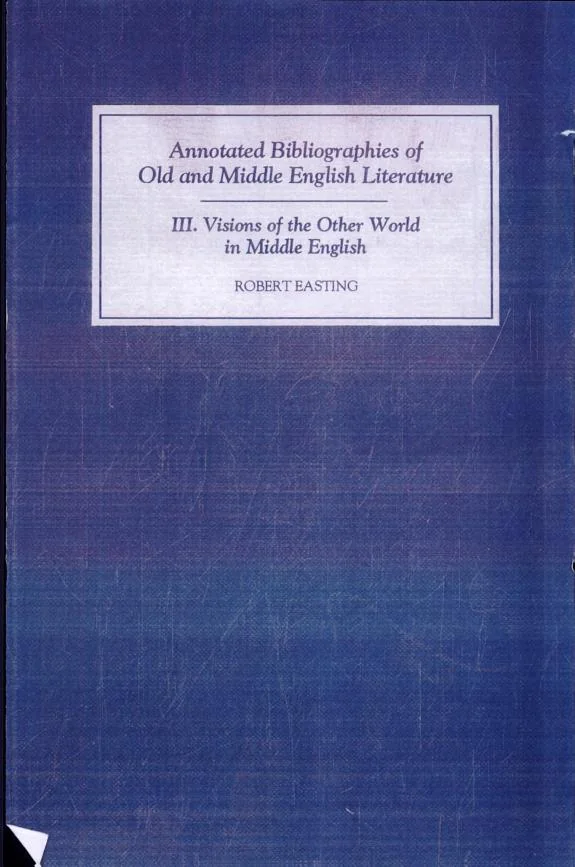
Visions of the Other World in Middle English
 80
80

Visions of the Other World in Middle English
Robert Easting’s *Visions of the Other World in Middle English* offers a necessary, if somewhat dry, collation of significant medieval afterlife texts. Its strength lies in its comprehensive bibliography and clear categorization of seven core vision types, including the well-known *St Patrick's Purgatory* and the *Vision of Tundale*. However, the scholarly distance maintained, while admirable for academic rigor, can make the profound spiritual weight of these accounts feel somewhat muted. The work meticulously details the textual variants of the *Vision of St Paul*, or the Eleven Pains of Hell, providing invaluable comparative material for textual critics. Its limitation is a lack of deeper engagement with the *lived* esoteric experience these visions often represented for their audiences. Ultimately, it serves as an essential reference tool for serious study, rather than an accessible entry point for general readers.
📝 Description
80
Robert Easting's 1997 bibliography catalogs nineteen medieval English texts on the afterlife.
This bibliography meticulously analyzes nineteen medieval English texts that describe visions of the afterlife. It focuses on narratives detailing journeys through Heaven, Hell, Purgatory, and the Earthly Paradise. The work provides a structured entry into this specific body of medieval literature.
Scholars of medieval literature, religious studies, and esoteric traditions will find this a valuable resource. Its detailed approach suits researchers interested in primary source analysis and comparative studies of medieval afterlife beliefs. It also appeals to readers curious about the historical development of eschatological thought.
The texts cataloged originate from the Middle Ages, a period when afterlife conceptions held significant influence and were subject to theological debate. These visions presented vivid, often didactic, accounts that shaped popular and learned imagination regarding divine judgment and eternal destiny. The compilation places these narratives within their original cultural and religious context.
Medieval visions of the afterlife were a significant aspect of spiritual and theological life, offering a glimpse into perceived realities beyond death. These accounts, often presented as direct revelations or personal journeys, served both to reinforce religious doctrine and to explore the emotional and psychological impact of beliefs about divine judgment. They formed a distinct literary and devotional tradition within medieval Christianity, providing a framework for understanding the soul's fate and the moral implications of earthly existence.
💡 Why Read This Book?
• Gain a structured overview of seven key medieval afterlife vision types, including the distinct narrative of the *Monk of Eynsham's revelation*, to understand their commonalities and divergences. • Understand the specific medieval theological framework surrounding Purgatory and Hell as depicted in texts like the *Vision of Tundale*, offering insight into historical concepts of divine justice. • Access a foundational bibliography for the study of medieval visionary literature, directly engaging with the primary texts Easting analyzes, many of which are foundational to Western esoteric thought.
⭐ Reader Reviews
Honest opinions from readers who have explored this book.
❓ Frequently Asked Questions
What specific medieval texts are analyzed in Visions of the Other World in Middle English?
The book focuses on nineteen medieval English texts, analyzing seven core types of vision narratives, including the Vision of St Paul (or Eleven Pains of Hell), St Patrick's Purgatory, the Vision of Tundale, and the Revelation of the Monk of Eynsham.
When was Robert Easting's Visions of the Other World in Middle English first published?
Robert Easting's critical bibliography, Visions of the Other World in Middle English, was first published in 1997.
What is the primary focus of the visions described in the book?
The visions primarily concern journeys and revelations about the afterlife, specifically detailing experiences of Heaven, Hell, Purgatory, and the Earthly Paradise as described in medieval English literature.
Who would benefit most from reading this book?
This book is most beneficial for academics and students of medieval literature, religious studies, and those interested in the historical development of eschatological beliefs and visionary experiences.
Does the book interpret the visions from a modern esoteric perspective?
While the book provides historical and textual analysis, its primary aim is scholarly. It lays the groundwork for modern esoteric interpretation by detailing the content and context of these medieval visionary accounts.
Are the texts discussed in the book readily available elsewhere?
The book acts as a bibliography and analysis of these texts, guiding readers to the specific medieval English versions that Easting examines, thereby serving as a research tool for locating and understanding them.
🔮 Key Themes & Symbolism
Medieval Eschatology
The book examines the medieval Christian understanding of the end times and the afterlife, exploring how narratives of Heaven, Hell, and Purgatory served to educate, admonish, and inspire believers. It examines the theological underpinnings and popular reception of these visions, showing how they reinforced societal and religious norms by providing vivid, often terrifying, depictions of divine judgment and eternal reward or punishment.
Visionary Literature Corpus
This work meticulously catalogs and analyzes a specific corpus of nineteen Middle English texts. It categorizes them by the type of vision presented, focusing on seven distinct narrative structures such as the Vision of Tundale or the Revelation of the Monk of Eynsham. This systematic approach allows for comparative study of recurring motifs, symbolic language, and thematic elements across different accounts of otherworldly journeys.
The Otherworld in Medieval Imagination
The collection explores the medieval conception of the 'otherworld'— not just as a post-mortem destination but as a tangible spiritual reality accessible through divine revelation or intense spiritual experience. It highlights how these visions provided detailed cartographies of spiritual realms, influencing art, literature, and popular religious practice by making the unseen world concrete and immediate.
Textual Transmission and Variation
A significant aspect is the focus on the textual history of these visions. By examining variants across different manuscripts, particularly for foundational texts like the Vision of St Paul, the book illuminates how these narratives evolved and were adapted over time. This offers insight into scribal practices and the dynamic nature of medieval literature's dissemination.
💬 Memorable Quotes
Direct passages from the work, attributed to the author.
“The vision of St Paul, or the Eleven Pains of Hell”
— This refers to a foundational text within the corpus, illustrating the grim depictions of hellish torments that were a common feature in medieval afterlife literature, serving as a stark warning against sin.
“St Patrick's Purgatory”
— This signifies one of the most popular and enduring medieval vision narratives, detailing a descent into a physical cave believed to be an entrance to Purgatory, highlighting the medieval fascination with tangible access to spiritual realms.
“The vision of Tundale”
— This specific narrative is a key example of a vivid and detailed account of a journey through Hell and Purgatory, offering graphic descriptions of punishments tailored to specific sins, which influenced subsequent visionary literature.
“A revelation of purgatory”
— This phrase expresses the core function of many texts discussed: to offer divine insight into the state of souls undergoing purification after death, often serving didactic purposes for the living.
“The revelation of the Monk of Eynsham”
— This specific textual example showcases a particular type of visionary account, often originating from monastic contexts, that provided detailed and authoritative descriptions of the afterlife, influencing theological discourse and popular piety.
🌙 Esoteric Significance
Tradition
While not explicitly adhering to a single modern esoteric tradition, this work is foundational for understanding the roots of Western visionary and somatic spiritual practices. The medieval visions discussed prefigure later concepts in Hermeticism and Rosicrucianism concerning direct experiential knowledge of spiritual planes and the soul's journey, providing historical context for such pursuits.
Symbolism
Key symbols include the journey motif itself, representing the soul's path through trials; celestial landscapes contrasting with infernal torment, symbolizing states of consciousness and divine proximity; and specific punishments, which can be interpreted as psychological or energetic blockages. The 'Eleven Pains of Hell' specifically offers a symbolic taxonomy of suffering tied to spiritual transgression.
Modern Relevance
Contemporary practitioners of contemplative prayer, psychonautic exploration, and comparative mysticism draw upon the rich symbolic language and experiential accounts found in these medieval visions. They offer archetypal maps of consciousness and non-ordinary states, informing modern explorations of the psyche and the nature of reality beyond the material plane.
👥 Who Should Read This Book
• Scholars of Medieval Literature and Religious History: To gain a comprehensive bibliography and analytical framework for studying afterlife narratives and their cultural impact. • Students of Comparative Religion and Esotericism: To trace the historical development of concepts regarding the soul's journey, judgment, and spiritual realms in Western traditions. • Researchers interested in Medieval Mysticism: To explore primary source material and understand the textual basis for visionary experiences that shaped medieval spiritual life and belief.
📜 Historical Context
Published in 1997, Robert Easting's work arrives centuries after the medieval period it scrutinizes. The late 20th century saw a resurgence of academic interest in medieval religious experience and literature, moving beyond purely theological analysis to explore the cultural impact and textual variations of these visions. This period was marked by significant scholarship on medieval mysticism and popular religion, with figures like Norman Cohn examining apocalyptic beliefs. Easting’s bibliography engages with this scholarly milieu by providing a rigorous catalog, implicitly contributing to the ongoing re-evaluation of how medieval people understood their spiritual existence. The reception of these visions varied; while some were widely circulated and accepted, others faced scrutiny or were adapted to fit evolving theological landscapes, a dynamic Easting’s work implicitly addresses through textual comparison.
📔 Journal Prompts
The Purgatory narratives, such as St Patrick's Purgatory, and their depiction of purification.
The symbolic geography of Hell presented in the Vision of Tundale.
The specific textual variations within the Vision of St Paul.
The role of divine revelation in the Monk of Eynsham's account.
The contrast between the Earthly Paradise and Hell in these medieval visions.
🗂️ Glossary
Visionary Literature
A genre of writing, prevalent in the Middle Ages, that describes supernatural or otherworldly experiences, often involving journeys to Heaven, Hell, or Purgatory, typically presented as divine revelations.
Eschatology
The branch of theology concerned with death, judgment, the end of the world, and the ultimate destiny of the human soul and the universe.
Purgatory
In medieval Christian theology, a state or place of temporary punishment in which souls destined for Heaven undergo purification to remove the effects of sin before entering God's presence.
Middle English
The form of the English language spoken roughly between the Norman Conquest (1150) and the late 15th century, the period during which many of the texts discussed were written.
Earthly Paradise
A concept in medieval Christian tradition, often depicted as a physical location or spiritual state of blissful existence, distinct from Heaven but representing a state of prelapsarian innocence or ultimate reward.
Scribal Practice
The methods and habits of manuscript copyists in the medieval period, including how they transcribed, altered, or annotated texts, which contributes to textual variation.
Didactic Literature
Writings primarily intended to instruct or teach, often moral or religious lessons, which was a common purpose for medieval visionary texts.
This book appears in 1 collection
🔮 Readers Also Liked
Browse all →








From the “Visions” Collection
View all →

More Free Occult Philosophy Books
View all →