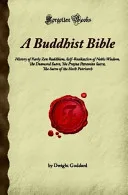
A Buddhist Bible
 83
83

A Buddhist Bible
Dwight Goddard's A Buddhist Bible, a 1938 compilation, attempts a broad sweep of Buddhist thought for the uninitiated Western reader. Its strength lies in its ambitious scope, drawing from Pali Canon, Mahayana sutras, and Zen writings to present a unified, albeit simplified, picture of Buddhist doctrine. Goddard's intention to make these profound teachings accessible is commendable. However, the work is not without its limitations. The very act of synthesis and translation, especially for a 1930s audience, inevitably flattens some of the nuanced distinctions between schools like Theravada and Mahayana. For instance, the treatment of emptiness can feel generalized, lacking the specific philosophical rigor found in dedicated Mahayana texts. A passage discussing the impermanence of all phenomena, while accurate in its broad strokes, might oversimplify the concept for those seeking a deeper philosophical engagement. Despite this, the book remains a significant historical document in the dissemination of Buddhist ideas in the West. It offers a decent starting point for those unfamiliar with the tradition, but serious students will need to move on to more specific, unadulterated sources.
📝 Description
83
Dwight Goddard published A Buddhist Bible in 1938, aiming to make Buddhist teachings accessible to Westerners.
First released in 1938, Dwight Goddard's A Buddhist Bible is not a single scripture but a curated collection of Buddhist writings. Goddard sought to synthesize core teachings from various Buddhist traditions, drawing from canonical texts, commentaries, and prominent figures. The anthology highlights universal Buddhist principles, making them understandable for a Western readership unfamiliar with the religion's diverse schools. It functions as an introduction to Buddhist philosophy and practice, offering a coherent overview of its ethical and philosophical foundations. Scholars of comparative religion and those interested in how Eastern philosophies were received in the West will also find this work of interest due to its broad scope.
Published in 1938, A Buddhist Bible emerged during a time of growing Western curiosity about Eastern religions, influenced by movements like Theosophy. This period saw Westerners interpreting Buddhist concepts like karma and reincarnation through their own philosophical frameworks. Goddard's work aimed to simplify these complex ideas, contributing to a broader trend of spiritual syncretism and the search for universal truths beyond Western religious norms.
💡 Why Read This Book?
• Gain an accessible overview of core Buddhist concepts like the Four Noble Truths and the Eightfold Path, as presented in Goddard's 1938 compilation, offering a foundational understanding not readily found in single-school texts. • Understand the historical context of Western engagement with Buddhism through Goddard's 1938 work, providing insight into early attempts to synthesize Eastern philosophy for a Western audience. • Explore the concept of suffering (dukkha) and its cessation as framed within Goddard's anthology, offering a practical perspective on liberation that can inform personal reflection and practice.
⭐ Reader Reviews
Honest opinions from readers who have explored this book.
❓ Frequently Asked Questions
When was A Buddhist Bible first published and who compiled it?
A Buddhist Bible was first published in 1938, compiled by Dwight Goddard. It aimed to make Buddhist teachings accessible to a Western readership by synthesizing selections from various Buddhist traditions.
What is the primary goal of A Buddhist Bible?
The primary goal of A Buddhist Bible is to present the core philosophical and ethical teachings of Buddhism in a coherent and accessible manner for Western readers, highlighting universal principles across different schools.
Does A Buddhist Bible focus on a single Buddhist tradition?
No, A Buddhist Bible is a compilation that draws from multiple Buddhist traditions, including Theravada, Mahayana, and Zen, to offer a broader perspective on Buddhist thought.
Is A Buddhist Bible considered a primary source text in Buddhism?
A Buddhist Bible is not a primary source text in the same way as ancient Buddhist scriptures. It is a secondary compilation and interpretation, designed for introductory purposes, first published in 1938.
Who would benefit most from reading A Buddhist Bible?
Individuals new to Buddhism, students of comparative religion, and those interested in the history of Western philosophy exploring Eastern thought would benefit from this 1938 compilation.
What are some key concepts covered in A Buddhist Bible?
Key concepts include the Four Noble Truths, the Eightfold Path, the nature of suffering (dukkha), impermanence, and the path to enlightenment, as presented in Goddard's 1938 anthology.
🔮 Key Themes & Symbolism
The Path to Liberation
The work extensively maps out the Noble Eightfold Path, presenting it not merely as a set of rules but as a practical, progressive method for overcoming suffering and achieving liberation. Goddard synthesizes teachings from various schools to emphasize the interconnectedness of right understanding, right thought, right speech, right action, right livelihood, right effort, right mindfulness, and right concentration as the means to dismantle attachment and ignorance. The emphasis is on diligent practice as the direct route to spiritual awakening, a core tenet across Buddhist lineages.
Understanding Suffering (Dukkha)
A central theme is the Buddhist analysis of suffering, or dukkha, presented as an inherent aspect of conditioned existence. The book explains that suffering arises from craving, aversion, and delusion, and that recognizing this is the first of the Four Noble Truths. Goddard's compilation illustrates how various Buddhist traditions approach the eradication of these root causes, offering a framework for understanding dissatisfaction and impermanence not as existential failures, but as phenomena to be understood and transcended through wisdom.
The Nature of Reality
The anthology explores concepts like impermanence (anicca) and non-self (anatta), challenging conventional notions of a permanent, independent self and a fixed reality. These ideas are crucial for understanding Buddhist cosmology and epistemology. By presenting excerpts that explore emptiness (sunyata) and the interdependent origination of all phenomena, Goddard guides the reader towards a perspective that deconstructs ego-centric views and fosters a more compassionate and insightful engagement with the world.
Synthesis of Buddhist Schools
A unique aspect of A Buddhist Bible is its attempt to create a unified discourse from diverse Buddhist traditions, including Theravada, Mahayana, and Zen. Goddard juxtaposes texts to highlight common ethical principles and philosophical insights, aiming to provide a comprehensive introduction for readers unfamiliar with the distinctions between these schools. This approach serves as an early example of comparative Buddhist studies in a Western context, bridging sectarian divides for a broader audience.
💬 Memorable Quotes
Direct passages from the work, attributed to the author.
“All compounded things are impermanent.”
— This distillation of the Anicca doctrine emphasizes the transient nature of all phenomena, encouraging detachment from fleeting experiences and a deeper understanding of existence's fluid quality.
“The path to enlightenment involves diligent practice of the Eightfold Path.”
— This highlights the practical, disciplined approach to spiritual development central to Buddhism, underscoring that wisdom and liberation are cultivated through consistent ethical conduct and mental training.
“Understanding the Four Noble Truths is the foundation for spiritual progress.”
— This emphasizes the foundational role of recognizing suffering, its cause, its cessation, and the path to cessation as the essential starting point for any Buddhist aspirant.
💡 Key Ideas
Editorial paraphrase of the work's core concepts — not direct quotes.
The cessation of suffering is achieved through the eradication of craving and ignorance.
This paraphrased concept highlights the core Buddhist teaching that liberation is not a passive state but an active process of mental purification, achieved by confronting and dissolving the root causes of discontent.
There is no permanent, independent self.
This paraphrase of the Anatta doctrine challenges the illusion of a fixed ego, pointing towards a more fluid and interconnected understanding of existence and identity.
🌙 Esoteric Significance
Tradition
While rooted in Buddhism, A Buddhist Bible functions as an esoteric text by selectively compiling and presenting teachings in a manner intended for a specific audience – Western seekers. It departs from strict adherence to any single Buddhist lineage, instead synthesizing elements to highlight universal principles often sought in esoteric traditions. Its appeal lies in offering a structured path to inner transformation, a common goal in esoteric movements, by explaining complex doctrines and presenting them as accessible practices for self-realization.
Symbolism
The book frequently engages with the concept of the 'Lotus Flower,' a symbol of purity and enlightenment emerging unstained from muddy waters, representing the potential for spiritual awakening within the conditions of ordinary life. Another motif is the 'Wheel of Dharma,' symbolizing the Buddha's teachings and the cyclical nature of existence, urging practitioners to engage with the path and break free from the cycle of rebirth. These symbols are presented not just as decorative elements but as potent metaphors for core philosophical insights.
Modern Relevance
Contemporary mindfulness practices and secular Buddhism often draw on the accessible ethical and psychological frameworks presented in works like A Buddhist Bible. Thinkers and practitioners exploring comparative spirituality and the integration of Eastern philosophies into Western life continue to find value in its broad overview. Its legacy is visible in modern adaptations of Buddhist concepts that emphasize psychological well-being and personal development, making its foundational synthesis relevant to current dialogues on secular spirituality and contemplative practices.
👥 Who Should Read This Book
• Beginners to Buddhist philosophy: Those new to Buddhist concepts will find this 1938 compilation offers a structured and accessible entry point into core teachings like the Four Noble Truths and the Eightfold Path. • Students of comparative religion: Individuals studying the historical dissemination of Eastern religions in the West will benefit from understanding early attempts at synthesis, such as Goddard's work. • Seekers of practical wisdom: Readers looking for actionable insights into overcoming suffering and cultivating inner peace, as framed by the principles articulated in this anthology, will find relevant guidance.
📜 Historical Context
Published in 1938, Dwight Goddard's A Buddhist Bible arrived during a period of burgeoning Western interest in Eastern philosophies, significantly influenced by the Theosophical Society's popularization of concepts like karma and reincarnation in the late 19th and early 20th centuries. This era saw a proliferation of translations and interpretations of Buddhist texts, often filtered through Western philosophical lenses. Goddard's work aimed to synthesize these diverse teachings into a more digestible format for a Western audience, seeking universal spiritual truths. It emerged in a landscape where figures like D.T. Suzuki were also beginning to introduce Zen Buddhism to the West, though Suzuki's approach often focused on philosophical depth, whereas Goddard's was more overtly devotional and introductory. The book's compilation style represented a common trend of the time: creating accessible anthologies that bridged perceived gaps between disparate spiritual traditions, sometimes at the expense of strict sectarian accuracy.
📔 Journal Prompts
The Four Noble Truths as a framework for personal dissatisfaction.
Reflecting on the impermanence of a specific relationship or possession.
The practice of right mindfulness in daily activities.
Identifying personal cravings that lead to suffering.
The concept of non-self in relation to ego identification.
🗂️ Glossary
Dukkha
A core Buddhist concept often translated as 'suffering,' 'dissatisfaction,' or 'stress.' It encompasses the inherent discomfort and impermanence of conditioned existence, arising from craving and attachment.
Anicca
The Buddhist doctrine of impermanence, stating that all conditioned phenomena are in a constant state of flux and change. Recognizing this is key to detachment.
Anatta
The doctrine of non-self, which asserts that there is no permanent, unchanging, independent self or soul. It challenges the ego-centric view of existence.
Sunyata
Often translated as 'emptiness,' this Mahayana Buddhist concept refers to the lack of inherent existence in all phenomena. It emphasizes interdependence and the absence of fixed, independent essences.
Bodhi
Enlightenment or awakening. It signifies the ultimate spiritual realization and liberation from the cycle of suffering and rebirth.
Karma
The principle of cause and effect, where intentional actions (physical, verbal, or mental) lead to future consequences, shaping one's experiences and rebirths.
Nirvana
The ultimate goal of Buddhist practice, signifying the cessation of suffering, the extinguishing of craving and ignorance, and liberation from the cycle of rebirth.