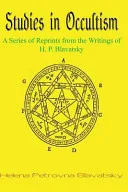
Studies in Occultism
 72
72

Studies in Occultism
Helena P. Blavatsky's *Studies in Occultism* offers a direct, albeit sometimes dense, portal into the foundational tenets of Theosophy. The strength lies in its unadulterated presentation of Blavatsky’s core doctrines, particularly her intricate cosmology and views on human spiritual evolution. A passage discussing the seven planes of existence, while challenging, provides a clear illustration of the work's ambition to map unseen realities. However, the prose can be demanding, often assuming prior familiarity with arcane terminology, which may present a barrier to newcomers. The historical reproduction, while culturally significant, means the text carries the weight of its original publication era, including potential stylistic choices that feel archaic. Despite these challenges, the book remains a crucial reference for understanding the genesis of modern esoteric thought.
📝 Description
72
Helena P. Blavatsky's 1897 collection, 'Studies in Occultism,' directly addresses esoteric principles.
This volume collects writings by Helena P. Blavatsky, focusing on the core esoteric ideas that shaped her larger philosophical system. Originally published after her death, this edition reflects its historical origins, including potential imperfections common to reprints of older texts. It offers direct access to foundational Theosophical concepts as articulated by Blavatsky herself. The book is intended for dedicated students of Western Esotericism, especially those tracing the roots of Theosophy and its early expressions. Researchers of comparative religion, scholars of 19th-century spiritual movements, and individuals eager to confront Blavatsky's original thought, free from later commentary, will find value here.
The late 19th century saw a surge in spiritualism and a Western curiosity for Eastern philosophies. Blavatsky's work appeared during this period, concurrent with the Theosophical Society she co-founded in 1875. This era was marked by a convergence of interest in ancient traditions, the rise of Theosophy, and a countermovement against prevailing materialistic science. Blavatsky's writings elicited strong reactions, drawing both fervent praise and sharp criticism from her contemporaries and religious institutions.
Published in 1897, 'Studies in Occultism' emerged from a period of intense spiritual and intellectual ferment in the West. Blavatsky's Theosophical Society, founded in 1875, sought to synthesize Eastern religions, Western occultism, and a critique of materialism. This book engages directly with concepts drawn from ancient Sanskrit texts and Hermetic philosophy, placing it within the broader currents of 19th-century esotericism that sought alternative spiritual frameworks. It represents a significant primary source for understanding the development of modern occult traditions.
💡 Why Read This Book?
• Gain direct insight into Blavatsky's original articulation of karma and reincarnation, understanding how these concepts were presented before extensive secondary interpretation, allowing for a unique grasp of their Theosophical framework. • Explore the concept of the 'seven planes of existence' as detailed by Blavatsky, offering a specific cosmological model distinct from other spiritual traditions and providing a concrete mental map for advanced study. • Understand the historical milieu of the Theosophical Society's early days through Blavatsky's own words, gaining specific context about the intellectual currents of the late 19th century that shaped esoteric thought.
⭐ Reader Reviews
Honest opinions from readers who have explored this book.
❓ Frequently Asked Questions
What is the primary focus of Helena P. Blavatsky's Studies in Occultism?
The book focuses on fundamental esoteric principles, including cosmology, consciousness, karma, and reincarnation, as understood within the Theosophical tradition initiated by Blavatsky and the founding of the Theosophical Society in 1875.
Is this book suitable for beginners in occult studies?
While foundational, the text is dense and assumes a certain familiarity with esoteric concepts. Beginners might find it more accessible after exploring introductory works on Theosophy or Blavatsky's simpler writings.
What makes this edition of Studies in Occultism significant?
This edition is a reproduction of a pre-1923 publication, preserving the original text and its historical form, acknowledging potential imperfections that are part of the artifact's journey through time.
What historical period does Studies in Occultism reflect?
The book reflects the late 19th century, a period of intense interest in spiritualism, Eastern religions, and alternative philosophies in the West, concurrent with the rise of movements like Theosophy.
Does the book discuss specific occult practices?
While it outlines principles and the nature of spiritual development, *Studies in Occultism* is more focused on theoretical and philosophical aspects of occultism rather than providing detailed practical instructions for rituals or magic.
What is the relationship between Studies in Occultism and Theosophy?
This work is a core text for understanding Theosophy, directly presenting the philosophical and cosmological ideas developed by Helena P. Blavatsky, a principal founder of the Theosophical Society.
🔮 Key Themes & Symbolism
Cosmic Planes and Subtle Bodies
Blavatsky outlines a complex cosmology wherein existence is structured across multiple planes, extending far beyond the physical. She details the subtle bodies—astral, mental, causal—as integral components of human constitution, each corresponding to these higher realms. Understanding these planes and bodies is presented as crucial for comprehending the totality of being and the path of spiritual evolution, moving beyond the limitations of material perception.
Karma and Reincarnation as Universal Law
Central to Blavatsky's philosophy is the immutable law of Karma, understood not as divine judgment but as a principle of cause and effect governing all existence across successive lives. Reincarnation is presented as the mechanism through which souls experience the consequences of their actions, learn, and progress. This cyclical process is depicted as essential for the purification and ultimate liberation of the spiritual essence.
The Nature of Consciousness and the Divine Spark
The work explores consciousness as a fundamental aspect of the universe, inherent in all forms of life. Blavatsky posits an indwelling divine spark or Monad within each individual, obscured by the personality and material attachments. The esoteric path involves awakening this inner divinity, recognizing its true nature as one with the universal Absolute, and transcending the illusions of separateness.
Ancient Wisdom and Esoteric Lineages
Blavatsky frames her teachings as a revival of an ancient, universal wisdom tradition, present in all major religions and philosophies throughout history. She references Sanskrit texts and Hermetic principles, suggesting a continuous, albeit often hidden, stream of esoteric knowledge passed down through various cultures and epochs. This perspective positions Theosophy as a modern expression of this perennial philosophy.
💬 Memorable Quotes
Direct passages from the work, attributed to the author.
“Man is a threefold being, with a physical, a psychic, and a spiritual body.”
— This highlights Blavatsky's view of human composition as multi-layered, extending beyond the visible form to include energetic and spiritual components essential for occult understanding.
“The Law of Karma is the unerring law of cause and effect.”
— This emphasizes the deterministic yet non-punitive nature of karma in Theosophy, presenting it as a fundamental cosmic principle governing actions and their consequences across lifetimes.
“Every thought is a seed, and every action a harvest.”
— This metaphor illustrates the practical implication of karma, showing how even subtle mental states and overt actions contribute to future experiences and spiritual progression.
“The universe is animated by a single, divine intelligence.”
— This speaks to the monistic underpinnings of Blavatsky's philosophy, asserting a unified, conscious source from which all existence emanates.
“Spiritual progress requires the purification of the lower nature.”
— This points to the ethical and ascetic dimensions of the esoteric path, suggesting that liberation is achieved through disciplined self-mastery and the transcendence of material desires.
🌙 Esoteric Significance
Tradition
This work is a foundational text within the Theosophical tradition, which itself draws heavily from Hermeticism, Neo-Platonism, Kabbalah, and Eastern philosophies (particularly Vedanta and Buddhism). Blavatsky sought to present a unified 'Ancient Wisdom' underpinning these diverse streams. *Studies in Occultism* articulates key Theosophical doctrines such as karma, reincarnation, and the multi-plane cosmology, departing from purely Western occult systems by its explicit integration of Eastern metaphysics.
Symbolism
Key symbols include the 'Seven Planes of Existence,' representing a hierarchical structure of reality from the densest material to the most subtle spiritual. The 'Monad' or divine spark within humanity symbolizes the ultimate spiritual source, often depicted as a divine essence obscured by personality. The cyclical nature of 'Karma' and 'Reincarnation' symbolizes the universal law of cause and effect driving spiritual evolution and eventual liberation.
Modern Relevance
Contemporary esoteric schools and practitioners continue to draw upon Blavatsky's extensive cosmology and philosophical framework. Thinkers in New Age spirituality, modern occultism, and comparative religious studies often reference her concepts of consciousness, subtle bodies, and universal laws. Theosophical societies worldwide still study this work, and its ideas have indirectly influenced various forms of meditation, spiritual psychology, and holistic health movements seeking to integrate mind, body, and spirit.
👥 Who Should Read This Book
• Students of Helena P. Blavatsky and early Theosophy: Those seeking to understand the original, unadulterated presentation of her core philosophical and cosmological ideas directly from her writings. • Researchers of 19th-Century Esotericism: Individuals investigating the intellectual and spiritual range of the Victorian era and the development of modern occult movements. • Comparative Religion Scholars: Anyone interested in how Eastern philosophies were synthesized and reinterpreted within a Western esoteric framework during the late 1800s.
📜 Historical Context
Emerging in the late 19th century, *Studies in Occultism* reflects a period of intense spiritual and intellectual ferment in the West. Helena P. Blavatsky, a co-founder of the Theosophical Society in 1875, was active amidst a milieu fascinated by Eastern religions, spiritualism, and critiques of materialism. Her work engaged with and often challenged prevailing scientific and religious orthodoxies. This era saw figures like Madame Blavatsky herself, alongside contemporaries such as Annie Besant and later, thinkers exploring the broader range of Western Esotericism. The Theosophical movement, with its synthesis of Eastern and Western mystical traditions, offered an alternative worldview to many dissatisfied with conventional paradigms. Blavatsky's writings were met with both fervent discipleship and sharp academic and religious opposition, solidifying its controversial yet influential place in the history of modern occultism.
📔 Journal Prompts
The Seven Planes of Existence, as described by Blavatsky, require careful consideration.
Reflect on the concept of the 'divine spark' within human consciousness.
Analyze the interconnectedness of actions and consequences as presented in the Law of Karma.
Consider the role of subtle bodies in spiritual perception and evolution.
Examine the historical context of Theosophy's emergence in the late 19th century.
🗂️ Glossary
Theosophy
A philosophical and religious system originating in the 19th century, founded by Helena P. Blavatsky and others, seeking to understand the divine nature of existence and humanity's place within it, often by synthesizing Eastern and Western esoteric traditions.
Monad
In Blavatsky's philosophy, the individual spiritual principle or divine spark within each being, considered eternal and inherently connected to the Absolute, often obscured by the lower, material aspects of existence.
Karma
The universal principle of cause and effect, where actions (causes) inevitably lead to corresponding results (effects) across lifetimes, influencing an individual's spiritual progression and destiny.
Reincarnation
The cyclical process by which a spiritual entity (the Monad or soul) is reborn into a new physical body after death, to learn lessons and work through karmic consequences from previous lives.
Subtle Bodies
Non-physical components of human or cosmic constitution, such as the astral, mental, or causal bodies, which are believed to inhabit and interact with different planes of existence beyond the physical.
Planes of Existence
Hierarchical levels or dimensions of reality, ranging from the gross physical to the highly spiritual, through which consciousness operates and evolves according to Theosophical cosmology.
Esotericism
Teachings, practices, and philosophies that are intended for or understood by only a small number of people with specialized knowledge or initiation, often dealing with hidden spiritual truths.