Reclaiming Humility
 74
74

Reclaiming Humility
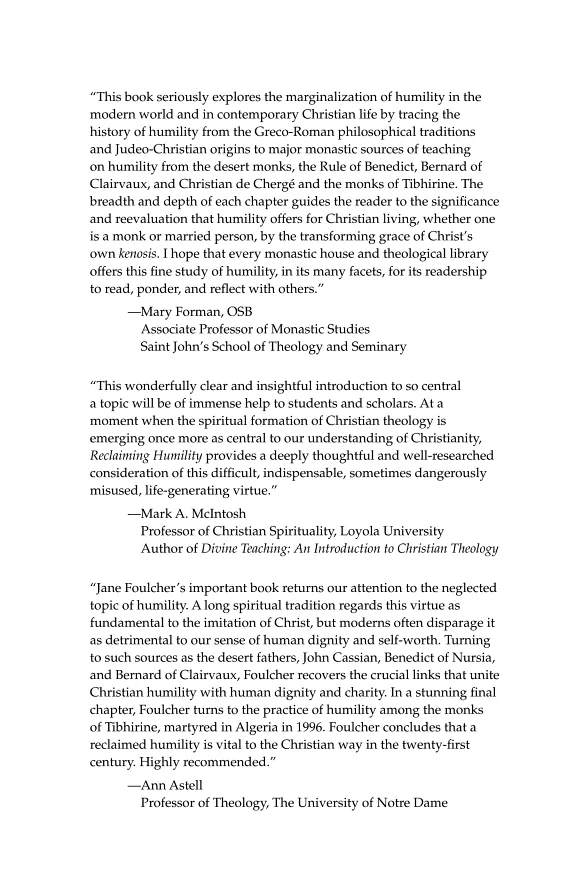
Jane Foulcher’s Reclaiming Humility performs a necessary intellectual excavation, unearthing the theological and historical substance behind a virtue frequently relegated to the dustbin of "monkish" antiquarianism. Her critique of Enlightenment figures like Hume and Nietzsche, who saw humility as a weakness, is sharp and well-supported by her tracing of early Christian thought and monastic traditions. A particular strength lies in her re-framing of humility not as a human effort but as a receptive state of grace, a "divine climate" that fosters spiritual openness. The book’s primary limitation, however, is its density; while intellectually rigorous, it can occasionally feel inaccessible to the casual reader, requiring a sustained engagement with theological and philosophical discourse. The section exploring the desert fathers’ understanding of humility, for instance, is illuminating but demands close attention. Foulcher ultimately succeeds in presenting a compelling case for humility’s enduring relevance, challenging contemporary assumptions about virtue and spiritual life.
📝 Description
74
Jane Foulcher's 2015 book reclaims humility from Enlightenment critiques that labeled it 'slave morality'.
Jane Foulcher's "Reclaiming Humility" examines the theological and historical roots of humility, pushing back against modern Western dismissal of the virtue. Published in 2015, the book argues that Enlightenment thinkers like Hume and Nietzsche misrepresented humility by viewing it solely as a "monkish virtue" or a tool of oppression. Foulcher counters this by tracing humility's lineage from early Christian thought through Western monastic traditions. She posits that humility is not a self-generated moral stance but a receptive state opened by divine grace.
The work situates humility as a "divine climate," a spiritual atmosphere that allows for encounters with the sacred. Foulcher shows how monastic communities preserved this understanding, providing a contrast to contemporary secular ideals of self-reliance. This historical and theological recovery is presented as vital for understanding how a virtue central to early Christian ethics was later denigrated. The book is aimed at scholars of theology, religious history, and philosophy, particularly those interested in the development of Western thought and critiques of Enlightenment values. It also appeals to readers engaged with spirituality, ethics, and monastic traditions.
This work engages with a long-standing contemplative tradition that views spiritual growth not as individual achievement but as a yielding to a higher power. The concept of humility as a receptive state, a "divine climate," resonates with mystical paths that emphasize detachment from the ego and openness to divine influence. Foulcher's focus on early Christian thought and monasticism connects to a lineage of spiritual practice that sought direct experience of the sacred through disciplined self-abnegation and surrender, a counterpoint to more voluntaristic or intellectual approaches to faith.
💡 Why Read This Book?
• Gain a nuanced understanding of humility’s theological roots, moving beyond secular interpretations. You will learn how early Christians and monastic communities, as explored in the historical context, viewed humility not as a weakness but as a spiritual posture. • Discover the concept of humility as a "divine climate," a specific theological framework presented by Foulcher that reframes spiritual receptivity as a grace-given state, offering a unique esoteric perspective. • Challenge the Enlightenment critiques of humility, as articulated by thinkers like Hume and Nietzsche, by engaging with Foulcher's counter-argument rooted in a recovery of early Christian thought and monastic practice.
⭐ Reader Reviews
Honest opinions from readers who have explored this book.
❓ Frequently Asked Questions
What is Jane Foulcher's central argument about humility in Reclaiming Humility?
Foulcher argues that humility, far from being a "monkish virtue" or "slave morality" as critiqued by Enlightenment thinkers, is best understood as a state opened by divine grace, a "divine climate" conducive to spiritual receptivity.
Which historical figures are central to the critique of humility discussed in the book?
The book engages with the critiques of humility presented by Enlightenment philosophers David Hume and Friedrich Nietzsche, who viewed it as a sign of weakness or an imposition of "slave morality."
How does Foulcher connect humility to monasticism?
The work examines the trajectory of humility at key junctures in the development of Western monasticism, showing how these communities preserved and transmitted a counter-cultural understanding of humility as a spiritual way of life.
Is Reclaiming Humility a practical guide to becoming more humble?
No, the book is primarily a theological and historical exploration. While it reframes the concept, it is not a self-help manual for cultivating humility through human effort.
What is the significance of the 'divine climate' concept?
The "divine climate" is Foulcher's term for humility as a spiritual atmosphere or environment created by grace, in which one is open to divine presence and influence, rather than an independently achieved virtue.
When was Reclaiming Humility first published?
Reclaiming Humility by Jane Foulcher was first published in 2015.
🔮 Key Themes & Symbolism
Humility as Divine Grace
This theme redefines humility not as a humanly constructed virtue or a sign of subservience, but as a state of openness gifted by divine grace. Foulcher posits it as a "divine climate," a spiritual atmosphere that allows for a deeper reception of the sacred. This perspective challenges secularized notions of self-mastery and achievement, aligning with mystical traditions that emphasize surrender and receptivity to higher forces.
Critique of Enlightenment Values
Foulcher directly confronts the Enlightenment's dismissal of humility, particularly the views of Hume and Nietzsche. The work analyzes how these thinkers, influential in shaping modern Western thought, perceived humility as "monkish" or indicative of "slave morality." By dissecting these critiques, the book aims to expose the limitations of a purely rationalist or materialist worldview in understanding spiritual virtues.
Monasticism and Spiritual Transmission
The book traces the historical trajectory of humility through Western monasticism, highlighting how monastic communities served as crucial custodians of this virtue. Foulcher examines how these traditions preserved and transmitted an understanding of humility distinct from secular ethics, offering a rich historical counterpoint to contemporary societal values and demonstrating the enduring influence of monastic spirituality.
Counter-Cultural Spirituality
Reclaiming Humility advocates for a counter-cultural reading of this virtue, positioning it as a radical alternative to the prevailing ethos of individualism and self-assertion. By rooting humility in early Christianity and monasticism, Foulcher presents it as a path that defies contemporary norms, offering a spiritual framework that emphasizes dependence, receptivity, and divine connection over personal autonomy.
💬 Memorable Quotes
Direct passages from the work, attributed to the author.
“Humility emerges not as a moral virtue achieved by human effort but as a way opened by grace.”
— This core interpretation shifts the paradigm of humility from an ethical discipline to a spiritual reception, emphasizing its divine origin rather than human will.
“Humility as a divine 'climate'.”
— This metaphor suggests humility is an ambient spiritual condition, an atmosphere created by divine presence that fosters receptivity, rather than an individual trait to be cultivated solely through personal striving.
“Rejection of humility as a "monkish virtue" (Hume).”
— This highlights the historical critique by Enlightenment thinkers who associated humility with religious asceticism and deemed it irrelevant to modern, secular life, a viewpoint Foulcher seeks to counter.
“Rejection of humility as a "slave morality" (Nietzsche).”
— This points to another significant Enlightenment critique, framing humility as a tool of the weak to subjugate the strong, a perspective Foulcher re-examines within its historical and theological context.
“Recovery of the counter-cultural reading of humility that marked early Christianity.”
— This indicates the book's project: to re-present humility as it was understood by its earliest adherents, emphasizing its radical, non-conformist nature against prevailing societal values.
🌙 Esoteric Significance
Tradition
While rooted in Christian theology and history, Foulcher's work touches upon perennial esoteric themes concerning the nature of the self, divine reception, and the limitations of purely rational understanding. It aligns with mystical traditions across various faiths that emphasize kenosis (self-emptying) and surrender as pathways to spiritual realization, departing from purely intellectual or magical approaches.
Symbolism
The concept of a "divine climate" itself functions metaphorically, symbolizing an ambient spiritual reality accessible through receptivity, akin to how hermetic traditions might speak of attuning to cosmic influences. The monastic cell, often a symbol of interiority and withdrawal, represents a space where this climate can be cultivated, fostering an inner landscape conducive to grace.
Modern Relevance
Foulcher's re-evaluation of humility appeals to contemporary movements in contemplative spirituality, eco-theology, and post-secular philosophy that question hyper-individualism and anthropocentrism. Thinkers and practitioners seeking alternatives to achievement-oriented cultures find in her work a theological grounding for a more receptive, grace-centered approach to spiritual life and ethical being.
👥 Who Should Read This Book
• Christian theologians and students of religious history seeking to understand the theological underpinnings and historical evolution of humility, particularly its counter-Enlightenment interpretations. • Scholars and practitioners of Western monastic traditions interested in how humility was understood and lived within these communities as a core spiritual discipline. • Philosophers and cultural critics examining the critique of Enlightenment values and seeking alternative perspectives on virtues like humility in contemporary society.
📜 Historical Context
Jane Foulcher's Reclaiming Humility (2015) intervenes in a long-standing debate about the virtue of humility, a debate significantly shaped by Enlightenment critiques. Thinkers like David Hume, in his 'Enquiry Concerning the Principles of Morals,' and Friedrich Nietzsche, particularly in 'On the Genealogy of Morality,' famously cast humility in a negative light, associating it with monasticism or an inversion of natural strength. Foulcher places her theological argument directly against this intellectual current. The work traces the concept's journey from its foundational role in early Christianity, through its nuanced development within various schools of Western monasticism (e.g., Benedictine, Cistercian), up to its contested status in contemporary thought. The book's publication in 2015 situates it within a broader resurgence of interest in theological anthropology and critiques of secular modernity, offering a counterpoint to the dominant individualistic ethos. Its reception has been primarily within academic theological and philosophical circles, engaging with scholars who revisit pre-Enlightenment spiritual traditions.
📔 Journal Prompts
The "divine climate" of humility: what conditions foster receptivity?
Nietzsche's critique of "slave morality": how does it shape modern views of humility?
Early Christian understanding of humility: contrast with contemporary self-help.
Monastic traditions as custodians of humility: what practices endure?
The virtue of humility: a personal challenge to Enlightenment ideals.
🗂️ Glossary
Monkish Virtue
A term, notably used by David Hume, to dismiss humility as a virtue primarily associated with religious ascetics and deemed irrelevant or even detrimental to robust, secular life.
Slave Morality
A concept from Friedrich Nietzsche, suggesting that humility and other virtues emphasized by Christianity are actually the values of the oppressed (the 'slaves') used to subvert the natural strengths and values of the ruling class (the 'masters').
Divine Climate
Jane Foulcher's metaphor for humility, presenting it not as a self-achieved virtue but as a spiritual atmosphere or environment created by divine grace, in which one is open to spiritual influence.
Counter-cultural Reading
An interpretation that positions a concept or practice (in this case, humility) against the prevailing norms and values of a society, highlighting its radical or alternative nature.
Enlightenment
An 18th-century intellectual and cultural movement emphasizing reason, individualism, and skepticism towards tradition and religious authority, which significantly influenced Western philosophical and ethical thought.
Western Monasticism
The religious way of life practiced in Christian monasteries in Europe and its cultural sphere, characterized by vows of poverty, chastity, and obedience, and historically significant for its preservation of knowledge and spiritual traditions.
Grace
In Christian theology, the divine assistance or love given to humans, enabling them to respond to God's call to live a holy life. Foulcher emphasizes humility as a gift of grace rather than a product of human will.
This book appears in 1 collection
🔮 Readers Also Liked
Browse all →









From the “Desert Fathers” Collection
View all →









More Free Occult Philosophy Books
View all →