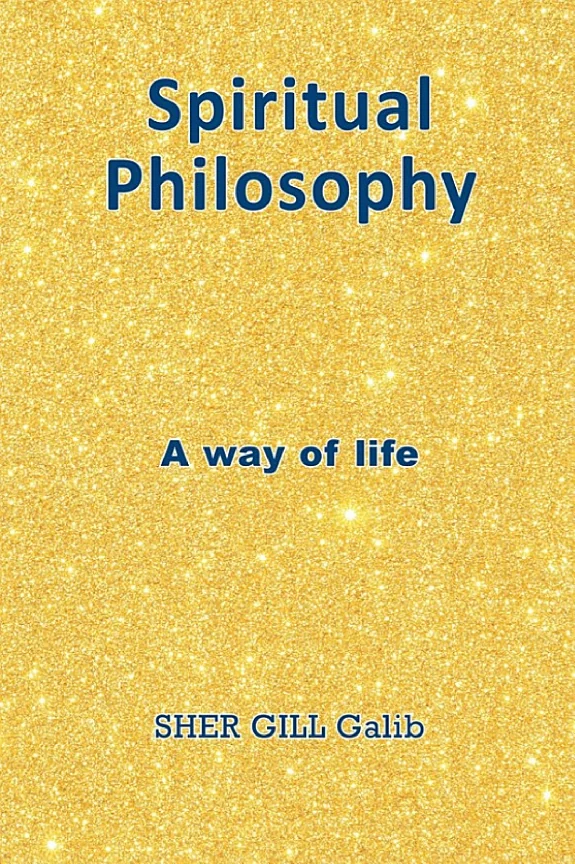
Spiritual Philosophy
 82
82

Spiritual Philosophy
Sher Gill Galib's *Spiritual Philosophy* attempts to bridge the gap between everyday experience and esoteric understanding, a common but challenging endeavor. The work’s strength lies in its direct, almost aphoristic style, which can jolt the reader into considering familiar concepts from novel angles. For instance, the concept of the "bridge of light and sound" as a path to the "nameless" is evocative, suggesting a sensory or vibrational approach to transcendence. However, the book's brevity and lack of sustained argumentation can also be its primary limitation. The leap from basic observations about humility to accessing "secret worlds" feels abrupt, lacking the detailed explication often required for such profound claims. The assertion that the reader is a "messenger" needing to "wake up the prophet within" is a powerful call to action, but it remains underdeveloped. Ultimately, *Spiritual Philosophy* offers intriguing glimpses into esoteric thought but requires significant reader participation to flesh out its potential.
📝 Description
82
Sher Gill Galib's *Spiritual Philosophy*, published in 2023, argues humility is an innate human capacity.
First released in 2023, Sher Gill Galib's *Spiritual Philosophy* examines humility, suggesting it is a natural human trait often obscured by external pressures or internal hesitation. The book proposes that cultivating humility is key to finding true happiness, likening this state to experiencing life's full spectrum. Galib frames spiritual growth as dependent on an individual's readiness and openness. The text questions a person's capacity for divine presence, presenting itself as a means to access hidden spiritual dimensions. The author describes the reader as a messenger responsible for awakening an inner spiritual voice, indicating that spiritual understanding comes through personal engagement, not just passive acceptance. Galib differentiates between outward, conventional life philosophies and inward, hidden ones. *Spiritual Philosophy* aims to guide readers from the former to the latter, fostering an esoteric awakening. A core image is the 'bridge of light and sound,' a path to a state beyond ordinary comprehension. The book stresses self-awareness in the search for truth, questioning the power of labels and identity in understanding ultimate reality. The ultimate aim presented is the union of the self with the knower of truth, a condition of deep insight and unity.
This work engages with esoteric traditions that posit an inner dimension of reality accessible through personal transformation. It aligns with mystical paths that emphasize direct experience of the divine rather than adherence to dogma. The metaphor of a 'bridge of light and sound' echoes concepts found in various contemplative traditions that describe subtle spiritual pathways. The emphasis on awakening an inner 'prophet' and the unification of the self with truth relates to Gnostic and Sufi ideas concerning inner gnosis and divine union.
⭐ Reader Reviews
Honest opinions from readers who have explored this book.
❓ Frequently Asked Questions
What is the core message of Sher Gill Galib's Spiritual Philosophy?
The book emphasizes humility as a key to happiness and spiritual realization, suggesting that awakening an inner prophet through an "esoteric experience" leads to understanding beyond names and concepts.
When was Spiritual Philosophy first published?
Spiritual Philosophy by Sher Gill Galib was first published on January 1, 2023.
What does the book mean by the 'bridge of light and sound'?
This metaphor represents a path or method to access higher states of consciousness, leading towards the 'nameless' – a state beyond ordinary identification and conceptualization.
How does the book relate humility to happiness?
Galib suggests that by cultivating humility, an often-suppressed quality, individuals can fill their lives with a sense of richness and joy, likened to the 'many colours of the rainbow'.
Who is the intended audience for Spiritual Philosophy?
The book is aimed at individuals seeking an "esoteric experience," those who wish to "wake up the prophet within," and readers interested in moving beyond exoteric (outward) philosophies to deeper, inward spiritual understanding.
What is the significance of the 'knower of truth' mentioned in the book?
It refers to a state of ultimate realization where the individual self merges with or recognizes the fundamental truth of existence, moving beyond dualistic perception.
🔮 Key Themes & Symbolism
The Nature of Humility
The work posits humility not merely as a virtue but as an innate quality crucial for genuine happiness. It suggests that this capacity is often dormant, requiring conscious effort to express. By embracing humility, individuals are encouraged to open themselves to a more profound experience of life, akin to embracing a spectrum of vibrant colors, moving away from a singular, limited perspective towards a more expansive, grateful state of being.
Exoteric vs. Esoteric Paths
Galib distinguishes between outward, conventional understanding (exoteric) and inward, hidden knowledge (esoteric). The book serves as a guide to transition from the former to the latter, facilitating a direct "esoteric experience." This journey involves recognizing that true spiritual insight often lies beyond the surface-level interpretations commonly accepted, requiring a shift in perception and consciousness.
The Self as Messenger
A central theme is the reader's role as a "messenger" tasked with awakening an inner "prophet." This framing emphasizes personal responsibility and the active role one must play in their spiritual development. It suggests that latent spiritual potential exists within each individual, waiting to be activated and expressed for deeper self-understanding and connection to divine truths.
Transcendence Through Sound and Light
The "bridge of light and sound" is presented as a metaphorical pathway to a state of "nameless" awareness. This concept points towards a reality that transcends language, identity, and form. It suggests that by harmonizing with fundamental universal vibrations—represented by light and sound—one can achieve a union with the "knower of truth," realizing a state of pure consciousness beyond the limitations of the ego.
💬 Memorable Quotes
Direct passages from the work, attributed to the author.
“To be happy, fill your life with the many colours of the rainbow.”
— This metaphor suggests that true happiness arises from embracing a complex existence, appreciating the full spectrum of experiences and perspectives, rather than limiting oneself to a narrow view.
“Are you graceful enough to be in the presence of God?”
— This question challenges the reader's readiness for spiritual communion, implying that a certain inner refinement or purity of being is necessary to connect with the divine.
“This book can lead you to an esoteric experience.”
— This statement clearly articulates the book's purpose: to serve as a guide facilitating a direct, inner spiritual encounter that goes beyond conventional, external religious or philosophical doctrines.
“The bridge of light and sound will lead you to the nameless.”
— This evocative phrase describes a method or pathway—potentially vibrational or energetic—for achieving a state of consciousness that transcends all names, forms, and conceptual limitations.
“You and the knower of truth are one.”
— This declaration points to the ultimate goal of spiritual realization: the dissolution of the separate self and the recognition of unity with the fundamental essence of reality.
🌙 Esoteric Significance
Tradition
While not explicitly aligning with a single lineage, *Spiritual Philosophy* draws from perennialist themes found across various esoteric traditions, including Hermeticism, Gnosticism, and Eastern philosophies. Its focus on inner awakening, the distinction between outer and inner knowledge, and the pursuit of a "nameless" state suggests an engagement with mystical and contemplative paths that emphasize direct experience over dogma.
Symbolism
The "many colours of the rainbow" symbolize the fullness and diversity of spiritual truth and happiness, contrasting with a limited, monochromatic view of existence. The "bridge of light and sound" represents a supra-rational pathway to consciousness, suggesting that fundamental universal energies are keys to unlocking higher awareness and transcending the mundane. The "prophet within" signifies the dormant divine potential inherent in every individual, awaiting activation.
Modern Relevance
In an era often characterized by information overload and spiritual seeking, Galib's work offers concise prompts for introspection. Contemporary thinkers exploring mindfulness, consciousness studies, and non-dual philosophies might find resonance in the book's emphasis on direct experience and the unity of self with truth. Its accessible style makes it relevant for individuals seeking practical, albeit brief, guidance toward inner transformation outside traditional religious structures.
👥 Who Should Read This Book
['• Seekers of direct spiritual experience: Individuals looking for practical, concise guidance to move beyond intellectual understanding towards genuine inner realization.', '• Students of comparative spirituality: Those interested in exploring core themes of esoteric thought, such as the distinction between exoteric and esoteric knowledge, presented accessibly.', '• Individuals questioning conventional life philosophies: Readers who feel a disconnect with outward societal norms and are searching for deeper meaning and purpose in their lives.']
📜 Historical Context
Published in 2023, *Spiritual Philosophy* enters a contemporary landscape saturated with spiritual literature, yet it harks back to perennial philosophical questions. Its direct, almost aphoristic style might find echoes in early 20th-century esoteric writings, such as those by P.D. Ouspensky, who also explored the transition from intellectual understanding to direct experience, albeit with more structured methodologies. Galib’s emphasis on an inner "prophet" and bridging exoteric with esoteric thought aligns with the broader New Age movement’s resurgence in the late 20th century, which sought accessible pathways to spiritual awakening. The work’s brevity, however, contrasts sharply with the dense, systematic treatises favored by established esoteric orders like the Hermetic Order of the Golden Dawn, which were prominent in the late 19th and early 20th centuries. Reception of such works in the current digital age often prioritizes shareability and immediate impact over deep scholarly engagement, a trend Galib’s concise pronouncements seem well-suited to.
📔 Journal Prompts
Reflect on the "many colours of the rainbow" as a metaphor for your own life's richness.
Consider the "bridge of light and sound": what sensory experiences might lead you toward the "nameless"?
How can you "wake up the prophet within" in your daily interactions?
Explore the concept of humility as an "innate quality" rather than a learned behavior.
What does it mean to you to be in the "presence of God"?
🗂️ Glossary
Esoteric Experience
A direct, inner spiritual realization or encounter that transcends ordinary, outward understanding and intellectual knowledge. It implies a personal, often transformative, perception of deeper realities.
Exoteric Philosophy
Philosophy or teachings that are outward-facing, intended for general public understanding, often dealing with conventional societal or religious norms and beliefs.
The Nameless
A state of being or ultimate reality that is beyond all names, forms, concepts, and descriptions. It represents a transcendent consciousness or absolute truth that cannot be captured by language.
The Knower of Truth
Refers to the ultimate consciousness or wisdom that understands reality in its fundamental essence. The book suggests achieving a state of unity with this universal knowing.
Prophet Within
An inner spiritual guide or intuitive voice representing one's latent divine potential and capacity for clear insights and truth, which needs to be awakened and heeded.
Bridge of Light and Sound
A metaphorical concept representing a pathway or means, likely involving universal energies or vibrations, that connects the individual consciousness to higher states of awareness or the 'nameless'.
Humility
Presented not just as modesty, but as an innate quality essential for happiness and spiritual receptivity, enabling one to embrace life's full spectrum.
This book appears in 1 collection
🔮 Readers Also Liked
Browse all →









From the “Soul Travel” Collection
View all →









More Free Occult Philosophy Books
View all →