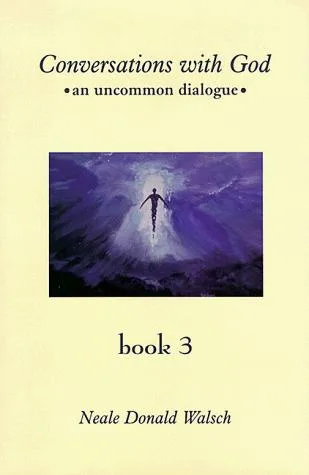
Conversations with God
 76
76

Conversations with God
Neale Donald Walsch's "Conversations with God" presents a challenging premise: a direct Q&A with the Almighty. The work’s strength lies in its accessibility; it translates complex spiritual ideas into plain language, bypassing theological jargon. Walsch’s questioning often mirrors the doubts and curiosities of many individuals seeking meaning. A particularly striking exchange concerns the nature of "evil," which the book reframes not as a force opposing God, but as a consequence of free will and the absence of good, or a tool for growth. However, the book's singular voice, presenting one perspective as divine revelation, can feel limiting. The interpretation of all existence as an extension of God's consciousness, while comforting to some, may not satisfy those seeking a more dualistic or nuanced cosmology. Ultimately, it functions less as definitive scripture and more as a highly personal, introspective spiritual dialogue.
📝 Description
76
Neale Donald Walsch published 'Conversations with God' in 1995, claiming it was a direct dialogue with the divine.
This book presents itself as a transcript of questions posed by Neale Donald Walsch and the answers he received from God. It is not structured as a traditional religious text but as a personal inquiry into existence. The work addresses fundamental questions about spirituality, life's purpose, and the nature of being. Walsch's text aims for a direct, conversational understanding of the divine, often diverging from established religious doctrines. It is intended for those questioning traditional beliefs and seeking a more personal spiritual connection. The book explores the idea that God is an ever-present, loving force accessible through direct communication. Concepts like reality being a mental construct, life's purpose being growth through experience, and universal interconnectedness are central to its message. It suggests that the perception of separation from God is the primary source of human suffering.
Emerging in the mid-1990s, a time of increased interest in New Age spirituality and a move away from rigid religious structures, 'Conversations with God' connected with a growing desire for personal spiritual exploration. The book's popularity grew within a market that valued self-help and direct spiritual experience over academic theology. It tapped into a current of thought that favored immanent divinity and direct, personal communion with the sacred, offering an alternative to more transcendent or institutionalized religious frameworks.
💡 Why Read This Book?
• You will gain a reframed understanding of divine communication, moving beyond prayer to a concept of direct dialogue, as explored in the book's Q&A format. • You will learn about the book's perspective on "evil" as an absence or consequence of free will, a specific concept discussed within its pages. • You will feel empowered to question traditional religious structures and explore personal spiritual inquiry, directly influenced by Walsch's own existential questioning in the 1990s.
⭐ Reader Reviews
Honest opinions from readers who have explored this book.
❓ Frequently Asked Questions
What is the main premise of Neale Donald Walsch's "Conversations with God"?
The book's premise is a direct, transcribed dialogue between author Neale Donald Walsch and God, where Walsch poses questions about life, spirituality, and existence, and receives detailed answers.
When was "Conversations with God" first published?
"Conversations with God" was first published in 1995, marking its entry into the spiritual and self-help literature of the mid-1990s.
Does the book offer specific religious doctrine or a personal spiritual perspective?
The book offers a highly personal spiritual perspective that challenges many traditional religious doctrines, focusing on concepts like universal love, personal responsibility, and direct divine connection.
What kind of questions does the author ask God in the book?
Walsch asks fundamental questions about the nature of God, the purpose of life, suffering, love, death, and the human experience, seeking clarity on universal spiritual dilemmas.
Is "Conversations with God" considered a sacred text?
While influential for many readers, "Conversations with God" is not considered a sacred text by established religious traditions. It is viewed as a personal spiritual exploration and philosophical dialogue.
What is the author's background before writing "Conversations with God"?
Before writing this book, Neale Donald Walsch experienced a period of personal hardship, including homelessness and unemployment, which served as a catalyst for his spiritual questioning.
🔮 Key Themes & Symbolism
Nature of God
The work presents God not as a remote, anthropomorphic figure, but as an all-encompassing presence of love and consciousness. This divine entity is described as being not separate from creation, but rather the essence of all that exists. The dialogue challenges the traditional concept of a judgmental deity, positing instead a God who is entirely accepting and loving, whose primary interaction with humanity is through the shared experience of existence and the unfolding of individual consciousness.
Purpose of Life
Life's purpose, according to the divine voice in the book, is fundamentally about learning, growth, and experience. It suggests that every soul chooses its path and its lessons before incarnation, and that challenges and joys are integral parts of this soul's curriculum. The emphasis is on the evolution of consciousness, with each experience, positive or negative, serving as an opportunity to understand oneself and one's connection to the whole more deeply.
The Role of Choice and Free Will
A significant theme is the absolute power of free will. The divine entity clarifies that God does not intervene directly to prevent suffering or hardship, not out of indifference, but because doing so would negate the very purpose of existence: to allow beings to learn through their own choices. This perspective places immense responsibility on the individual for their life's trajectory and their spiritual development, framing every decision as a crucial step in the soul's journey.
Interconnectedness and Unity
The book strongly advocates for the concept of universal interconnectedness. It posits that the perceived separation between individuals, and between humanity and the divine, is an illusion. All beings are presented as facets of the same divine essence, sharing a common origin and destiny. This unity implies that actions affecting one person or entity ultimately affect the whole, fostering a sense of collective responsibility and empathy.
💬 Memorable Quotes
Direct passages from the work, attributed to the author.
“You create your own reality.”
— This statement captures the book's emphasis on personal agency. It suggests that our thoughts, beliefs, and intentions are the primary architects of our experiences, rather than external forces or predetermined fate.
“The day you stop learning is the day you begin to die.”
— This aphorism highlights the book's view of life as a continuous process of evolution and discovery. It implies that intellectual and spiritual stagnation is antithetical to true aliveness.
“There is no 'other'.”
— This concept underscores the theme of unity, asserting that the perceived divisions between individuals are illusory. It suggests a fundamental oneness underlying all existence.
“Love is the answer.”
— Presented as the ultimate solution to life's conflicts and questions, this phrase posits love not merely as an emotion, but as the fundamental nature of reality and the guiding principle for all action.
“You are not your body or your mind.”
— This points to the spiritual self, the eternal essence of a person, distinct from their physical form and cognitive processes. It suggests that true identity lies beyond the transient aspects of human existence.
🌙 Esoteric Significance
Tradition
While not strictly adhering to a single historical esoteric lineage, "Conversations with God" draws heavily from Neoplatonic and Gnostic traditions in its conception of God as an immanent, all-encompassing consciousness and its emphasis on the illusory nature of the material world. It echoes Hermetic principles regarding the universality of divine law and the power of human consciousness to shape reality, but presents these concepts through a modern, accessible, conversational format rather than through cryptic texts or formal initiation.
Symbolism
The primary 'symbol' is the dialogue itself, representing the breakdown of barriers between the human and the divine, and the possibility of direct, unmediated communion. Another motif is 'light,' often used to signify divine presence, understanding, and truth, contrasting with the 'darkness' of ignorance or separation. The concept of the 'soul' functions as a core symbol of the eternal, true self, distinct from the physical body and ego, which is on a journey of growth and remembrance.
Modern Relevance
The work continues to influence contemporary spirituality, particularly within the self-help and personal development spheres. It speaks to modern spiritual but not religious (SBNR) individuals, and its ideas about manifestation, the power of thought, and personal divine connection are echoed in current law of attraction teachings and mindfulness practices. Thinkers and practitioners exploring consciousness studies, quantum spirituality, and the psychological aspects of faith often reference its accessible articulation of complex metaphysical ideas.
👥 Who Should Read This Book
• Individuals questioning established religious doctrines and seeking a more personal, direct relationship with the divine, mirroring Walsch's own existential inquiries. • Seekers interested in exploring concepts of consciousness, free will, and the nature of reality from a non-traditional spiritual perspective, as presented in the book's dialogue format. • Those undergoing personal crises or seeking existential answers, who may find solace and a sense of empowerment in the book's message of self-creation and universal love.
📜 Historical Context
Published in 1995, Neale Donald Walsch's "Conversations with God" emerged during a period of significant spiritual searching in the West, often termed the 'New Age' movement. This era saw a growing disillusionment with established religious institutions and a concurrent rise in interest in alternative spiritualities, Eastern philosophies, and direct personal experience of the divine. The book found fertile ground among individuals seeking answers outside traditional dogma, offering a seemingly intimate and accessible channel to spiritual wisdom. Its success can be contextualized alongside other popular spiritual authors of the time, like Deepak Chopra and Marianne Williamson, who also explored themes of consciousness, healing, and personal divinity. While not directly engaging with academic theology, the work implicitly challenged orthodoxies, positioning itself as a modern revelation. Its reception was largely positive among its target audience, though it also faced criticism from some religious scholars for its departure from established doctrines.
📔 Journal Prompts
The concept of 'divine dialogue' as a tool for self-discovery.
Your personal definition of God and how it compares to the book's portrayal.
The role of 'evil' or adversity in your own life's learning process.
How the idea of 'interconnectedness' might influence your daily interactions.
Your understanding of 'free will' versus external determination in shaping your reality.
🗂️ Glossary
The Absolute
Referring to God or the ultimate reality, the Absolute is described as the sum total of all that is, an all-encompassing consciousness and energy from which all existence emanates.
Consciousness
The book posits consciousness as the fundamental fabric of reality. It is the divine essence, the field of awareness within which all experiences occur and all beings are interconnected.
Soul
The eternal, true self of an individual, distinct from the physical body and personality. The soul is seen as part of the divine consciousness, on a journey of learning and evolution.
Free Will
The capacity of individuals to make choices independently. The book emphasizes that free will is a sacred gift, essential for learning and growth, and God does not override it.
Separation
The illusion that individuals are distinct and separate from each other and from God. This perceived separation is presented as the root cause of fear, conflict, and suffering.
The Grand Illusion
This refers to the belief in a separate, material reality governed by rigid laws, as opposed to the underlying spiritual reality of unity and divine consciousness.
Encounters
Specific life experiences, often challenging, that serve as catalysts for spiritual growth and learning, chosen by the soul before incarnation.
🔮 Readers Also Liked
Browse all →









More by Neale Donald Walsch
All books →





More Free Spiritual Development Books
View all →