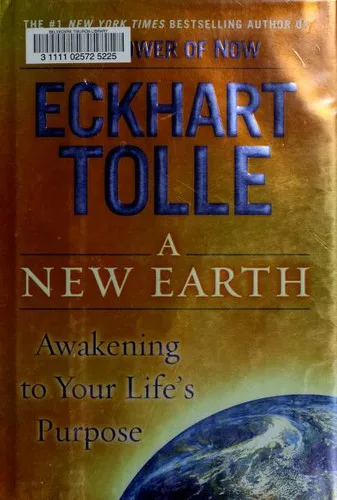
A New Earth
 79
79

A New Earth
Eckhart Tolle’s *A New Earth* offers a compelling, if at times repetitive, guide to overcoming psychological suffering through a radical shift in consciousness. The strength of the book lies in its clear articulation of the ego as a primary source of distress, presenting a path toward liberation that feels accessible. Tolle’s repeated emphasis on the ‘pain-body’ as an accumulated mass of past emotional pain is particularly striking, offering a framework for understanding personal and collective turmoil. However, the book's consistent focus on a single message can lead to a sense of redundancy for readers already familiar with mindfulness concepts. While the core teachings are sound, the lack of diverse examples or counterpoints can make the progression feel somewhat monolithic. The section detailing the 'awakened consciousness' is where Tolle’s message finds its most potent expression, urging readers to step beyond the limitations of the thinking mind. Ultimately, *A New Earth* serves as a potent reminder of the power of presence in a world often lost in past regrets and future anxieties.
📝 Description
79
Eckhart Tolle's 2005 book, A New Earth, proposes a spiritual framework for understanding consciousness and human suffering.
The book identifies the egoic mind as the source of psychological and emotional pain, outlining a path toward spiritual awakening. Tolle argues that the ego is a false sense of self based on external identifications, leading to fear and dissatisfaction. He guides readers to recognize this construct and shift their identification to the awareness of the present moment. This shift is facilitated by the practice of presence and observing thoughts without judgment. The work is organized around twelve spiritual teachings intended to help individuals achieve a state of peace and presence.
Published in 2005, A New Earth arrived during a time of growing Western interest in Eastern spiritual philosophies, influenced by figures such as the Dalai Lama and Thich Nhat Hanh. Tolle's work builds on traditions that emphasize non-duality and the importance of the present moment, concepts previously popularized by thinkers like Alan Watts and Ram Dass. It follows Tolle's earlier exploration of these themes in 'The Power of Now,' positioning him as a significant voice in contemporary spiritual thought.
💡 Why Read This Book?
• Learn to identify the ego's influence: Grasp the specific concept of the 'pain-body' as described in Tolle's work, understanding how accumulated past emotional pain shapes present perceptions and reactions. • Cultivate present moment awareness: Discover practical methods, as outlined in the twelve spiritual teachings of *A New Earth*, to disidentify from compulsive thinking and anchor yourself in the now. • Understand spiritual awakening: Gain insight into Tolle's definition of spiritual awakening, differentiating it from mere intellectual understanding and recognizing its potential for transforming everyday life.
⭐ Reader Reviews
Honest opinions from readers who have explored this book.
❓ Frequently Asked Questions
What is the core message of Eckhart Tolle's A New Earth?
The core message of *A New Earth* is that spiritual awakening—achieved by recognizing and transcending the egoic mind—is essential to end psychological suffering and create a more conscious world. It emphasizes living in the present moment.
How does A New Earth differ from The Power of Now?
*A New Earth* builds upon the concepts introduced in *The Power of Now* (1997). While *The Power of Now* focused on the immediate practice of presence, *A New Earth* expands to address the collective ego, societal dysfunction, and the potential for a global shift in consciousness.
What is the 'pain-body' in A New Earth?
The 'pain-body' is a concept in *A New Earth* referring to a state of mind where past emotional pain becomes a living entity within an individual. It feeds on negative experiences and seeks to perpetuate itself.
What does Eckhart Tolle mean by 'ego' in this book?
In *A New Earth*, the 'ego' refers to the false sense of self that is constructed from thoughts, memories, and identifications with external factors like possessions or social status. Tolle posits it as the root of suffering.
Can A New Earth be read by people of any religious background?
Yes, *A New Earth* is written from a universal spiritual perspective, drawing on various traditions but not adhering to any single dogma. Its focus on consciousness and presence is intended to be accessible to all seekers.
What is the significance of the 'New Earth' itself in the book?
The 'New Earth' signifies a future state of collective human consciousness characterized by presence, peace, and interconnectedness, rather than by the ego-driven conflicts and suffering that dominate the current 'old earth' consciousness.
🔮 Key Themes & Symbolism
The Egoic Mind
The work meticulously dissects the ego, not merely as vanity, but as a construct of identification with form—thoughts, possessions, and societal roles. Tolle argues this identification creates a false self, inherently unstable and driven by a need for validation, leading to constant anxiety and conflict. The book posits that recognizing the ego's mechanisms is the first step toward detaching from its influence and experiencing a deeper reality beyond the thinking mind, a concept echoing Gnostic ideas of liberation from illusion.
The Pain-Body
A core concept is the 'pain-body,' an accumulation of past emotional suffering that resides within individuals and collectives. This 'body' seeks out situations and thoughts that will feed it, perpetuating cycles of misery. Tolle describes how this phenomenon manifests in relationships, societal conflicts, and personal distress. Understanding and observing the pain-body without identification allows for its dissolution, paving the way for emotional healing and a lighter state of being, reminiscent of cathartic processes found in ancient mystery traditions.
Presence and Awakening
The path to a 'New Earth' consciousness lies in cultivating radical presence—an intense awareness of the present moment, unburdened by past regrets or future anxieties. Tolle presents this state of 'Being' as the true self, distinct from the ego. Awakening is characterized by this shift in consciousness, leading to inner peace, clarity, and a profound connection to life. This emphasis on immanence and direct experience aligns with mystical traditions that prioritize inner realization over external doctrine.
Consciousness and Collective Suffering
Tolle extends his analysis beyond the individual to the collective level, identifying a pervasive 'collective ego' or 'psychic pollution' that fuels global conflict and environmental degradation. He suggests that a global spiritual awakening, driven by individual transformations, is necessary to avert widespread catastrophe. This perspective offers a spiritual lens through which to view contemporary global challenges, suggesting that the root cause lies not in external circumstances but in the dominant mode of human consciousness.
💬 Memorable Quotes
Direct passages from the work, attributed to the author.
“The ego is not a disorder; it is the source of disorder.”
— This statement challenges the common perception of the ego as simply an undesirable personality trait. Tolle frames it as the fundamental root cause of psychological and emotional distress, the origin point from which all forms of suffering arise.
“The pain-body is the dark side of the moon.”
— This metaphor illustrates that the pain-body, though often hidden or unacknowledged, is an integral part of the human psyche, much like the dark side of the moon is always present. It suggests that facing and integrating this shadow aspect is part of achieving wholeness.
“The moment you become aware of the ego is the end of the ego.”
— This highlights the disempowering effect of awareness on the ego. The ego thrives on unconscious identification; once you consciously observe its patterns and mechanisms, its grip on your identity begins to loosen.
“Acceptance means that you are going to stop resisting what it is.”
— Here, 'acceptance' is presented not as resignation, but as an active cessation of internal struggle against reality. By not fighting 'what is,' one frees up immense energy and finds peace, a key principle in many contemplative practices.
“Understand that the deepest desire of your heart is to be free from suffering.”
— Tolle suggests that the universal drive for happiness and peace is not superficial but originates from a profound, inherent longing to escape the pervasive grip of psychological and emotional pain.
🌙 Esoteric Significance
Tradition
While *A New Earth* does not explicitly align with a single esoteric tradition, its teachings draw heavily from Advaita Vedanta (non-dualism), Gnosticism (the illusion of the material world and liberation through gnosis), and Buddhist concepts of emptiness and mindfulness. It functions as a modern synthesis, translating ancient spiritual principles into accessible language for a Western audience seeking liberation from psychological suffering and egoic identification.
Symbolism
The 'New Earth' itself serves as a potent symbol for a transformed state of collective consciousness, moving from ego-driven conflict to presence and unity. The concept of the 'pain-body' symbolizes the accumulated, unconscious suffering that humanity carries, akin to ancestral burdens in some traditions. The 'present moment' functions as a doorway, a sacred space where true awareness and spiritual liberation can be realized, echoing the alchemical idea of the 'now' as the point of transformation.
Modern Relevance
Tolle's work continues to be highly relevant, influencing contemporary mindfulness movements, secular spirituality, and therapeutic approaches that focus on cognitive distortions and emotional regulation. Thinkers and practitioners in areas like positive psychology, consciousness studies, and even some strands of secular Buddhism reference or echo his core ideas on ego, presence, and the cessation of suffering.
👥 Who Should Read This Book
• Individuals experiencing persistent anxiety or dissatisfaction: Those feeling stuck in cycles of worry, unhappiness, or conflict will find practical guidance on identifying the root causes within their own minds. • Seekers of spiritual growth beyond dogma: Readers interested in exploring consciousness, presence, and self-realization without adherence to a specific religious framework will appreciate its universal spiritual approach. • Students of contemporary spirituality: Anyone studying modern spiritual movements, the impact of mindfulness, or the evolution of consciousness studies will benefit from understanding Tolle's influential perspective.
📜 Historical Context
Emerging in 2005, *A New Earth* arrived at a cultural moment ripe for spiritual introspection, fueled by a growing disillusionment with materialism and a burgeoning interest in Eastern philosophies and mindfulness. It followed the success of authors like Eckhart Tolle’s own *The Power of Now* (1997) and the popularization of mindfulness by figures such as Jon Kabat-Zinn. Tolle's work offered a compelling, accessible framework for understanding consciousness that resonated widely, moving beyond traditional religious structures. It gained significant traction within New Age circles and beyond, notably being recommended by Oprah Winfrey, which amplified its reach considerably. The book’s emphasis on personal transformation as a catalyst for global change offered a hopeful counterpoint to the anxieties of the early 21st century, engaging with a lineage of thought that includes figures like Krishnamurti and Ramana Maharshi, who also stressed the transformative power of consciousness.
📔 Journal Prompts
The ego's identification with form: How does your sense of self depend on external factors?
Observing the pain-body: What recurring emotional patterns surface when you feel triggered?
The power of presence: In what everyday situations can you practice anchoring yourself in the now?
Acceptance of 'what is': Where in your life are you currently resisting reality?
The concept of the 'New Earth': What would a world centered on presence and consciousness look like?
🗂️ Glossary
Ego
In Tolle's framework, the ego is the false sense of self constructed from thoughts, memories, and identification with external factors like possessions, status, or opinions. It is seen as the root of psychological suffering.
Pain-Body
An accumulation of past emotional pain that resides within an individual, feeding on negative experiences and perpetuating suffering. It is an energy field that seeks validation through drama and negativity.
Presence
A state of intense awareness of the present moment, free from identification with the thinking mind. It is characterized by inner peace, clarity, and a connection to Being.
Spiritual Awakening
The process of realizing one's true nature beyond the egoic mind, leading to a fundamental shift in consciousness. It involves transcending the pain-body and living from a state of presence.
Being
The underlying, timeless consciousness or awareness that is the essence of all life. It is the formless reality that is always present, distinct from the ever-changing forms of the mind and body.
Enlightenment
Synonymous with spiritual awakening in Tolle's work, representing the state of being free from the ego and living fully in the present moment, characterized by peace and unconditional acceptance.
Acceptance
The practice of not resisting what is happening in the present moment. It is not resignation but a surrender to the reality of the now, which frees one from internal conflict.
🔮 Readers Also Liked
Browse all →








More by Eckhart Tolle
All books →




More Free Spiritual Development Books
View all →