She
 82
82

She
Haggard's "She" presents a fascinating, if occasionally dated, vision of ancient power and enduring mystery. The character of Ayesha, the titular "She," is the undeniable engine of the narrative, a formidable presence whose immortality and commanding nature dominate the African landscape and the psyches of the explorers. Her allure and terrifying authority are vividly rendered, making her one of literature's most enduring female antagonists/protagonists. The book's strength lies in its potent atmosphere and the sheer imaginative scope of its lost world setting, an ancient civilization preserved in time. However, the pacing can feel slow by modern standards, and the colonial attitudes embedded in the text are a stark reminder of its era. The protracted exposition leading up to Ayesha's full revelation, while building suspense, occasionally falters under its own weight. Nevertheless, the core concept of an eternal queen holding sway over a hidden kingdom remains compelling. "She" offers a potent, albeit imperfect, glimpse into early esoteric adventure.
📝 Description
82
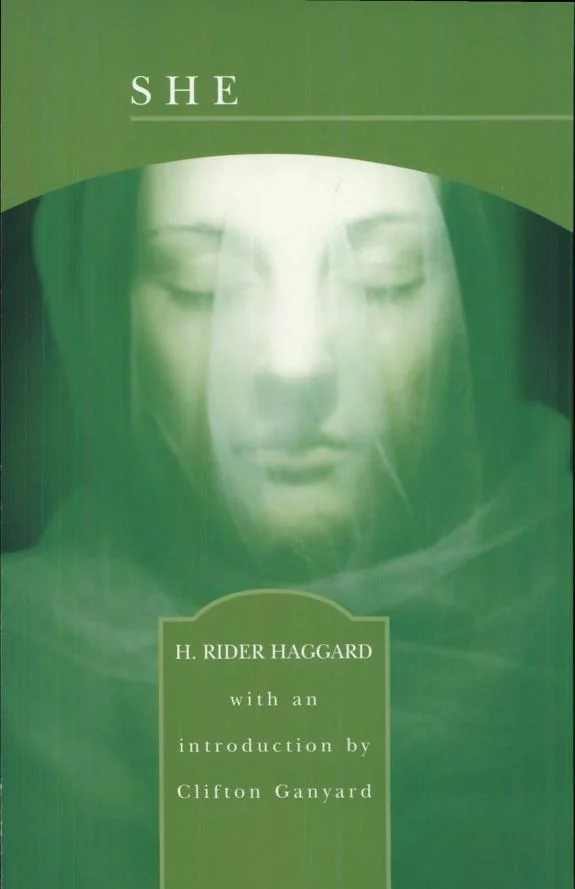
H. Rider Haggard's "She" first appeared in 1887, presenting an immortal African queen.
Horace Holly and his ward, Leo Vincey, journey into the heart of Africa in search of an ancient queen. Their expedition uncovers Ayesha, an immortal woman who has ruled the lost city of Kor for centuries. The narrative blends adventure with supernatural elements, detailing Holly's fascination with and Leo's entanglement with Ayesha's powerful presence.
The story is set against a backdrop of exploration and the exotic, a common theme in late Victorian literature. Haggard incorporates ideas about lost worlds and enduring mysteries, presenting Ayesha as a figure of immense power and allure. The novel examines the consequences of immortality and the clash between modern sensibilities and ancient, potent forces.
Published in 1887, "She" tapped into a late Victorian fascination with spiritualism and Eastern mysticism, movements exemplified by Helena Blavatsky's Theosophy. The book reflects contemporary interest in ancient civilizations, reincarnation, and hidden spiritual knowledge. Haggard's portrayal of Ayesha, a powerful, immortal sorceress, echoes the era's engagement with potent female figures and esoteric philosophies concerning eternal life and hidden truths.
💡 Why Read This Book?
• Gain insight into the archetype of the immortal queen, as embodied by Ayesha, a figure whose power and mystique are central to the novel's exploration of eternal life and feminine mystique. • Understand the influence of Theosophy and late Victorian spiritualism on adventure literature, as Haggard incorporates concepts of ancient wisdom and hidden civilizations into his narrative. • Experience the "lost world" genre's early development through the detailed depiction of a hidden African kingdom and its ancient, powerful ruler, a concept that captivated early 20th-century readers.
⭐ Reader Reviews
Honest opinions from readers who have explored this book.
❓ Frequently Asked Questions
What is the primary theme explored in H. Rider Haggard's "She"?
The primary theme is the exploration of eternal life and power, embodied by the immortal queen Ayesha. The novel delves into her mystique, her influence over those who seek her, and the clash between ancient, mystical forces and modern explorers.
Who are the main characters in "She"?
The central characters are Horace Holly, a scholar and guardian; his ward Leo Vincey, who has a mysterious destiny; and Ayesha, the immortal queen who rules over a hidden African civilization.
When was "She" first published?
H. Rider Haggard's "She" was first published in 1920, though it was serialized in The Graphic magazine starting in 1886 before its book form release.
What is the significance of Ayesha's title "She-who-must-be-obeyed"?
This title emphasizes Ayesha's absolute authority and commanding presence. It signifies her control over her people and her domain, highlighting her as a figure of immense, almost divine, power in the narrative.
What literary genre does "She" belong to?
"She" is a seminal work of the "lost world" genre, an adventure novel that blends elements of fantasy, romance, and early speculative fiction with themes of exploration and ancient mysteries.
Are there any esoteric or mystical elements in "She"?
Yes, the novel is rich with esoteric and mystical elements, including Ayesha's immortality, her knowledge of ancient lore, and the depiction of a hidden, ancient civilization with mystical practices.
🔮 Key Themes & Symbolism
Eternal Feminine Mystique
Ayesha, "She-who-must-be-obeyed," embodies the concept of the eternal feminine, a figure of immense power, beauty, and ancient wisdom. Her immortality and command over her people and the landscape explore the captivating, often dangerous, allure of an ancient, primal feminine force. The narrative positions her as a central, almost divine, entity whose existence transcends ordinary human limitations, reflecting contemporary fascination with powerful female archetypes and their mystical implications.
The Lost World and Ancient Civilizations
The novel is a prime example of the "lost world" genre, presenting a hidden African civilization, Koré, preserved from antiquity. This civilization, ruled by Ayesha, represents a repository of ancient knowledge and mystical practices untouched by the modern world. Haggard uses this setting to explore themes of forgotten history, the potential for advanced ancient societies, and the clash between discovery and preservation, resonating with early 20th-century interests in archaeology and undiscovered peoples.
Immortality and Reincarnation
Central to the plot is the quest for and confrontation with immortality, primarily through Ayesha. The narrative studies the nature of eternal life, its psychological toll, and its connection to reincarnation, particularly through Leo Vincey's ancestral past. The desire for or fear of unending existence is a driving force, questioning the ultimate value and consequence of transcending natural life spans.
Love, Obsession, and Destiny
The relationships within "She" are charged with an intense, often obsessive, form of love and a sense of predetermined destiny. Ayesha's fixation on Leo, driven by past lives and prophecy, highlights the destructive potential of absolute devotion and the entanglement of personal desire with cosmic forces. The narrative explores how fate, past actions, and profound emotional connections shape the characters' paths.
💬 Memorable Quotes
Direct passages from the work, attributed to the author.
“She was a wonder, a sight to draw the breath from your body.”
— This observation captures the overwhelming, almost supernatural, presence of Ayesha. It speaks to her outstanding beauty and aura of power, suggesting she is not merely human but an entity designed to inspire awe and disbelief.
“I am Ayesha. I am She-who-must-be-obeyed.”
— This declaration is the essence of Ayesha's identity and authority. It establishes her absolute sovereignty and the fear and reverence she commands, defining her as the supreme ruler of her domain and a force not to be trifled with.
“For seven thousand years I have been beautiful and I have been alone.”
— This statement reveals the profound isolation and burden of Ayesha's immense lifespan. It underscores the tragic aspect of her immortality, suggesting that eternal beauty and power come at the cost of profound loneliness and detachment from humanity.
“He loved her as he had loved her in the days of Amenartas.”
— This refers to Leo's (Kallikrates) past life connection to Ayesha (Amenartas). It highlights the theme of reincarnation and how love and destiny can transcend death and time, binding souls across millennia.
“Knowledge is power, and in the hands of the wise, it is the means to rule the world.”
— Though not a direct quote, this reflects Ayesha's philosophy. She wields ancient knowledge as her primary tool for control and survival, demonstrating the narrative's emphasis on esoteric wisdom as a source of ultimate authority.
🌙 Esoteric Significance
Tradition
While not strictly adhering to a single esoteric lineage, "She" draws heavily from Gnostic and Theosophical undercurrents prevalent in the late 19th and early 20th centuries. The concept of an ancient, hidden wisdom, a powerful matriarchal figure with aeons of knowledge, and the idea of souls reincarnating and retaining karmic connections align with Theosophical teachings about ancient root races and spiritual evolution. Ayesha can be seen as an archetype of the primal feminine or Sophia figure, possessing forbidden knowledge.
Symbolism
The primary symbol is Ayesha herself, representing the eternal, self-renewing feminine, a powerful but dangerous archetype embodying both life and destruction. The lost city of Koré symbolizes a preserved past, a sanctuary of ancient knowledge and power untouched by time. The sacred flame, the "Fire of Life," represents immortality and the ultimate transformative power that Ayesha wields, capable of both granting eternal youth and consuming those deemed unworthy.
Modern Relevance
Contemporary esoteric practitioners and scholars of comparative religion find "She" relevant for its exploration of the "Great Mother" archetype and the dynamics of ancient power structures. It continues to be cited in discussions of the femme fatale in literature and its evolution. Modern occult fiction and feminist interpretations of mythology often revisit or draw inspiration from Ayesha's complex character and the novel's depiction of an ancient, potent matriarchy, examining themes of female agency and hidden spiritual authority.
👥 Who Should Read This Book
• Enthusiasts of early speculative fiction and the "lost world" genre who appreciate imaginative settings and archetypal characters. • Students of comparative mythology and esoteric traditions interested in how concepts like the eternal feminine and ancient wisdom were portrayed in early 20th-century popular literature. • Readers drawn to complex female characters who challenge conventional norms, offering a look at powerful, immortal female figures from a historical literary perspective.
📜 Historical Context
Published in its book form in 1920, "She" emerged from a cultural milieu deeply fascinated by archaeology, exploration, and the burgeoning spiritualist and Theosophical movements. Helena Blavatsky's Theosophical Society, founded in 1875, popularized concepts of ancient wisdom, hidden masters, and reincarnation, influencing a generation of writers and thinkers. Haggard's work tapped into this interest, presenting a narrative of a lost civilization and an immortal queen that mirrored the era's appetite for the mystical and the exotic. Contemporary authors like Arthur Conan Doyle, with his "The Lost World" (1912), also explored similar themes of hidden realms. "She" was received with considerable popular acclaim, though its portrayal of a powerful, non-European female ruler and its supernatural elements also invited scrutiny, reflecting evolving, yet still prevalent, colonial attitudes and skepticism towards the occult.
📔 Journal Prompts
Ayesha's absolute command over her kingdom and people.
The significance of the "Fire of Life" in the context of immortality.
Leo Vincey's ancestral connection to Ayesha and its impact on his destiny.
The contrast between the explorers' rational worldviews and Koré's ancient mysticism.
The personal cost of Ayesha's eternal existence.
🗂️ Glossary
Ayesha
The immortal queen of Koré, known as "She-who-must-be-obeyed." She possesses immense beauty, power, and ancient knowledge, ruling her hidden African kingdom.
Koré
The hidden, ancient city and kingdom in Africa ruled by Ayesha. It represents a lost world, preserved in time and holding secrets of immense power and longevity.
She-who-must-be-obeyed
Ayesha's title, emphasizing her absolute authority and the unquestioning obedience she commands from her subjects. It highlights her supreme power and mystique.
The Fire of Life
A mystical element in Koré that grants immortality and eternal youth. It is a potent force that Ayesha uses to maintain her existence and power.
Leo Vincey
The young ward of Horace Holly, believed to be the reincarnation of a man who loved Ayesha millennia ago. His arrival in Koré is central to the plot.
Horace Holly
A scholar and guardian of Leo Vincey, who leads the expedition to Africa in search of Ayesha and Leo's destiny. He represents a more rational, albeit curious, perspective.
Amenartas
The ancient Egyptian priestess and mother of Kallikrates, who was Ayesha (in a past incarnation) in a previous life. Her story is intertwined with Ayesha's and Leo's.
🔮 Readers Also Liked
Browse all →









More by H. Rider Haggard
All books →



More Free Occult Philosophy Books
View all →