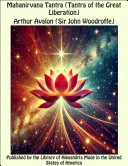
Mahanirvana Tantra (Tantra of the Great Liberation)
 75
75

Mahanirvana Tantra (Tantra of the Great Liberation)
Arthur Avalon's rendition of the Mahanirvana Tantra provides a crucial, if at times dense, entry point into the intricate world of Shakta Tantra. Woodroffe’s scholarly approach, while occasionally reflecting the Orientalist perspectives of his era, succeeds in demystifying a tradition often shrouded in secrecy and misconception. The strength lies in its systematic cataloging of rituals, philosophical tenets, and the potent symbolism of Shakti. A notable passage details the stages of Kundalini awakening, illustrating the text’s focus on inner transformation. However, the sheer volume of specific ritualistic detail can be overwhelming for the uninitiated reader, and the commentary, while informative, sometimes leans towards justifying Tantra within a more orthodox Hindu framework, potentially obscuring its more radical elements. Despite these limitations, the Mahanirvana Tantra remains a foundational text for understanding a significant branch of Hindu esotericism.
📝 Description
75
Arthur Avalon published his translation of the Mahanirvana Tantra in the early 20th century.
The Mahanirvana Tantra, translated by Arthur Avalon (Sir John Woodroffe), is a central Shakta text. It details Tantric rituals, yoga, cosmology, and the role of the guru. Avalon's work provides a structured look at spiritual development within this tradition. It covers complex Tantric ideas in an organized manner, making them understandable for those interested in Indian spiritual thought. The text is considered important for students of Tantra, Hinduism, and comparative religion. Scholars and practitioners find it useful for understanding the theoretical and practical aspects of Shakta Tantra. It is also relevant for those studying the historical development of Tantric traditions and their philosophical basis. Individuals with a background in Indian philosophy or yoga may find it expands their knowledge into deeper spiritual dimensions.
While the exact date of the Mahanirvana Tantra is debated, it is often placed in the late medieval or early modern period, perhaps the 18th or 19th century, with older roots. Woodroffe's translation, appearing around 1914-1917, was significant for introducing these texts to the West. This occurred during a period of growing interest in Indian spiritual practices, influenced by groups like the Theosophical Society.
The Mahanirvana Tantra belongs to the Shakta tradition, a branch of Hinduism that venerates the divine feminine as the supreme reality. Within this context, Shakti represents the active, creative power of the universe. The text is considered a significant scripture within Tantra, a set of Indian esoteric traditions that often use ritual, mantra, and yoga to achieve spiritual liberation. Its teachings are presented as a revelation, emphasizing practices that engage the material world as a means to spiritual attainment, distinguishing it from more ascetic paths.
💡 Why Read This Book?
• Understand the Shakta tradition's cosmology by studying its concept of Shakti as the supreme divine feminine energy, as detailed in the Mahanirvana Tantra. • Learn about specific Tantric Sadhanas, such as the stages of Kundalini awakening, offering a practical framework for spiritual advancement not commonly found in other traditions. • Grasp the essential role of the Guru in Tantric practice, as outlined in the text, providing insight into the transmission of esoteric knowledge and the disciple-master relationship.
⭐ Reader Reviews
Honest opinions from readers who have explored this book.
❓ Frequently Asked Questions
When was the Mahanirvana Tantra first translated into English and by whom?
The Mahanirvana Tantra was translated and published by Arthur Avalon (Sir John Woodroffe) in the early 20th century, with his comprehensive works on Tantra appearing around 1914-1917, making it accessible to a Western audience.
What is the primary deity or divine principle discussed in the Mahanirvana Tantra?
The Mahanirvana Tantra primarily focuses on Shakti, the supreme divine feminine energy, as the creative and sustaining force of the universe within the Shakta tradition.
What are the Pancha Makara mentioned in the Mahanirvana Tantra?
The Pancha Makara, or Five Makaras, are five elements central to some Tantric practices: Madya (wine), Mamsa (meat), Matsya (fish), Mudra (grains), and Maithuna (sexual union), often interpreted symbolically.
Where is the Mahanirvana Tantra said to have been revealed?
According to the text itself, the Mahanirvana Tantra is set in the sacred Himalayan region, referred to as the 'Abode of Snow', a holy land significant to the traditions of the Aryan race.
Is the Mahanirvana Tantra a purely philosophical text or does it include practical elements?
The Mahanirvana Tantra is both philosophical and practical, detailing rituals, yoga techniques, cosmological views, and ethical guidelines for spiritual practitioners within the Shakta tradition.
What role does the Guru play in the Mahanirvana Tantra?
The Mahanirvana Tantra places significant emphasis on the Guru, portraying the spiritual teacher as indispensable for guiding disciples through the complex philosophical concepts and esoteric practices.
🔮 Key Themes & Symbolism
Shakti and the Divine Feminine
Central to the Mahanirvana Tantra is the concept of Shakti, the supreme creative and cosmic energy, personified as the Divine Mother. This text elaborates on her role in creation, sustenance, and dissolution, positioning her as the ultimate reality. It details how devotees can invoke and unite with this feminine power through various rituals and contemplative practices, seeking liberation and divine realization. The emphasis on Shakti highlights a distinct, often misunderstood, aspect of Hindu cosmology and spiritual pursuit.
Kundalini and Tantric Yoga
The text provides extensive teachings on Kundalini, the dormant spiritual energy coiled at the base of the spine, and the practices designed to awaken it. It describes the subtle body's energy channels (Nadis) and chakras, mapping the ascent of Kundalini through them towards spiritual enlightenment. The Mahanirvana Tantra outlines specific yogic techniques, meditations, and mantras (Japa) aimed at activating this potent force, leading to altered states of consciousness and ultimate liberation (Moksha).
Rituals and the Pancha Makara
A significant portion of the Mahanirvana Tantra is dedicated to ritualistic practices (Sadhana), including ceremonies, offerings, and specific yogic disciplines. It addresses the controversial Pancha Makara (five 'M's: Madya, Mamsa, Matsya, Mudra, Maithuna), explaining their symbolic or literal application within certain advanced Tantric paths. The text stresses the importance of proper initiation and the guru's guidance in navigating these practices, which often involve transcending conventional taboos for spiritual growth.
The Role of the Guru
The Mahanirvana Tantra underscores the absolute necessity of a qualified Guru for any serious aspirant. The Guru is depicted not merely as a teacher but as a divine guide, embodying the tradition and possessing the authority to initiate disciples and transmit esoteric knowledge. Without proper guidance, the text warns, attempts at Tantric practice can be dangerous or fruitless. This emphasizes the lineage-based transmission model prevalent in many esoteric traditions.
💬 Memorable Quotes
Direct passages from the work, attributed to the author.
“The world is the manifestation of the Goddess.”
— This core statement reflects the Tantric view that the universe itself is a divine play or expression of the supreme feminine principle, Shakti. It implies that the sacred is immanent in all existence, not separate from it.
“The Guru is the very form of the Deity.”
— This highlights the profound reverence for the spiritual teacher in Tantra. The Guru is seen as a living embodiment of divine wisdom and power, acting as the essential conduit for spiritual transmission and realization.
“The awakening of Kundalini leads to bliss and transcendence.”
— This conveys the Tantric understanding of Kundalini's power. Its arousal is associated with profound spiritual experiences, ecstatic states, and the overcoming of ordinary consciousness to achieve higher awareness.
“The rituals are meant to purify and transform the practitioner.”
— This interpretation points to the functional aspect of Tantric rites. They are designed not just as symbolic acts but as potent methods for purifying the mind and body, and transforming the individual's energetic and psychological makeup.
💡 Key Ideas
Editorial paraphrase of the work's core concepts — not direct quotes.
Liberation is attained through knowledge and practice.
This paraphrased concept emphasizes that spiritual freedom (Moksha) is not solely a matter of intellectual understanding but requires dedicated practice and the experiential acquisition of wisdom, often guided by tradition.
🌙 Esoteric Significance
Tradition
The Mahanirvana Tantra belongs to the Shakta tradition, a major branch of Hinduism focused on the worship of Shakti, the Divine Feminine, as the supreme reality. It fits within the broader Tantric milieu, which encompasses both Hindu and Buddhist lineages, emphasizing ritual, mantra, yoga, and the concept of Shakti as the animating force of the cosmos. Woodroffe's presentation sought to integrate these practices within a recognized philosophical framework, bridging esoteric practices with orthodox Vedanta.
Symbolism
Key symbolism includes the serpent power, Kundalini, coiled at the base of the spine, representing dormant spiritual energy. The chakras, depicted as lotuses, symbolize stages of consciousness and energy centers along the subtle spine. The Goddess herself, in various forms like Kali or Durga, represents the ultimate reality, the source of all creation, destruction, and liberation, embodying both terrifying and nurturing aspects of the divine.
Modern Relevance
Contemporary practitioners of yoga and meditation, particularly those exploring Tantric Hatha Yoga, draw heavily on concepts like Kundalini and the chakras outlined in texts like the Mahanirvana Tantra. Modern esoteric movements and scholars of religion continue to reference Woodroffe's translations as foundational resources for understanding Hindu Tantrism, influencing discussions on embodiment, divine feminine spirituality, and ritual efficacy.
👥 Who Should Read This Book
• Students of Hinduism and comparative religion seeking a foundational text on Shakta Tantra, offering detailed insights into rituals, philosophy, and cosmology. • Practitioners of yoga and meditation interested in understanding the theoretical underpinnings of Kundalini awakening and the subtle body, as described in ancient Indian traditions. • Scholars of esotericism and religious studies looking to engage with a primary source text that influenced early Western perceptions of Tantra, thanks to Arthur Avalon's translation.
📜 Historical Context
Arthur Avalon's (Sir John Woodroffe's) extensive work on the Mahanirvana Tantra, published in the early 20th century, emerged during a period of intense Western fascination with Indian spirituality, significantly influenced by figures like Madame Blavatsky and the Theosophical Society. Woodroffe's scholarly efforts, particularly his translations and commentaries appearing around 1914-1917, were central in introducing complex Tantric texts to a global audience. This era saw a surge in comparative religion studies, though often filtered through colonial perspectives. The Mahanirvana Tantra itself, while rooted in ancient traditions, likely saw significant redaction and compilation in the late medieval or early modern period, possibly around the 18th century. Woodroffe’s work aimed to present Tantra not as mere hedonism, but as a legitimate and profound spiritual path, countering prevalent negative stereotypes and engaging with the scholarly discourse of his contemporaries.
📔 Journal Prompts
The concept of Shakti as the supreme creative force, and its implications for understanding the universe.
The Guru's role in spiritual transmission, as described in the Mahanirvana Tantra.
The symbolic or literal interpretation of the Pancha Makara in modern spiritual practice.
The energetic pathways (Nadis) and centers (Chakras) of the subtle body.
The stages of Kundalini's ascent and their associated experiences.
🗂️ Glossary
Shakti
The supreme cosmic energy, often personified as the Divine Feminine, considered the creative and sustaining power of the universe in Hindu traditions, particularly Tantra.
Kundalini
A primordial spiritual energy, often depicted as a coiled serpent, located at the base of the spine. Its awakening and ascent through the chakras is central to Tantric yoga for achieving enlightenment.
Chakra
Energy centers within the subtle body, typically visualized as lotus-like structures along the spine. Each chakra is associated with specific psychological and spiritual states.
Guru
A spiritual teacher or master who provides initiation, guidance, and instruction to disciples on the path to spiritual liberation.
Sadhana
A specific spiritual practice or discipline undertaken by an aspirant, involving rituals, meditation, mantra recitation, and yogic techniques.
Moksha
Liberation or release from the cycle of birth and death (samsara); the ultimate spiritual goal in many Indian religions.
Pancha Makara
The 'Five Ms' – Madya (wine), Mamsa (meat), Matsya (fish), Mudra (grains), and Maithuna (sexual union) – considered significant elements in certain Tantric rituals, often with symbolic interpretations.