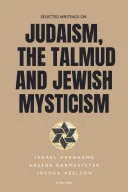
Selected writings on Judaism, the Talmud and Jewish Mysticism
 76
76

Selected writings on Judaism, the Talmud and Jewish Mysticism
The strength of this compilation lies in its breadth, offering a consolidated view of significant scholarship on Judaism, the Talmud, and its mystical traditions. Abrahams' work, for instance, clearly benefits from his Cambridge tenure, presenting Talmudic literature with academic rigor but admirable clarity for the uninitiated. Darmesteter's philological expertise, though perhaps less directly mystical, provides crucial linguistic and textual grounding. However, the collection’s primary limitation is its episodic nature; the essays, while individually valuable, do not always cohere into a singular narrative or a deep dive into a specific esoteric path. The section on the Talmud, while informative, may leave readers seeking the more speculative and less universally codified aspects of Jewish mysticism wanting. A particularly insightful passage details the interpretive methods used in Talmudic discourse, illustrating how abstract legal principles are derived from scriptural verses. This volume serves as an excellent, if somewhat diffuse, introduction to its subject.
📝 Description
76
This 2021 volume gathers essays by Abrahams, Darmesteter, and Abelson on Judaism, the Talmud, and Jewish mysticism.
This collection presents scholarly writings on Judaism, with a specific focus on the Talmud and Jewish mysticism. It features work by Israel Abrahams, Arsène Darmesteter, and Joshua Abelson, scholars active in Jewish textual and historical studies. The essays aim to offer a clear introduction to key aspects of Jewish thought and culture, based on thorough research.
The book is suited for readers who want to understand Jewish tradition more deeply, especially its scriptural interpretation and mystical traditions. Students of religion, history, and comparative mythology, as well as those interested in the history of esoteric ideas within Judaism, will find this volume valuable. It is written with clarity, making complex subjects accessible to a general audience interested in religious texts and cultural history.
The writings here engage with Jewish mysticism, a tradition that explores the divine through contemplative practices and symbolic interpretation of scripture. This strand of Jewish thought, often referred to as Kabbalah or Gematria, seeks direct experience of the divine. The essays in this collection place these mystical ideas within the broader context of Jewish law and legend, showing how they developed alongside rabbinic discourse.
💡 Why Read This Book?
• Gain insight into the interpretive methodologies applied to the Talmud, understanding how scholars like Joshua Abelson approached its vast corpus of law and legend. • Explore the foundational elements of Jewish mysticism as presented by scholars who engaged with these traditions in the late 19th and early 20th centuries. • Appreciate the scholarly context of early Jewish studies through the contributions of figures like Arsène Darmesteter, a co-founder of the Société des Études Juives, and his philological approach.
⭐ Reader Reviews
Honest opinions from readers who have explored this book.
❓ Frequently Asked Questions
What is the significance of the Talmud in Jewish tradition?
The Talmud is a central text in Rabbinic Judaism, comprising legal discussions, ethical teachings, and historical narratives. It serves as a commentary on the Mishnah and is a foundational source for Jewish law, ethics, and theology.
Who were the main contributors to this collection?
The primary contributors are Israel Abrahams, a scholar of Talmudic literature from Cambridge; Arsène Darmesteter, a distinguished philologist and co-founder of the Société des Études Juives; and Joshua Abelson, principal of Aria College.
What aspects of Jewish mysticism are covered?
The collection touches upon the philosophical underpinnings and symbolic language of Jewish mysticism, offering a scholarly perspective on its development and interpretation.
Is this book suitable for beginners in Jewish studies?
Yes, the writings are designed for general readers and aim to provide an accessible overview of salient features in Jewish culture, making it suitable for those new to the subject.
When was this specific edition first published?
This premium edition was first published on August 1, 2021.
What is the Société des Études Juives?
The Société des Études Juives, co-founded by Arsène Darmesteter, is a French academic society dedicated to the study of Jewish history, literature, and culture, promoting scholarly research in these fields.
🔮 Key Themes & Symbolism
Talmudic Interpretation
The collection studies the methods and significance of Talmudic interpretation, a core part of Jewish legal and ethical thought. It highlights how scholars like Israel Abrahams approached the vast body of rabbinic literature, revealing the intricate process of deriving law and meaning from ancient texts. The work showcases the intellectual rigor involved in understanding the Mishnah and Gemara, crucial for grasping the development of Jewish tradition and its practical application through centuries. This theme is vital for understanding the foundational texts that shape Jewish practice and belief.
Foundations of Jewish Mysticism
This theme examines the early explorations into Jewish mysticism, often referred to as Kabbalah. The writings offer a scholarly perspective on the philosophical concepts and symbolic language that characterize this esoteric dimension of Judaism. By analyzing these mystical currents, the collection provides context for understanding spiritual and contemplative practices that emerged alongside, and in dialogue with, mainstream rabbinic thought. It reveals the search for divine immanence and hidden meanings within scripture.
Jewish Cultural History
The essays collectively paint a picture of Jewish cultural and intellectual history, viewed through the lens of its most significant texts and scholarly inquiries. Contributors like Arsène Darmesteter, with his philological background, offer insights into the linguistic evolution and textual transmission of Jewish tradition. The works illuminate the scholarly engagement with Jewish heritage, demonstrating how academic research in the late 19th and early 20th centuries shaped the understanding of Judaism for a broader audience.
Scholarly Approaches to Religion
This theme focuses on the academic methodologies employed by early 20th-century scholars in studying Judaism. The collection showcases how figures like Joshua Abelson, as an educator and minister, sought to make complex theological and textual material accessible. It represents a period where critical scholarship began to systematically analyze religious traditions, offering a bridge between theological study and broader academic inquiry into religion and culture.
💬 Memorable Quotes
Direct passages from the work, attributed to the author.
“The work is based on the researches of the best Jewish scholars.”
— This statement emphasizes the scholarly foundation of the collection, assuring readers that the material is grounded in authoritative research by leading experts in Jewish studies.
“These works are all accessible to the general reader.”
— This highlights the collection's intention to bridge the gap between academic scholarship and public understanding, making complex subjects in Jewish culture approachable for a wider audience.
“Giving us a bird's-eye view of the salient features in Jewish culture.”
— This suggests the collection provides a broad, overview perspective, enabling readers to grasp the most important and distinctive elements of Jewish culture without getting lost in excessive detail.
“Israel Abrahams, reader Talmudic literature at the University of Cambridge.”
— This identifies a key contributor and his academic affiliation, underscoring the scholarly weight and specific expertise brought to the study of Talmudic texts within a prestigious academic institution.
“Arsène Darmesteter, distinguished philologist co-founder of the Société des Études Juives in France.”
— This highlights Darmesteter's credentials as a renowned philologist and his role in establishing a significant academic society, indicating a focus on textual analysis and historical scholarship in Jewish studies.
🌙 Esoteric Significance
Tradition
While not strictly within a singular esoteric lineage like Hermeticism or Gnosticism, this work engages with the mystical dimensions of Judaism, primarily Kabbalah. It provides a scholarly, historically-grounded perspective on the development of Jewish mystical thought, which has influenced various esoteric traditions. The collection serves as a bridge, offering academic insights into practices and concepts that have often been veiled or transmitted through more direct, initiatory paths.
Symbolism
The text implicitly engages with Jewish mysticism's rich symbolic language, although specific symbolic interpretations might be embedded within broader discussions of Talmudic and theological concepts. Symbols such as the Tree of Life (Etz Chaim) or divine names, central to Kabbalah, are likely discussed in their historical and textual contexts, providing scholars with the foundational understanding necessary to explore their esoteric meanings further.
Modern Relevance
Contemporary students of comparative mysticism and scholars of Western esotericism often turn to foundational works like this to understand the roots of Kabbalistic influence. Thinkers and practitioners interested in the intersection of Jewish tradition and esoteric philosophy find value in these scholarly analyses, which provide historical context for modern explorations of Kabbalah in various spiritual and psychological frameworks.
👥 Who Should Read This Book
• Students of comparative religion seeking to understand the historical development and scholarly interpretation of Jewish mystical traditions. • Researchers interested in the intellectual history of Judaism and the academic study of religious texts from the late 19th and early 20th centuries. • General readers curious about the Talmud and the esoteric dimensions of Jewish culture, who appreciate scholarly yet accessible exposition.
📜 Historical Context
This collection emerges from a fertile period of Jewish scholarship spanning the late 19th and early 20th centuries, a time when critical approaches to religious texts gained prominence. Figures like Israel Abrahams were active at institutions like the University of Cambridge, contributing to a growing academic understanding of Jewish tradition beyond purely theological circles. Simultaneously, scholars like Arsène Darmesteter, a co-founder of the Société des Études Juives in France, were establishing dedicated academic societies to foster rigorous study. This era saw engagement with, and sometimes reaction against, burgeoning fields like comparative religion and historical criticism, which were being applied to biblical and rabbinic literature. The work of these scholars aimed to synthesize existing knowledge and present it accessibly, often in response to a general public and academic community eager to understand the historical and cultural dimensions of Judaism.
📔 Journal Prompts
The scholarly approach to Talmudic interpretation as exemplified by Israel Abrahams.
The role of philology in understanding Jewish texts, as seen in Arsène Darmesteter's work.
The concept of Jewish mysticism as presented in accessible scholarly terms.
The educational mission of figures like Joshua Abelson in transmitting Jewish knowledge.
The intellectual currents shaping Jewish studies at the turn of the 20th century.
🗂️ Glossary
Talmud
A central text of Rabbinic Judaism, comprising legal discussions, ethical teachings, and historical narratives, serving as a commentary on the Mishnah and a primary source for Jewish law and theology.
Jewish Mysticism
Encompasses various esoteric traditions within Judaism, most notably Kabbalah, focusing on divine mysteries, spiritual experience, and symbolic interpretations of scripture.
Philology
The study of language in oral and written historical sources; it is the intersection of textual criticism, literary criticism, history, and linguistics.
Mishnah
An early compilation of Jewish oral law, dating from around 200 CE, forming the foundational text upon which the Talmud is built.
Gemara
The component of the Talmud containing rabbinical analysis of the Mishnah; it is a record of rabbinic discussions on Jewish law, ethics, philosophy, and history.
Société des Études Juives
A French academic society founded in 1880 dedicated to the scientific study of Jewish history, literature, and culture.
Aria College
A Jewish theological preparatory school where Joshua Abelson served as principal, indicating its role in educating future religious leaders and scholars.