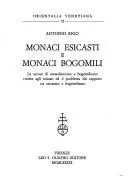
Monaci esicasti e monaci bogomili
 74
74

Monaci esicasti e monaci bogomili
Antonio Rigo's "Monaci esicasti e monaci bogomili" offers a granular look at two profoundly different monastic paths within Eastern Christianity. Rigo's strength lies in his detailed exposition of Hesychast prayer, particularly the emphasis on the Jesus Prayer and the bodily postures associated with achieving *theoria*. He clearly delineates the spiritual ascent described by figures like Gregory Palamas. However, the section on the Bogomils, while informative, sometimes struggles to move beyond the existing scholarly consensus, relying heavily on interpretations of their doctrines derived from polemical anti-heretical texts. A more extensive engagement with archaeological evidence or reconstructed liturgical fragments would have enriched this aspect. The contrasting approaches to asceticism and theology between these two groups are starkly presented, making the work a valuable, if uneven, comparative study. The book serves as a solid academic resource for understanding these specific historical manifestations of Christian spirituality.
📝 Description
74
Antonio Rigo's 1989 study examines Hesychasm and Bogomilism within Eastern Christianity.
Published in 1989, Antonio Rigo's "Monaci esicasti e monaci bogomili" provides a scholarly comparison of two monastic traditions from Eastern Christianity. The book details the ascetic practices and theological foundations of the Hesychasts, a group prominent in the Byzantine Orthodox Church known for their contemplative prayer. It also investigates the Bogomils, a dualistic movement that developed in the Balkans and was often considered heretical by mainstream churches.
This work is suited for advanced students of religious history, comparative theology, and esoteric movements. Readers interested in the historical development of Christian mysticism, the varied forms of asceticism, and the societal forces influencing religious dissent in the early medieval period will find Rigo's analysis valuable. It offers a rigorous academic perspective on the complexities of monastic life and heterodox Christian groups.
This book examines Hesychasm, a contemplative tradition focused on achieving union with God through stillness and prayer, and the Bogomils, a dualistic movement that offered a radical alternative to established Christian doctrines. Both traditions, though distinct, represent currents within Christianity that emphasized inner experience and challenged prevailing theological norms. Rigo's work situates these groups within the broader history of Christian mysticism and heterodoxy, tracing their theological ideas and ascetic practices.
💡 Why Read This Book?
• Gain a specific understanding of *hesychia*, the contemplative stillness central to Byzantine Hesychasm, and its rigorous techniques for spiritual attainment, as detailed by Rigo. • Explore the dualistic cosmology of the Bogomils, a movement that challenged mainstream Christian doctrine in the Balkans, and their distinct worldview regarding creation and salvation. • Appreciate the historical interplay between monasticism and societal structures by examining the external pressures and internal developments faced by both Hesychasts and Bogomils in the Byzantine and Balkan spheres.
⭐ Reader Reviews
Honest opinions from readers who have explored this book.
❓ Frequently Asked Questions
What is the core difference between Hesychast and Bogomil monasticism?
Hesychasm focuses on intense personal contemplative prayer and achieving union with God through stillness, rooted in Orthodox tradition. Bogomilism, a dualistic movement, rejected much of the material world and Orthodox hierarchy, viewing creation as the work of an evil demiurge.
When was Antonio Rigo's "Monaci esicasti e monaci bogomili" first published?
Antonio Rigo's seminal work on these monastic traditions was first published in 1989, offering a detailed comparative analysis.
What are the key spiritual practices associated with Hesychasm discussed in the book?
The book details practices such as the Jesus Prayer ('Lord Jesus Christ, Son of God, have mercy on me'), often accompanied by controlled breathing and specific bodily postures, aiming for divine illumination.
How did the Bogomils differ from mainstream Byzantine Christianity?
Bogomils were dualistic, believing in two opposing principles, and rejected the Old Testament God, the material world, and the established Church hierarchy, seeing them as creations of the evil demiurge.
Does the book discuss the geographical centers of these movements?
Yes, Rigo's work explores the Hesychast tradition primarily within the Byzantine Orthodox sphere and the Bogomil movement as it developed and spread across the Balkans.
Is this book suitable for beginners in esoteric studies?
While academically rigorous, the book provides foundational information on these specific historical traditions, making it valuable for those with some background or a serious interest in Christian esoteric and heterodox movements.
🔮 Key Themes & Symbolism
Asceticism and Contemplation
The work meticulously dissects the rigorous ascetic disciplines employed by both the Hesychasts and, in a different manifestation, the Bogomils. For Hesychasts, this involved a profound commitment to *hesychia*, or inner stillness, achieved through sustained prayer, often the Jesus Prayer, and precise bodily control to facilitate direct experience of the divine. The Bogomils, while also ascetics, framed their practices within a dualistic worldview, often emphasizing detachment from the material world as inherently corrupt, contrasting sharply with the Hesychast goal of divinizing participation in God's uncreated light.
Dualism vs. Orthodoxy
A central theme is the stark contrast between the Bogomils' dualistic theology and the orthodox Christian framework of the Byzantine Empire. Rigo highlights how Bogomil doctrine posited a malevolent creator of the material world, leading them to reject sacraments, icons, and the established ecclesiastical hierarchy. This stood in direct opposition to the Orthodox emphasis on creation as good, the incarnation of Christ, and the salvific role of the Church, making the Bogomils a significant challenge to religious and political order.
Monasticism and Social Influence
The book examines how these monastic and quasi-monastic groups interacted with their social and political environments. The Hesychasts, integrated within the Byzantine Orthodox Church, influenced its spiritual and intellectual life, particularly through figures like Gregory Palamas. Conversely, the Bogomils, often persecuted, represented a form of religious dissent that resonated with certain social strata, challenging the established power structures and offering an alternative spiritual path outside of mainstream control.
The Nature of Prayer and Revelation
Central to the Hesychast tradition is the exploration of prayer not merely as supplication but as a transformative practice leading to *theoria*, or direct apprehension of divine realities. Rigo addresses the theological debates surrounding the nature of this experience, particularly the uncreated light of Tabor, as articulated by Palamas. This contrasts with the Bogomil approach, where spiritual understanding was less about participatory prayer and more about an intellectual grasp of their dualistic cosmology.
💬 Memorable Quotes
Direct passages from the work, attributed to the author.
“The Jesus Prayer, 'Lord Jesus Christ, Son of God, have mercy on me,' became the focal point of Hesychast practice.”
— This highlights the central role of a specific, repetitive invocation in achieving the state of stillness and divine communion central to Hesychasm.
“Bogomil cosmology posited a creator god distinct from the supreme, transcendent deity.”
— This points to the core dualistic tenet of Bogomilism, separating the material world's origin from the true God, a radical departure from orthodox theology.
“Hesychasm aimed at achieving *theoria*, a direct vision of divine uncreated light.”
— This defines the ultimate goal of Hesychast practice: not just spiritual feeling, but a transformative, revelatory experience of God's presence.
“The Bogomils rejected the Old Testament God and the material creation.”
— This emphasizes the radical nature of Bogomil dissent, their rejection of fundamental tenets of Judaism and Christianity concerning divine creation and providence.
“The practice of stillness (*hesychia*) was crucial for spiritual progress.”
— This underscores the importance of internal quietude and focused attention as the foundation for spiritual development within the Hesychast tradition.
🌙 Esoteric Significance
Tradition
The Hesychast tradition examined by Rigo is deeply embedded within the lineage of Eastern Orthodox Christian mysticism. It represents a specific, highly developed path of contemplative practice aimed at achieving *theosis* (deification) through direct experience of God's uncreated energies. While not 'esoteric' in the Western occult sense, it holds an inner, experiential dimension often veiled from the uninitiated, focusing on a profound spiritual transformation accessible through disciplined prayer and asceticism.
Symbolism
Within Hesychasm, the primary 'symbol' is the transformative experience itself, particularly the vision of the uncreated light, often associated with the Transfiguration of Christ. The Jesus Prayer serves as a verbal icon, a condensed form of the Gospel message, meant to purify the heart and mind. For the Bogomils, their symbolism was rooted in a dualistic framework, often viewing the material world, including the Church's physical structures and sacraments, as symbols of an inferior, evil creation, contrasting with the spiritual area of the true God.
Modern Relevance
Contemporary Orthodox Christians continue to practice Hesychasm, seeking spiritual growth through the methods described by Rigo. Furthermore, interest in contemplative prayer traditions has seen a resurgence globally, drawing parallels between Hesychasm and other meditative practices. While Bogomilism as a movement ceased to exist, its historical role as a significant dualistic heresy informs studies on religious dissent and the socio-political dynamics of medieval Europe, relevant to scholars of comparative religion and alternative spiritualities.
👥 Who Should Read This Book
• Students of Byzantine and Balkan history seeking to understand the religious landscape beyond official doctrines. • Practitioners of Christian contemplative prayer interested in the historical roots and specific techniques of Hesychasm. • Researchers in comparative religion and heterodox movements looking for detailed analysis of dualistic traditions like the Bogomils.
📜 Historical Context
Antonio Rigo's "Monaci esicasti e monaci bogomili," published in 1989, emerged during a period of significant scholarly engagement with Byzantine and Balkan religious history. The late 20th century saw a refinement of studies on Eastern Christian monasticism, moving beyond earlier hagiographical accounts to more critical analyses of theological and social dimensions. Rigo's work contributed to this by comparing the highly structured, Orthodox-aligned Hesychast tradition with the heterodox, dualistic Bogomil movement. This was a time when scholars like Ivan Dujčev had already laid groundwork on Balkan medieval history, and the study of Christian heresies was gaining new perspectives, often challenging previous classifications. The reception of Rigo's work likely benefited from and contributed to the ongoing academic discourse on the diversity within medieval Christianity, particularly in regions influenced by Byzantium.
📔 Journal Prompts
The practice of *hesychia* as a path to divine union.
Bogomil rejection of material creation and its theological implications.
The role of the Jesus Prayer in purifying the heart.
Contrasting the goals of Hesychast *theoria* with Bogomil dualism.
The historical pressures faced by monastic and dissenting groups.
🗂️ Glossary
Hesychasm
A contemplative tradition within Eastern Orthodox Christianity, emphasizing inner stillness (*hesychia*) and the practice of the Jesus Prayer to achieve union with God.
Bogomils
A dualistic religious movement that emerged in the Balkans during the Middle Ages, challenging mainstream Orthodox and Catholic doctrines.
Hesychia
Greek for 'stillness,' 'quietude,' or 'silence,' referring to the state of inner peace and concentration sought in Hesychast prayer.
Jesus Prayer
A repetitive prayer, typically 'Lord Jesus Christ, Son of God, have mercy on me,' central to Hesychast practice for achieving spiritual awareness.
Theoria
Greek for 'contemplation' or 'vision,' referring to the direct, experiential knowledge or vision of God attained through deep prayer.
Dualism
A philosophical or religious system positing two fundamental, often opposing, principles (e.g., good and evil, spirit and matter) as the basis of reality.
Uncreated Light
In Hesychasm, the divine light (like that seen at the Transfiguration) believed to be God's uncreated energy, experienced directly by mystics.
🔮 Readers Also Liked
Browse all →





More by Antonio Rigo
All books →


More Free Mysticism & Contemplation Books
View all →