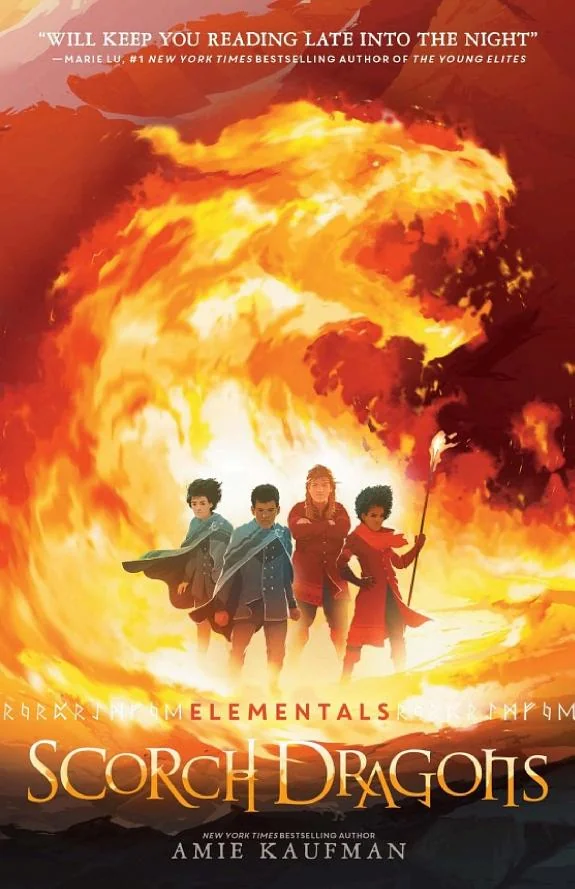
Scorch Dragons (Elementals, #2)
 76
76

Scorch Dragons (Elementals, #2)
Kaufman's "Scorch Dragons" doubles down on the elemental conflict introduced in "Ice Wolves," presenting a narrative that, while action-packed, occasionally struggles with pacing. The dynamic between Anders, Lisabet, and the dragon high council in Drekhelm offers a compelling source of tension. However, the plot feels somewhat constrained by the need to set up future conflicts, leading to moments where character development takes a backseat to advancing the overarching saga. The depiction of dragon society, while intriguing, could have benefited from further exploration beyond its immediate role in housing the protagonists. The strength of the book lies in its vivid portrayal of elemental magic and creature interactions, a testament to Kaufman's imaginative scope. A limitation is the predictable nature of some plot turns, particularly concerning the dragons' immediate reactions. The passage detailing the dragon council's deliberations, while necessary, feels protracted. Ultimately, "Scorch Dragons" delivers a serviceable middle-volume continuation, rich in action but less so in nuanced character arcs.
📝 Description
76
Amie Kaufman's 2019 novel, Scorch Dragons, continues the Elementals series with Anders and Lisabet facing dragon council suspicion.
Scorch Dragons, the second book in Amie Kaufman's Elementals series, picks up after the events of Ice Wolves. Anders and his wolf companion, Lisabet, find themselves in Drekhelm, the home of the dragon high council. Their presence is met with suspicion by the dragons, forcing them to rely on the dragon leader for protection. The narrative focuses on Anders and his twin sister Rayna's reunion, which is quickly overshadowed by the political tensions within the dragon society. The book delves into the challenges of being an outsider and the potential for conflict when different elemental beings interact.
This installment continues to build the world established in the first book, detailing the societal structures and hierarchies of the elemental dragons. Readers who enjoyed the initial exploration of elemental forces and creature interactions will find further development here. The story emphasizes the consequences of prejudice and the struggle for acceptance when Anders and Lisabet are viewed as threats by the dragon council. It is a continuation of their adventure as they navigate this new, potentially hostile environment.
Published in 2019, Scorch Dragons engages with a contemporary trend in young adult fiction that animates mythical creatures and elemental forces. It situates itself within speculative fiction that personifies natural powers, reflecting a lineage of thought that views the world through the lens of active, sentient elements. The series' structure, with distinct elemental factions and their societal rules, echoes earlier fantasy and science fiction that explored organized, non-human civilizations and their interactions with humanity. This approach revisits ancient lore through a modern, character-driven narrative.
💡 Why Read This Book?
• Gain insight into the complex political landscape of Drekhelm, where Anders and Lisabet must navigate the dragon high council's suspicion, learning about their societal structures and laws established after the battle detailed in 'Ice Wolves.' • Experience the tension of hiding and seeking refuge, as Anders and Lisabet are perceived as threats, forcing them to rely on the dragon leader's protection in the mountains of Drekhelm. • Explore the consequences of interspecies conflict, understanding how the actions of ice wolves and scorch dragons impact the fragile peace and the characters' immediate survival.
⭐ Reader Reviews
Honest opinions from readers who have explored this book.
❓ Frequently Asked Questions
What is the main conflict in Scorch Dragons?
The main conflict in Scorch Dragons involves Anders and his wolf companion, Lisabet, hiding in Drekhelm under the dragon high council's watchful eye. They are perceived as threats, creating tension and forcing them to seek protection from the dragon leader.
Who are the main characters in Scorch Dragons?
The primary characters are Anders, his twin sister Rayna, and Anders's wolf friend, Lisabet. The narrative also prominently features the dragon high council and the leader of the dragons in Drekhelm.
What happened before Scorch Dragons?
Before Scorch Dragons, a fateful battle occurred between ice wolves and scorch dragons. Anders and his sister Rayna were reunited after this conflict, setting the stage for the events in the second book.
What is the setting for Scorch Dragons?
The primary setting for Scorch Dragons is Drekhelm, specifically the mountains where Anders and Lisabet are hiding under the protection of the dragon high council.
When was Scorch Dragons published?
Scorch Dragons was first published on April 1, 2019, as part of Amie Kaufman's Elementals series.
What themes are explored in Scorch Dragons?
The book explores themes of prejudice, fear, sanctuary, the balance of power between elemental factions, and the consequences of conflict, particularly between dragons and wolves.
🔮 Key Themes & Symbolism
Interspecies Fear and Prejudice
Scorch Dragons looks at the palpable fear and prejudice directed towards Anders and Lisabet by the dragon high council. Their presence in Drekhelm is not welcomed, but viewed with suspicion and as a potential threat. This theme highlights how perceived differences can lead to ostracization, forcing characters to seek refuge and prove their worth in environments where they are unwelcome. The narrative uses this dynamic to explore the societal implications of conflict between elemental factions, such as dragons and wolves.
Sanctuary and Leadership
The concept of sanctuary is central to Scorch Dragons, as Anders and Lisabet are forced to hide away in the mountains of Drekhelm. Their safety hinges on the protection offered by the leader of the dragons, who must decide whether to harbor individuals perceived as threats. This theme examines the responsibilities and challenges of leadership, particularly when faced with internal dissent and external pressures from differing elemental factions. The dragon high council's scrutiny underscores the precariousness of their refuge.
Elemental Faction Dynamics
The book continues to explore the intricate relationships and conflicts between different elemental beings, specifically the scorch dragons and ice wolves. Scorch Dragons focuses on the dragon council's perspective and their internal politics following the battle. It illustrates how past conflicts shape present alliances and hostilities, influencing the safety and movement of characters like Anders and Lisabet. The narrative hints at a larger, ongoing struggle for balance and power among these elemental forces.
Survival Under Scrutiny
A significant theme is the struggle for survival under constant scrutiny. Anders and Lisabet, despite being reunited, cannot relax. They are under the watchful eye of the dragon high council, who perceive them as potential dangers. This creates an atmosphere of constant tension and necessitates a cautious approach to their existence in Drekhelm. Their reliance on the dragon leader for protection emphasizes their vulnerable position and the high stakes involved in their continued safety.
💬 Memorable Quotes
Direct passages from the work, attributed to the author.
“They are perceived as threats, and only the leader of the dragons can keep them safe.”
— This sentence expresses the core conflict for Anders and Lisabet in Drekhelm. It underscores the prejudice they face and their dependence on a single, powerful figure for protection, emphasizing the political and social barriers they must overcome.
“After the fateful battle between the ice wolves and scorch dragons, Anders and his twin sister, Rayna, have been reunited.”
— This serves as a narrative anchor, referencing the significant events of the previous book and the characters' immediate history. It signifies a moment of relief but immediately foreshadows that the peace is temporary.
“Kirkus on Ice Wolves: '[A] CLIFFHANGER ENDING LEAVE[S] READERS WANTING MORE'”
— This review snippet indicates the high level of suspense and engagement created by the preceding book, implying that Scorch Dragons must address the unresolved plot points and satisfy the reader's anticipation.
💡 Key Ideas
Editorial paraphrase of the work's core concepts — not direct quotes.
Anders and his wolf friend Lisabet are hiding away in the mountains of Drekhelm under the watchful eye of the dragon high council.
This passage establishes the central precariousness of the protagonists' situation. It highlights their isolation and the constant surveillance they endure, setting a tone of unease and impending danger within the dragon's domain.
Then the temperature in Drekhelm starts to drop.
This line, though brief, suggests a shift in atmosphere and potential danger. It could symbolize an external threat or an internal conflict brewing within Drekhelm, hinting at escalating challenges for the characters.
🌙 Esoteric Significance
Tradition
While not explicitly rooted in a specific historical esoteric tradition like Hermeticism or Gnosticism, "Scorch Dragons" engages with archetypal elemental forces that have been central to various mystical and philosophical systems for centuries. The concept of distinct elemental beings—fire (dragons) and ice/water (wolves)—and their inherent natures and conflicts can be loosely connected to Neoplatonic ideas of elemental spheres and the ancient Greek concept of elements as fundamental building blocks of the cosmos.
Symbolism
Dragons in this context often symbolize primal power, untamed passion, and formidable strength, particularly associated with the element of fire and its transformative or destructive potential. Wolves, conversely, can represent instinct, pack loyalty, and the wild, often linked to the element of ice or water, signifying control, fluidity, or even stagnation. The high council and their watchful eyes symbolize institutional authority and ingrained societal prejudice, while Drekhelm itself can represent a place of both potential sanctuary and hidden danger.
Modern Relevance
Contemporary fantasy literature and urban fantasy continue to explore elemental themes and creature mythology, often drawing on similar symbolic resonances. Modern practitioners of nature-based spiritualities or those interested in animism might find parallels in the personification of elemental forces. The narrative's exploration of interspecies conflict and the challenges of coexistence also speaks to contemporary discussions on environmentalism and societal harmony, albeit through a fantastical lens.
👥 Who Should Read This Book
• Young adult readers who enjoy high-stakes fantasy adventures featuring elemental magic and mythical creatures like dragons and wolves, seeking to continue the plot from 'Ice Wolves.' • Fans of Amie Kaufman's writing style, particularly those who appreciate intricate world-building and character-driven narratives with a focus on conflict and survival. • Readers interested in exploring themes of prejudice, sanctuary, and the dynamics between different powerful factions within a fantastical setting.
📜 Historical Context
Amie Kaufman's "Scorch Dragons" (2019) arrived in a YA fantasy market saturated with elemental magic and creature-centric narratives. The early 21st century saw a surge in books drawing on mythology and folklore, often reimagined for younger audiences, a trend exemplified by series like Rick Riordan's "Percy Jackson & The Olympians." While "Scorch Dragons" doesn't directly engage with classical mythology in the same vein, its focus on sentient elemental beings and their societal structures taps into a broader vein of speculative fiction exploring personified natural forces, present since the days of early science fiction and fantasy. The series' construction, building on a previous installment ("Ice Wolves"), reflects the common practice of serial publication and character development within the YA genre. Reception was largely tied to the established fanbase of the "Elementals" series, with critical commentary often focusing on plot progression and character arcs within the context of the ongoing saga.
📔 Journal Prompts
The dragon high council's perception of Anders and Lisabet as threats.
The precariousness of sanctuary in Drekhelm.
The balance of power between scorch dragons and ice wolves.
Lisabet's role as a wolf companion to Anders.
The leadership decisions of the dragon high council.
🗂️ Glossary
Scorch Dragons
A faction of elemental beings associated with fire, featured prominently in the book. They possess significant power and influence within their mountainous domain of Drekhelm.
Ice Wolves
Another elemental faction, associated with ice or cold, who were in conflict with the scorch dragons prior to the events of this book. They represent a contrasting elemental force.
Drekhelm
The mountainous region and primary setting for the narrative, ruled by the dragon high council. It serves as a place of both potential refuge and intense scrutiny for the protagonists.
Dragon High Council
The governing body of the scorch dragons in Drekhelm. They are depicted as cautious and potentially hostile towards outsiders like Anders and Lisabet.
Lisabet
A wolf companion to Anders, who, along with Anders, seeks refuge in Drekhelm. Her presence highlights the interspecies dynamics and potential for conflict or alliance.
Anders
One of the main protagonists, who, along with his sister Rayna, is central to the elemental conflict. He is hiding in Drekhelm with Lisabet.
Rayna
Anders's twin sister. While reunited with Anders, her direct involvement in the Drekhelm plot may be less prominent than Anders's, serving as a point of familial connection.
This book appears in 1 collection
🔮 Readers Also Liked
Browse all →







From the “Elementals” Collection
View all →






More Free Occult Philosophy Books
View all →