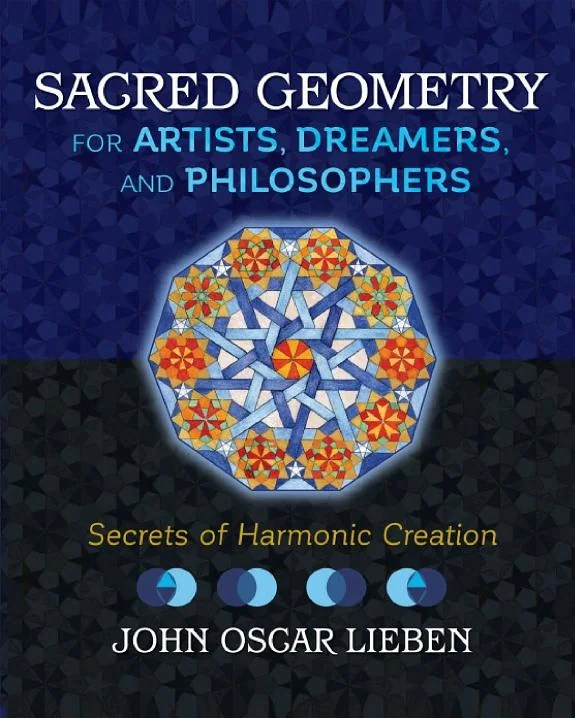
Sacred Geometry for Artists, Dreamers, and Philosophers
 71
71

Sacred Geometry for Artists, Dreamers, and Philosophers
Lieben's "Sacred Geometry for Artists, Dreamers, and Philosophers" offers a compelling argument for the pervasive influence of harmonic geometry. The work's strength lies in its meticulous cross-referencing of natural phenomena, ancient structures, and theoretical concepts, particularly its detailed examination of the vesica piscis as a generative form. One limitation is the occasional density of the technical explanations, which may require focused rereading for those less familiar with mathematical or harmonic principles. The section analyzing the Earth-Moon relationship, for instance, presents complex data that, while fascinating, could benefit from further visual aids to fully grasp its implications. Nevertheless, the book provides a robust framework for understanding how abstract geometry underpins our perceived reality. It is a valuable resource for anyone seeking to bridge the gap between the visible world and its unseen, ordered architecture.
📝 Description
71
John Oscar Lieben's 2011 book presents geometric forms as the fundamental matrices of existence.
Sacred Geometry for Artists, Dreamers, and Philosophers argues that universal structures emerge from basic geometric shapes. Lieben posits that forms like the vesica piscis are not static diagrams but active principles from which reality originates. The book connects these geometric concepts across diverse fields, including music, cosmology, and the composition of matter, suggesting a deep unity in all things. This work is intended for those who seek to understand the cosmos's underlying order. It provides a perspective for artists to translate abstract ideas into concrete work, for dreamers who see symbolic meaning in the world, and for philosophers contemplating existence. It is for individuals who look beyond superficial appearances for deeper, recurring patterns.
Lieben's study is rooted in the historical practice of sacred geometry, observed in ancient Egyptian structures, Greek thought, and Renaissance art. The book links these historical uses to contemporary scientific findings, showing that these geometric principles have been recognized and applied over vast periods. This includes applications from building megalithic sites to comprehending celestial movements. The central argument focuses on harmonic relationships and their geometric representation. It explains how patterns such as the vesica piscis act as a primary model, connecting spatial measurements, temporal cycles, and sound frequencies. Through analysis of nature and historical objects, Lieben offers a way to understand this inherent cosmic organization.
This book engages with the tradition of sacred geometry, a field that posits a divine or inherent mathematical order underpinning reality. This perspective is found across various esoteric and philosophical systems, from Pythagoreanism and Neoplatonism to Hermeticism and Rosicrucianism. These traditions often see geometric forms as keys to understanding creation, consciousness, and the cosmos, linking the visible world to invisible principles. Lieben's work fits within this lineage by presenting geometric archetypes as fundamental to both the physical universe and human perception.
💡 Why Read This Book?
• Understand the generative power of the vesica piscis symbol, recognizing it as a matrix that generates forms, connects cosmic cycles, and even influences musical tones, a concept explored in detail within the book's early chapters. • Learn to apply harmonic analysis to diverse subjects, from the proportions of ancient sculpture and architecture to the structural patterns found in water and solar system dynamics, as demonstrated through specific case studies. • Gain practical skills in using sacred geometry for design and creation, specifically how to apply its principles in architectural planning and the creation of harmonious spaces, a focus of the book's later sections.
⭐ Reader Reviews
Honest opinions from readers who have explored this book.
❓ Frequently Asked Questions
What is the primary geometric concept explored in Sacred Geometry for Artists, Dreamers, and Philosophers?
The book's primary concept is the vesica piscis, presented as a fundamental matrix from which ideas, forms, and measurements of space and time emanate, connecting cosmic cycles and musical tones.
Who is John Oscar Lieben, the author?
John Oscar Lieben is the author of "Sacred Geometry for Artists, Dreamers, and Philosophers," first published in 2018. His work focuses on the harmonic principles underlying the natural world.
What kind of practical applications does the book offer?
The book demonstrates practical applications of sacred geometry, including its use in analyzing ancient sculpture and architecture, understanding celestial relationships, and applying harmonic principles to building floor plans.
How does the book connect geometry to natural phenomena?
It connects geometry to natural phenomena by providing harmonic analyses of structures like water, waves, and the Earth-Moon relationship, showing how these patterns reflect underlying geometric principles.
What is the significance of harmonics in this book?
Harmonics are presented as the sacred geometry principles that structure the natural world. The book illustrates how sonic frequencies and geometric forms are intrinsically linked, revealing a universal order.
When was Sacred Geometry for Artists, Dreamers, and Philosophers first published?
The book was first published on August 28, 2018, offering a contemporary exploration of ancient geometric wisdom.
🔮 Key Themes & Symbolism
The Vesica Piscis Matrix
The central theme revolves around the vesica piscis, not just as a symbol but as a generative matrix. Lieben demonstrates how this simple intersection of two circles births complex forms and concepts, acting as a cosmic blueprint. It's presented as the origin point for ideas, spatial measurements, temporal cycles, and even musical tones, illustrating its role as a fundamental building block of reality that permeates both the macrocosm and the microcosm. The book provides visual and theoretical evidence for its pervasive influence across various domains of existence.
Harmonic Interconnectedness
This theme emphasizes the underlying harmonic principles that bind the universe together. Lieben argues that geometry is the language of these harmonics, visible in everything from the structure of water and waves to the orbits of celestial bodies and the proportions of ancient monuments. The book bridges the gap between art, science, and spirituality by showing how these seemingly disparate fields are unified by shared geometric and harmonic laws, suggesting an intelligent design or inherent order.
Applied Geometry in Art and Architecture
Lieben explores the practical application of sacred geometry, particularly for artists and architects. He analyzes how ancient cultures intuitively, or deliberately, incorporated these principles into their creations. The book offers insights into understanding the aesthetic and structural success of historical art and buildings through their geometric underpinnings. Furthermore, it guides readers on how to consciously apply these harmonic ratios and forms in contemporary design, aiming for greater beauty, resonance, and functional integrity.
Cosmological and Terrestrial Patterns
The book extends its geometric analysis to a grand scale, examining the solar system, the Earth-Moon relationship, and the fundamental structure of matter. It posits that these vast cosmic arrangements and the subtle dynamics of our planet follow predictable harmonic geometric laws. By analyzing these large-scale patterns, Lieben aims to provide readers with a deeper appreciation for the order that governs existence, reinforcing the idea that the same principles seen in a flower's petal can be observed in planetary orbits.
💬 Memorable Quotes
Direct passages from the work, attributed to the author.
“Harmonics are the sacred geometry principles that underlie the natural world.”
— This statement highlights the book's focus on the fundamental role of harmonic relationships, asserting that they are the unseen geometric architecture shaping all natural phenomena and forms.
“Provides harmonic analyses of ancient sculpture, architecture, the solar system, the Earth-Moon relationship, and the structure of water and waves.”
— This descriptive phrase from the blurb points to the book's methodological approach, showcasing its breadth in applying geometric analysis across diverse subjects, from human creations to cosmic and elemental structures.
“Explains how to apply sacred geometry to create building floor plans.”
— This highlights the practical, actionable advice offered in the book, demonstrating that sacred geometry is not just theoretical but can be a tool for conscious design in the built environment.
“Demonstrates how the vesica piscis connects cosmic time cycles, measures of space, and musical tones.”
— This emphasizes the interdisciplinary nature of the book's arguments, showing how a single geometric form can serve as a nexus for understanding seemingly disparate concepts like time, space, and sound.
💡 Key Ideas
Editorial paraphrase of the work's core concepts — not direct quotes.
The vesica piscis is a matrix from which ideas and forms emanate.
This quote captures the book's central thesis, positioning the vesica piscis as more than a symbol but as a generative principle underlying creation, linking abstract thought to physical manifestation.
🌙 Esoteric Significance
Tradition
The work aligns with the Hermetic and Pythagorean traditions, emphasizing the concept of 'As Above, So Below.' It posits that the geometric principles governing the cosmos are mirrored in earthly phenomena and human creations. Unlike some more strictly Kabbalistic or Gnostic texts, Lieben's focus is on the universal language of form and number derived from observation and harmonic ratios, rather than specific divine emanations or historical narratives.
Symbolism
Key symbols include the vesica piscis, representing creation, duality, and the intersection of the spiritual and material. The circle symbolizes unity and the divine, while straight lines represent manifestation and order. The book also implicitly explores the symbolism of the Golden Ratio and other harmonic proportions, seen as divine signatures within nature and art, reflecting an inherent cosmic intelligence.
Modern Relevance
Lieben's work finds resonance with contemporary movements in biomimicry, sustainable architecture, and fractal geometry, which explore nature's design principles. Thinkers and practitioners interested in consciousness studies, integral theory, and the intersection of art, science, and spirituality often draw upon similar geometric frameworks to understand interconnectedness and emergent properties in complex systems.
👥 Who Should Read This Book
• Artists and designers seeking to imbue their work with deeper meaning and structural integrity by understanding the harmonic principles that govern aesthetics and form. • Philosophers and spiritual seekers interested in exploring the underlying order of the universe and the symbolic language of geometry as a path to understanding reality. • Students and practitioners of architecture and urban planning looking for foundational geometric concepts to create more harmonious, resonant, and intuitively balanced spaces.
📜 Historical Context
Published in 2018, John Oscar Lieben's "Sacred Geometry for Artists, Dreamers, and Philosophers" emerged in an era where interest in esoteric traditions and ancient wisdom was experiencing a resurgence, often fueled by online communities and a growing dissatisfaction with purely materialistic worldviews. The book engages with a lineage of thought tracing back to figures like Pythagoras and Plato, who explored the mathematical and geometric underpinnings of the cosmos. It also implicitly dialogues with 20th-century thinkers such as Buckminster Fuller, who championed geometric efficiency, and proponents of the New Age movement who sought to integrate spiritual principles with scientific understanding. While not directly engaging with specific censorship events, the field of sacred geometry itself has often been positioned outside mainstream academic discourse, sometimes viewed as pseudoscience by empirical disciplines. Lieben's work, however, attempts to bridge this gap by grounding its explorations in observable natural phenomena and historical artifacts, offering a more structured, less purely metaphysical approach compared to some earlier esoteric texts.
📔 Journal Prompts
The generative power of the vesica piscis: Reflect on its appearance in natural forms you observe.
Harmonic analysis of everyday objects: Identify potential geometric ratios in common items.
Personal application of geometric principles: How can the concept of harmonics inform your creative process?
The Earth-Moon relationship: Consider the geometric implications of celestial mechanics on terrestrial life.
Structure of water and waves: Observe and sketch the geometric patterns in flowing water or wave formations.
🗂️ Glossary
Vesica Piscis
A geometric shape formed by the intersection of two circles of the same radius, intersecting at each other's center. It is considered a fundamental matrix in sacred geometry, symbolizing creation and the union of opposites.
Harmonics
The principles of proportion and relationship that underlie natural phenomena. In this context, it refers to the mathematical and geometric laws that govern the structure of the universe, often linked to musical ratios.
Matrix
In sacred geometry, a matrix refers to a foundational pattern or structure from which other forms and ideas emerge. The vesica piscis is presented as a primary matrix.
Sacred Geometry
The study of geometric shapes, proportions, and patterns that are believed to hold spiritual or mystical significance and to reflect the underlying order of the cosmos.
Cosmic Time Cycles
The recurring patterns and durations observed in celestial movements, such as planetary orbits, solstices, and equinoxes, which are understood to be governed by harmonic geometric principles.
Measure of Space
Refers to the geometric principles and proportions that define spatial relationships and forms, from the smallest particles to the vastness of the universe.
Musical Tones
The relationship between geometric ratios and audible frequencies, suggesting that the structure of music is inherently tied to the geometric order of the universe.
This book appears in 1 collection
🔮 Readers Also Liked
Browse all →









From the “Sacred Geometry” Collection
View all →









More Free Occult Philosophy Books
View all →