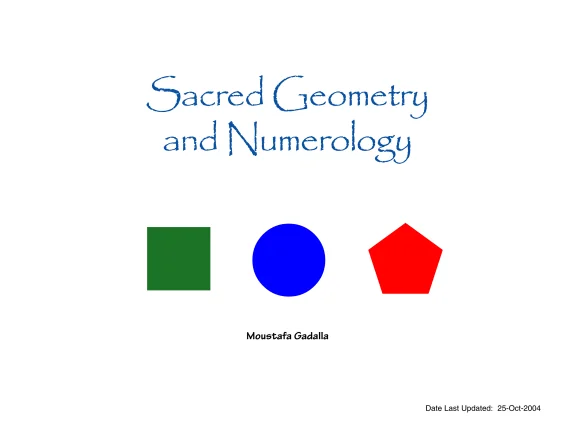
Sacred Geometry and Numerology
 83
83

Sacred Geometry and Numerology
Gadalla's "Sacred Geometry and Numerology" presents a clear, if brief, overview of its titular subjects. The strength lies in its directness; it avoids unnecessary jargon, making complex ideas digestible for the uninitiated. For instance, the explanation of how the summation series relates to natural growth is particularly well-articulated for a beginner text. However, the work's brevity is also its primary limitation. Concepts like "squaring the circle" are introduced but not explored with the depth one might expect for a truly comprehensive understanding. The discussion of Egyptian artwork, while present, feels more like a cursory mention than an in-depth analysis. Ultimately, the e-document serves as a useful primer, offering a competent introduction to foundational esoteric mathematical principles.
📝 Description
83
Moustafa Gadalla's 2016 book examines the relationship between form and number in esoteric traditions.
Published in 2016, Moustafa Gadalla's "Sacred Geometry and Numerology" investigates the connections between shapes and numbers within various esoteric systems. The book breaks down core ideas, showing how geometric rules and numerical patterns appear to shape the universe's perceived order. It acts as a basic guide for understanding the symbolic meanings of shapes and numbers as they show up in old traditions and the natural world.
This text is written for people new to studying esoteric math and cosmology. It is especially useful for students of metaphysics, comparative religion, and ancient philosophies who want a basic grasp of sacred geometry and numerology. Those interested in the symbolic designs in Egyptian art and buildings, or the mathematical basis of harmonic design, will find its explanations clear and helpful. The book places its topics within a wider history of symbolic study, linking them to ancient cultures and their ideas about cosmic order. It discusses the historical use of geometry in art and building, suggesting a shared human need to find meaning in mathematical connections. The work implies a line of thought that sees geometry and numbers as tools for understanding creation itself.
This work fits within the occult philosophy category by connecting mathematical concepts to spiritual and cosmic understanding. It follows traditions that view geometry and numbers not just as abstract tools but as fundamental principles of creation and universal order. The book touches on historical applications of these ideas in art, architecture, and philosophy, suggesting a continuous human quest to find meaning in mathematical relationships and patterns found in nature.
💡 Why Read This Book?
• Gain a foundational grasp of how geometric shapes and numerical sequences, like the summation (Fibonacci) series, are believed to manifest in natural forms and ancient art, as discussed in the book's exploration of Egyptian artwork. • Understand the symbolic meaning of classical geometric problems such as "squaring the circle," which Gadalla explains as representing the relationship between the finite and infinite. • Learn about the significance of specific geometric figures, including the pentagon and whirling squares/spirals, and their role in creating harmonic design elements, as detailed within the text.
⭐ Reader Reviews
Honest opinions from readers who have explored this book.
❓ Frequently Asked Questions
What is the primary focus of Moustafa Gadalla's "Sacred Geometry and Numerology"?
The book focuses on the fundamental principles of sacred geometry and numerology, exploring how geometric shapes and numerical series, such as the summation (Fibonacci) series, are understood to form the basis of universal order and natural phenomena.
What is meant by 'squaring the circle' in the context of this book?
In "Sacred Geometry and Numerology," squaring the circle refers to a classical geometric problem that symbolizes the attempt to reconcile the finite (a square) with the infinite (a circle), representing a union of opposites.
Does the book explain the summation series?
Yes, the e-document explains the summation series, often referred to as the Fibonacci Series, detailing its properties and how it appears in various natural patterns and growth structures.
Are there examples of sacred geometry in Egyptian art mentioned?
Yes, the book includes examples of sacred geometry found within Egyptian artwork, illustrating how these principles were applied in ancient artistic and architectural expressions.
Who is Moustafa Gadalla and when was this book first published?
Moustafa Gadalla is an author focused on esoteric subjects. "Sacred Geometry and Numerology" was first published in 2016 as an e-document.
What are "whirling squares" in relation to sacred geometry?
Whirling squares, or spirals, are geometric forms discussed in the book as examples of sacred geometry. They represent dynamic growth and expansion, often derived from sequences like the summation series.
🔮 Key Themes & Symbolism
Geometric Principles in Nature
The work posits that fundamental geometric shapes are not arbitrary but constitute the underlying structure of the natural world. It examines how concepts like the pentagon and spiral forms, derived from series such as the summation (Fibonacci) series, appear consistently in biological growth and cosmic arrangements. This suggests a divinely ordered universe where mathematical ratios dictate form and function, a perspective shared by various ancient philosophical schools seeking to understand creation's blueprint.
Numerology and Cosmic Harmony
Gadalla introduces the significance of numbers, particularly the "two primary numbers" in numerology, as foundational elements of reality. The text explores how numerical relationships, including the summation series, are believed to create harmony and balance. This aligns with Pythagorean and Neoplatonic thought, which viewed numbers as the language of the cosmos, capable of revealing deeper truths about existence and consciousness when properly understood.
Symbolism in Ancient Art
The book highlights the presence of sacred geometry within the artwork of ancient civilizations, specifically referencing Egyptian examples. This demonstrates a historical understanding of geometry as more than just a practical tool for construction, but as a symbolic language encoding spiritual and cosmological knowledge. The integration of geometric patterns in art suggests a deliberate attempt to imbue creations with universal order and meaning.
The Quest for Universal Laws
Fundamentally, , "Sacred Geometry and Numerology" is about uncovering universal laws that govern existence. Concepts like squaring the circle represent the human endeavor to comprehend the relationship between the manifest and the unmanifest, the material and the spiritual. The work positions these mathematical and geometric studies as paths to understanding a coherent, interconnected cosmos, a pursuit common in esoteric traditions worldwide.
💬 Memorable Quotes
Direct passages from the work, attributed to the author.
“The summation (so-called Fibonacci) Series reveals underlying patterns of growth.”
— This statement points to the book's assertion that mathematical sequences are not abstract but are active principles in the universe, governing natural development and observable in diverse phenomena.
“Squaring the circle represents the union of finite and infinite.”
— This interpretation frames a classic geometric puzzle not just as a mathematical problem, but as a profound symbolic representation of cosmic dualities and their potential integration.
“Geometric shapes are foundational elements in Egyptian artwork.”
— This highlights the book's claim that ancient cultures, like the Egyptians, consciously employed sacred geometry as a symbolic language, imbuing their art and architecture with cosmic principles.
“The pentagon and spirals are recurring forms in sacred geometry.”
— This emphasizes the specific geometrical motifs that the book identifies as significant, suggesting their universal importance and symbolic meaning across different traditions and natural occurrences.
“The work explores the harmonic design elements inherent in geometric principles.”
— This indicates that the book connects the study of geometry to aesthetics and order, proposing that beautiful and balanced designs are rooted in fundamental mathematical relationships.
🌙 Esoteric Significance
Tradition
The work draws heavily from the Pythagorean and Neoplatonic traditions, which view numbers and geometry as fundamental principles of the cosmos. It aligns with esoteric interpretations that see mathematical ratios and forms as expressions of divine intelligence and universal order, a perspective echoed in Hermeticism and later Renaissance occultism. Gadalla's approach emphasizes clarity and direct application, aiming to make these ancient insights accessible.
Symbolism
Key symbols explored include the circle and square, representing the union of the infinite and finite, a recurring theme in mystical traditions. The pentagon, with its connection to the Golden Ratio, is presented as a symbol of harmony and human proportion. Spirals, often derived from the summation series, symbolize growth, evolution, and the unfolding of cosmic consciousness.
Modern Relevance
Contemporary interest in sacred geometry is evident in fields ranging from alternative spirituality and consciousness studies to art, design, and even some branches of theoretical physics exploring fundamental patterns. Thinkers and practitioners exploring conscious design, bio-architecture, and the intersection of science and spirituality often reference these foundational geometric and numerical principles, finding continued relevance in Gadalla's exploration.
👥 Who Should Read This Book
['• Beginners in esoteric studies seeking a clear introduction to the foundational concepts of sacred geometry and numerology, particularly as they relate to ancient symbolism and natural forms.', '• Students of comparative religion and ancient philosophy interested in understanding the mathematical and geometric underpinnings of various cosmological systems and their symbolic interpretations.', '• Artists, designers, and architects looking to explore the historical and philosophical basis of harmonic proportions and symbolic design elements rooted in geometric principles.']
📜 Historical Context
Moustafa Gadalla's "Sacred Geometry and Numerology," published in 2016, enters a field with a long lineage, notably influenced by Pythagoreanism and later by the Theosophical movement of the late 19th and early 20th centuries. Works by figures like Helena Blavatsky and Rudolf Steiner explored similar connections between mathematics, cosmology, and spiritual development. Gadalla's approach, however, is presented as a more direct and accessible exposition, potentially aiming to bypass some of the more complex philosophical arguments found in earlier esoteric texts. The book's focus on Egyptian artwork places it within a tradition of Egyptology that has long sought esoteric meanings in ancient monuments and symbols, a practice that gained traction in the 19th century with scholars and occultists alike. While not explicitly engaging with specific contemporary critiques, the work implicitly addresses a modern secular worldview by reasserting the significance of ancient symbolic systems.
📔 Journal Prompts
The summation (Fibonacci) Series and its manifestation in natural growth patterns.
Reflect on the symbolic representation of 'squaring the circle' in your understanding.
Analyze the presence of geometric shapes in Egyptian artwork discussed in the book.
Consider the role of irrational numbers in the context of universal order.
Explore the concept of harmonic design elements through the lens of the pentagon.
🗂️ Glossary
Sacred Geometry
The study of geometric shapes and mathematical proportions believed to hold symbolic and spiritual significance, seen as fundamental patterns in the universe and creation.
Numerology
The belief in a divine or mystical relationship between numbers and events, where numbers are assigned symbolic meanings to interpret or predict phenomena.
Squaring the Circle
A classical geometric problem of constructing a square with the same area as a given circle using only a compass and straightedge, symbolically representing the union of opposites.
Summation Series (Fibonacci Series)
A sequence where each number is the sum of the two preceding ones, typically starting with 0 and 1 (0, 1, 1, 2, 3, 5, 8...), found extensively in nature and art.
Irrational Numbers
Numbers that cannot be expressed as a simple fraction (a/b), such as pi (π) or the square root of 2, often associated with the infinite or incommensurable aspects of geometry.
Pentagon
A five-sided polygon, often considered a sacred shape due to its relationship with the Golden Ratio and its appearance in natural forms.
Whirling Squares/Spirals
Geometric constructions often derived from sequences like the Fibonacci series, illustrating dynamic growth and expansion, visually representing a spiral's outward movement.
This book appears in 1 collection
🔮 Readers Also Liked
Browse all →








From the “Sacred Geometry” Collection
View all →





More Free Occult Philosophy Books
View all →