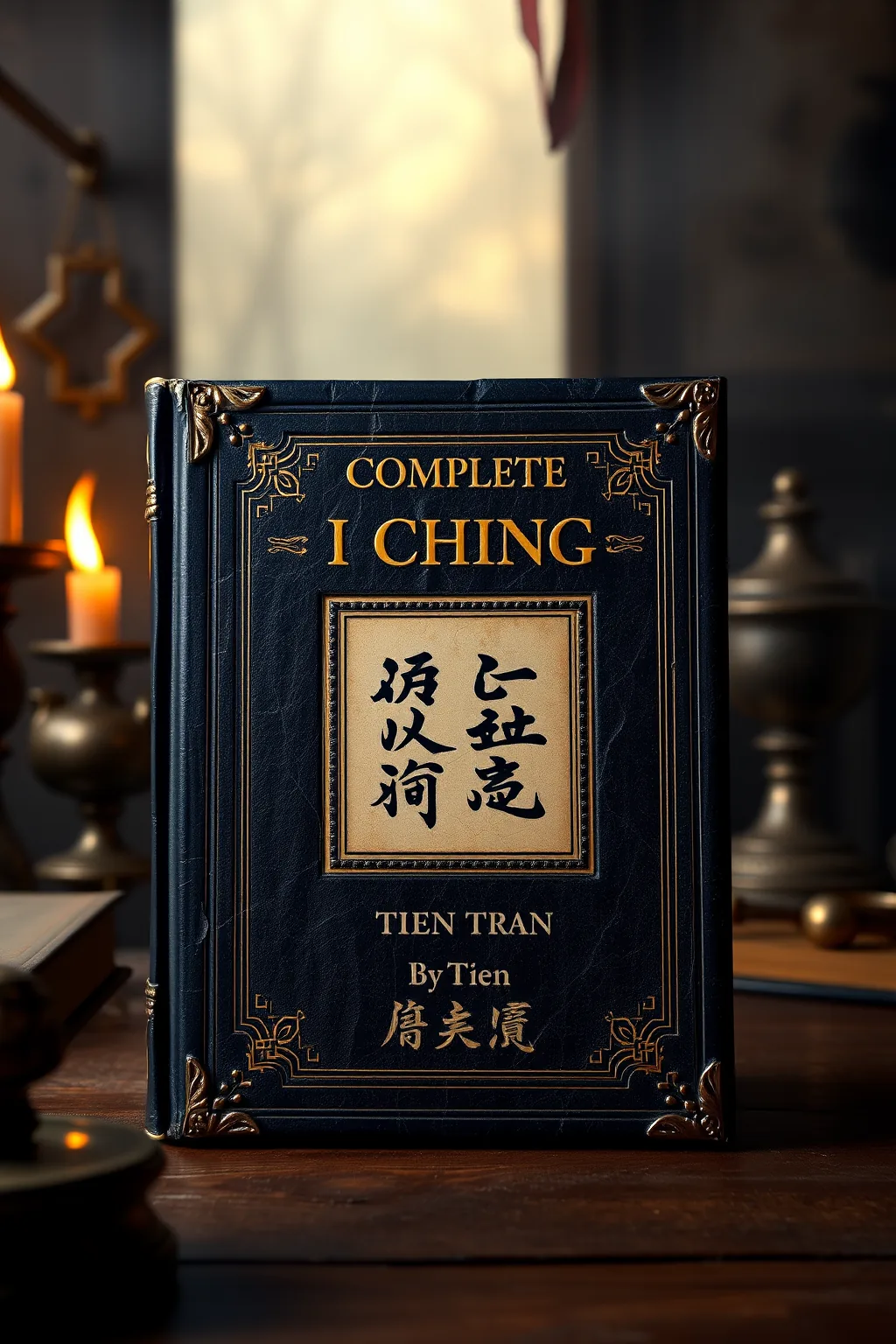
Complete I Ching (Book of Change)
 61
61

Complete I Ching (Book of Change)



Lorelei Sage, Contemplative Literature Editor:
Tien Tran's 'Complete I Ching' is a luminous beacon in the often-murky waters of esoteric texts. Tran masterfully excavates the profound philosophical and metaphysical depths of the Yijing, presenting its ancient wisdom with clarity and reverence. The text transcends simple fortune-telling, revealing itself as a profound guide to understanding cosmic principles and personal evolution. Its strength lies in its accessible yet deeply insightful interpretations, making the complex philosophy of change palpable. This edition is essential for anyone seeking to integrate ancient esoteric knowledge into their spiritual practice or academic pursuits, offering a pathway to profound self-discovery and alignment with universal rhythms.
📝 Description
61
Tien Tran's 'Complete I Ching' translates the ancient Chinese text for contemporary understanding.
Tien Tran's edition of the I Ching, or Book of Change, presents the classic Chinese oracle and philosophical work. This version aims to clarify the text's complex symbolism and its philosophical underpinnings. The I Ching functions not only as a method for divination but also as a framework for understanding natural cycles and human experience.
Tran's translation focuses on the layered meanings within the hexagrams, their psychological depth, and their application to modern life. Readers can examine the interplay of Yin and Yang, concepts central to Taoist philosophy, and how these are represented in the text's structure. The book offers guidance for those interested in the I Ching's wisdom for personal growth and understanding life's transitions.
The I Ching is a foundational text within Chinese esoteric traditions, particularly Taoism. Its sixty-four hexagrams, formed by combinations of broken (Yin) and solid (Yang) lines, are seen as representations of universal patterns and transformations. For centuries, practitioners have used the text for divination, seeking insight into the flow of events and guidance for action. This book engages with that lineage, making its complex system accessible to a new generation of readers interested in its philosophical and spiritual dimensions.
💡 Why Read This Book?
Uncover the ancient secrets of cosmic balance and personal transformation. This edition offers a profound exploration of the Yijing's philosophical underpinnings, revealing its power as a guide for navigating life's challenges. Ideal for seekers of esoteric knowledge, students of ancient wisdom, and practitioners seeking deeper insight into universal patterns and personal destiny. Discover how the 'Book of Change' can illuminate your path and foster profound inner growth.
⭐ Reader Reviews
Honest opinions from readers who have explored this book.
❓ Frequently Asked Questions
What is the 'I Ching' and why is it called the 'Book of Change'?
The 'I Ching,' or 'Book of Change,' is an ancient Chinese divination text and philosophical classic. It's called the 'Book of Change' because its core philosophy centers on the understanding that everything in the universe is in a constant state of flux and transformation, governed by underlying patterns.
How is this 'Complete I Ching' different from other versions?
This edition by Tien Tran offers a comprehensive and richly interpreted version, emphasizing the esoteric and philosophical dimensions of the hexagrams, making its profound wisdom accessible to a modern audience seeking deeper spiritual and psychological insights.
Can anyone use the 'I Ching' for divination?
Yes, the 'I Ching' can be consulted by anyone with a sincere intention to seek guidance. While mastery takes practice, its core principles are accessible, offering wisdom and perspective on any question posed.
What are hexagrams?
Hexagrams are the sixty-four symbols that form the foundation of the 'I Ching.' Each is composed of six lines, either broken (Yin) or solid (Yang), representing a specific situation, cosmic principle, or stage of transformation.
What is the philosophical significance of the 'I Ching'?
Its philosophical significance lies in its exploration of balance, harmony, and the cyclical nature of existence. It teaches principles of adaptability, foresight, and understanding the interconnectedness of all things, guiding one towards a more balanced and enlightened life.
🔮 Key Themes & Symbolism
The Cosmic Dance of Yin and Yang
At the heart of the I Ching lies the profound philosophy of Yin and Yang, the primordial complementary forces that govern all creation. This edition elucidates how these seemingly opposing energies are in perpetual, dynamic interaction, shaping the ebb and flow of the universe and our individual lives. Understanding this duality is key to grasping the I Ching's insights into balance, harmony, and the cyclical nature of change, revealing how to navigate life's transitions by embracing both stillness and movement.
The Art of Navigating Transformation
The I Ching is fundamentally a manual for understanding and responding to change. Each of its 64 hexagrams represents a unique situation and a corresponding wisdom for navigating it. This edition examines the symbolic language of these hexagrams, offering useful insights into personal growth, decision-making, and adapting to life's inevitable shifts. It empowers readers to view change not as a threat, but as an opportunity for evolution and deeper self-awareness.
Symbolic Resonance and Universal Patterns
The hexagrams of the I Ching are rich tapestries of symbolism, drawing from observations of nature, human relationships, and cosmic phenomena. Tran's work illuminates the intricate web of meanings embedded within these symbols, revealing how they reflect universal patterns and archetypes. By understanding this symbolic resonance, readers can gain a profound connection to the underlying order of the universe and apply these timeless principles to their own lives, fostering a sense of interconnectedness and cosmic awareness.
💬 Memorable Quotes
Direct passages from the work, attributed to the author.
“Stillness births movement; movement finds rest.”
— This highlights the inherent duality and cyclical nature of existence, where periods of quiet contemplation lead to action, and action ultimately seeks equilibrium.
“Each hexagram, a mirror to the soul's journey.”
— This suggests that the I Ching's symbols are not just external predictions, but profound reflections of our inner states and the spiritual path we are traversing.
“The potent force resides in understanding.”
— This underscores that true power and agency come not from external control, but from deep comprehension of the forces at play, both within and around us.
💡 Key Ideas
Editorial paraphrase of the work's core concepts — not direct quotes.
The wise adapt to the flow of the Tao.
This quote emphasizes the importance of aligning oneself with the natural order of the universe, embracing fluidity and change with wisdom rather than resistance.
Change is the only constant, embrace its wisdom.
A core tenet of the I Ching, this quote encourages acceptance of life's transformations and learning from them, rather than fearing or resisting them.
🌙 Esoteric Significance
Tradition
The 'I Ching' is deeply embedded within the Taoist and Confucian traditions, serving as a foundational text for understanding the fundamental principles of the universe. Esoterically, it is viewed as a cosmic map, revealing the energetic currents and cyclical patterns that govern existence. It is a key text in Chinese Neidan (internal alchemy) practices, used to understand the transformation of the self in alignment with celestial forces, and is often considered a bridge between the mundane and the divine realms.
Symbolism
The core symbolism lies in its 64 hexagrams, each composed of six lines (solid Yang, broken Yin). These lines represent elemental forces, human relationships, and stages of cosmic development. The trigrams (three-line combinations) symbolize fundamental elements like Heaven, Earth, Water, Fire, and Thunder. The interplay and transformation between these trigrams and hexagrams reveal the dynamic, ever-changing nature of reality, offering useful insights into causality, synchronicity, and the interconnectedness of all phenomena.
Modern Relevance
In the modern era, the 'I Ching' offers a vital counterpoint to materialistic worldviews, providing a framework for understanding the subtle energies and interconnectedness that shape our lives. It serves as a powerful tool for self-reflection, decision-making, and cultivating resilience in a rapidly changing world. Its emphasis on balance, adaptability, and the wisdom of natural cycles resonates deeply with contemporary seekers of mindfulness, personal growth, and a more holistic understanding of existence.
👥 Who Should Read This Book
This comprehensive edition is a treasure for a diverse audience. **Beginners** seeking an accessible yet profound introduction to the 'I Ching' will find clarity and depth. **Scholars** of Eastern philosophy and comparative religion will appreciate its meticulous scholarship and nuanced interpretations. **Spiritual seekers** yearning for a guide to personal growth, divination, and understanding life's unfolding will discover invaluable wisdom. **Practitioners** of esoteric arts, meditation, and contemplative practices will find it an essential resource for deepening their connection to universal principles and inner wisdom.
📜 Historical Context
The 'I Ching' (Book of Change) boasts a lineage stretching back over three millennia, originating in ancient China. Its earliest roots are intertwined with shamanic practices and early forms of divination, evolving over centuries into a complex philosophical and ethical system. During the Spring and Autumn period (771–476 BCE) and the Warring States period (475–221 BCE), prominent philosophers like Confucius and his disciples are believed to have significantly contributed to its textual compilation and interpretation, imbuing it with deep moral and social significance. The Han Dynasty (206 BCE – 220 CE) saw it elevated to one of the Five Classics of Confucianism, solidifying its status as a central to Chinese intellectual and spiritual life. Its influence extended far beyond China, impacting East Asian cultures and eventually captivating Western thinkers and mystics from the 19th century onwards, proving its enduring power to resonate across diverse historical and cultural landscapes.
📔 Journal Prompts
Reflect on a recent period of significant change in your life. How did the principles of the I Ching apply to your experience?
Consider the concept of Yin and Yang in your daily life. Where do you see imbalances, and how can you cultivate greater harmony?
Choose a hexagram that speaks to you today. What message does it hold for your current circumstances or inner state?
How can the wisdom of the 'Book of Change' help you approach an upcoming decision or challenge with greater insight and equanimity?
Explore the symbolism of a particular trigram. How does its elemental meaning relate to your personal journey or the world around you?
🗂️ Glossary
Hexagram
A symbol composed of six lines, either solid (Yang) or broken (Yin), representing a specific situation, principle, or stage of transformation within the I Ching. There are 64 unique hexagrams.
Trigram
A basic building block of the hexagram, consisting of three lines (solid or broken). The eight trigrams (Ba Gua) represent fundamental elements and cosmic forces such as Heaven, Earth, Water, Fire, and Thunder.
Tao (Dao)
The fundamental principle of the universe in Taoism, often translated as 'The Way.' It represents the natural order, the underlying force that flows through all things, and the path of harmonious existence.
Yin
One of the two fundamental, complementary forces in Chinese philosophy. Yin represents the passive, feminine, dark, receptive, and yielding aspects of reality, often associated with the moon and earth.
Yang
The complementary force to Yin. Yang represents the active, masculine, light, assertive, and creative aspects of reality, often associated with the sun and heaven.
This book appears in 3 collections
🔮 Readers Also Liked
Browse all →







From the “I Ching” Collection
View all →









More Free Divination & Tarot Books
View all →