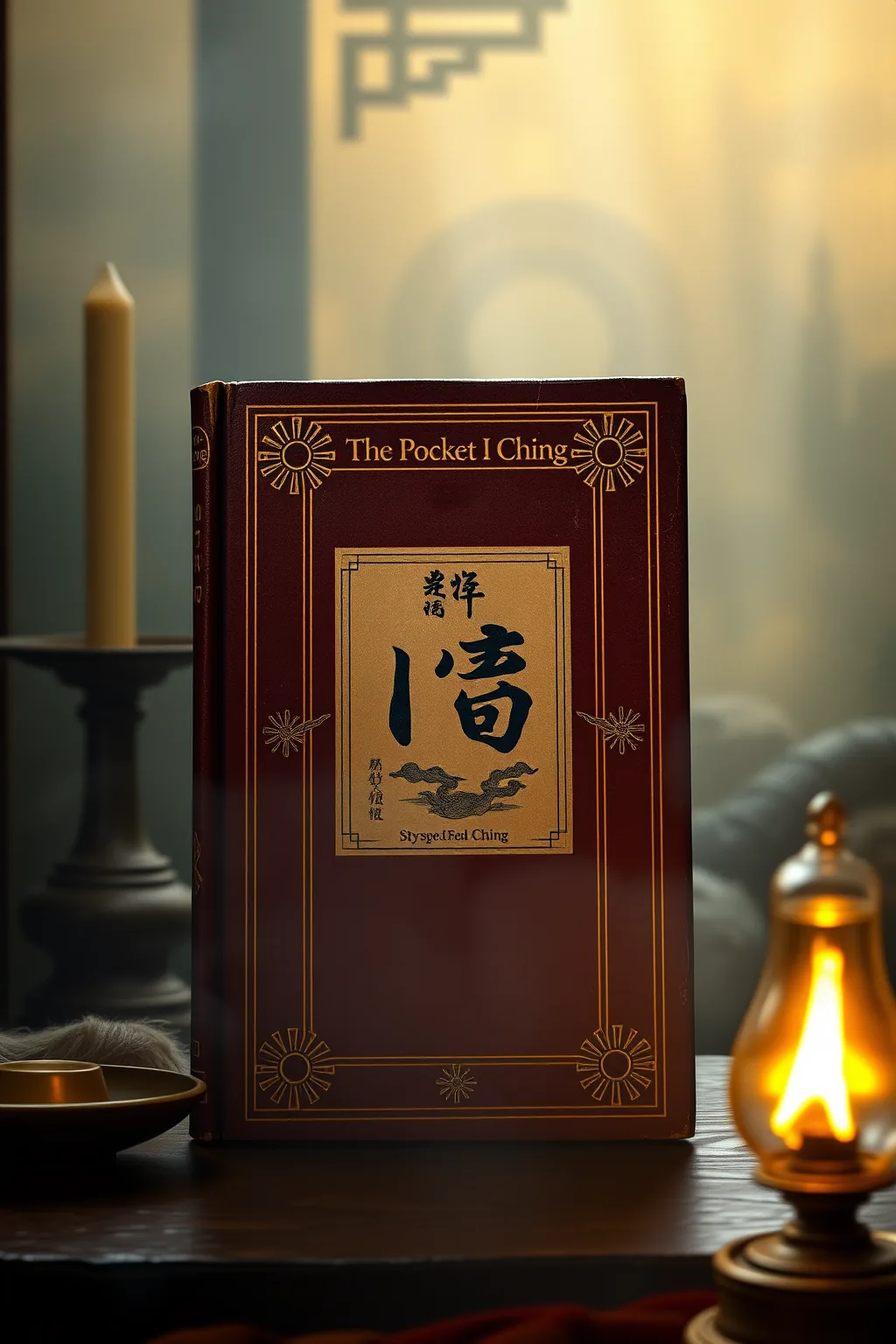
The pocket I Ching
 61
61

The pocket I Ching



Marcus Thorne, Esoteric Sciences Reviewer — 'The Pocket I Ching' offers an accessible yet profoundly deep dive into one of the world's most ancient and revered divination systems. Esoteric Library proudly presents this edition, which distills the complex wisdom of the I Ching into a manageable and insightful format. Its strength lies in its clarity, making the intricate symbolism of the 64 hexagrams comprehensible without sacrificing their esoteric potency. Ideal for both neophytes curious about divination and seasoned practitioners seeking a portable reference, this edition illuminates the philosophical underpinnings and practical applications of the Sage's Book. A truly indispensable tool for those who seek guidance from the cosmic currents.
📝 Description
61
'The Pocket I Ching' presents the ancient Chinese oracle for modern readers.
This small edition of the I Ching offers the core text of the venerable Chinese oracle. For centuries, this system has served as a tool for divination and philosophical reflection. The book explains the cyclical patterns of existence, the balance of Yin and Yang, and the forces that influence events.
Each of the 64 hexagrams uses symbolic images to provide guidance for current situations and potential futures. It is not simply a book of fortune telling. Instead, it offers insights for those seeking spiritual understanding and personal growth. The philosophical ideas touch on change, equilibrium, and the Tao, encouraging readers to find inner peace and approach life's changes with greater awareness.
This edition acts as a portable source for understanding cosmic principles and achieving personal clarity.
The I Ching, or 'Book of Changes,' is one of the oldest Chinese classical texts. Its origins are attributed to legendary figures like Fu Xi and King Wen. It is a foundational text in Chinese philosophy and religion, influencing Confucianism and Taoism. The system uses sets of broken and unbroken lines to form 64 hexagrams, each representing a specific situation or state of being. These are interpreted through commentary to offer advice and foresight. Its use spans from personal divination to understanding broader cosmic and societal patterns.
💡 Why Read This Book?
Unveil the veiled wisdom of the East with 'The Pocket I Ching.' This essential guide offers an accessible entry point into the profound philosophical and divinatory traditions of ancient China. It's ideal for seekers of personal growth, students of esoteric lore, and practitioners of mindfulness who wish to connect with timeless cosmic patterns. Gain profound insights into life's challenges and opportunities, fostering inner wisdom and intuitive decision-making. A portable sanctuary for contemplation.
⭐ Reader Reviews
Honest opinions from readers who have explored this book.
❓ Frequently Asked Questions
What is the I Ching?
The I Ching, or 'Book of Changes,' is an ancient Chinese divination text and philosophical classic. It uses a system of 64 hexagrams, formed by combining six stacked lines, to offer insights into the forces influencing situations and guide decision-making.
How do I use the I Ching for divination?
Divination typically involves focusing on a question, then using a random method (like coin tosses or yarrow stalks) to generate a hexagram, which is then interpreted using the text's explanations.
Is the I Ching only for fortune-telling?
While used for divination, the I Ching is also a profound philosophical text exploring change, balance, and the Tao. It's a guide for self-cultivation and understanding the natural order of the universe.
What does 'Pocket' imply in the title?
The 'Pocket' designation suggests a more concise, accessible, and portable version of the I Ching, making its wisdom easier to carry and consult on the go, suitable for daily reflection.
Who is the 'Unknown' author?
The I Ching's origins are ancient and attributed to legendary figures like Fu Xi, King Wen, and Confucius. The 'Unknown' author signifies its evolution over centuries, representing collective wisdom rather than a single individual.
🔮 Key Themes & Symbolism
The Dynamics of Change and Transformation
Fundamentally, the I Ching is a profound meditation on the ceaseless flow of change that governs all existence. It teaches that nothing is static and that understanding the patterns of transformation is key to navigating life's vicissitudes. Through its 64 hexagrams, it illustrates how situations evolve, offering guidance on how to align oneself with the natural unfolding of events. This principle encourages adaptability, resilience, and a mindful approach to both personal growth and external circumstances, fostering a deeper appreciation for the impermanence that defines our reality and the potential for renewal inherent in every transition.
The Interplay of Yin and Yang
The fundamental principle underpinning the I Ching is the cosmic dance of Yin and Yang – the complementary, opposing forces that shape the universe. Yin represents the passive, receptive, dark, and feminine, while Yang embodies the active, creative, light, and masculine. The hexagrams themselves are constructed from broken (Yin) and unbroken (Yang) lines, symbolizing their constant interplay. Understanding this duality is crucial for achieving balance and harmony within oneself and in one's environment. The I Ching guides us to recognize these forces in action, promoting a holistic perspective that embraces both stillness and movement, receptivity and action, as essential components of a well-lived life.
Symbolism and Archetypal Wisdom
Each of the 64 hexagrams is rich with symbolic imagery drawn from nature, human relationships, and societal structures. These symbols act as archetypes, resonating with universal human experiences and offering clear insights into the underlying nature of any given situation. The I Ching's language is poetic and metaphorical, inviting contemplation and intuitive understanding rather than rigid interpretation. By deciphering these potent symbols, readers can tap into a deep well of ancient wisdom, gaining a unique perspective on their present challenges and future possibilities, and fostering a connection with the archetypal forces that shape human consciousness.
💬 Memorable Quotes
Direct passages from the work, attributed to the author.
“When one has mastery over the changes, he has mastery over the world.”
— This highlights the I Ching's core teaching: by understanding the principles of change and flow, one can navigate life's complexities with wisdom and achieve a form of inner dominion over external circumstances.
“What is essential is to have a clear purpose and to be steadfast in it.”
— This profound statement underscores the importance of intention and perseverance. A focused mind and unwavering resolve are presented as crucial elements for navigating challenges and achieving one's goals.
“To know the changes is to know the Tao.”
— This captures the deep philosophical connection between the I Ching and the concept of the Tao, suggesting that understanding the natural patterns of change is equivalent to understanding the fundamental principles of the universe.
💡 Key Ideas
Editorial paraphrase of the work's core concepts — not direct quotes.
The superior man acts before he speaks, and in his acting, he expresses himself.
This quote emphasizes the power of action over mere words, suggesting that true self-expression and efficacy are found in deeds that align with one's inner convictions and intentions.
The superior man understands the signs of the times.
This quote points to the divinatory aspect of the I Ching, encouraging awareness of the subtle cues and energies present in any situation, allowing for informed and timely action.
🌙 Esoteric Significance
Tradition
The I Ching is intrinsically linked to Taoism and Confucianism, serving as a bridge between practical philosophy and esoteric cosmology. Within esoteric traditions, it is viewed as a living oracle, a cosmic blueprint that reflects the underlying order of the universe. Its hexagrams are seen as vibrational patterns that can be consulted to understand the flow of energy and destiny. It functions as a tool for spiritual alchemy, guiding the practitioner towards inner harmony and alignment with the Tao, fostering self-awareness and promoting the integration of the subtle energies that govern existence.
Symbolism
The core symbolism of the I Ching lies in its binary system of broken (Yin) and unbroken (Yang) lines, representing the fundamental duality of existence. These lines combine to form 64 hexagrams, each imbued with rich imagery derived from nature (mountains, water, thunder, wind) and human experience (family, conflict, success). Each hexagram is a microcosm of universal principles, acting as a symbolic map of potential outcomes and guiding forces. The trigrams, components of the hexagrams, further refine these symbolic meanings, creating a complex yet coherent language for understanding the ever-shifting nature of reality and the archetypal forces at play.
Modern Relevance
In contemporary times, the I Ching continues to offer profound relevance as a tool for reading through the complexities of modern life. Its emphasis on adaptability, balance, and understanding cycles of change provides invaluable guidance for personal growth, decision-making, and stress management. For those seeking spiritual depth, it remains a powerful oracle for self-reflection and intuitive insight. Its philosophical underpinnings resonate with modern psychological theories of archetypes and the collective unconscious, offering a timeless framework for understanding the human condition and our place within the grand range of existence.
👥 Who Should Read This Book
This 'Pocket I Ching' is an indispensable companion for a diverse range of seekers. For the **beginner** curious about ancient wisdom and divination, it offers an accessible and clear introduction to one of the world's most profound oracles. **Scholars** of Eastern philosophy and comparative religion will find it a valuable resource for understanding its historical and cultural significance. **Spiritual seekers** and practitioners of mindfulness will benefit from its guidance on personal growth, intuition, and aligning with universal principles. **Practitioners** of divination and esoteric arts will appreciate its portable format and concise interpretations, making it an ideal tool for daily consultations and deepening their understanding of cyclical patterns and cosmic forces.
📜 Historical Context
The I Ching, or 'Book of Changes,' boasts an lineage stretching back over three millennia, originating in ancient China. Its earliest layers are believed to date to the Western Zhou Dynasty (c. 1046–771 BCE), with significant contributions attributed to figures like King Wen, who is credited with developing the 64 hexagrams, and the Duke of Zhou, who provided initial commentaries. Later, Confucius and his disciples are thought to have added further layers of commentary and philosophical interpretation, solidifying its status as a seminal text in Chinese thought. Throughout its history, the I Ching has been a core part of Chinese philosophy, cosmology, and divination, influencing not only scholars and rulers but also common people seeking guidance. Its adaptability has allowed it to transcend eras, remaining a vital source of wisdom and spiritual insight in both ancient and modern times, a evidence of its enduring power and universal themes.
📔 Journal Prompts
Reflect on a recent situation where understanding the interplay of Yin and Yang might have offered a different perspective. How did these forces manifest?
Choose a hexagram that speaks to you today. What specific imagery or symbolism stands out, and how does it relate to your current life circumstances?
Consider the concept of 'change' as presented in the I Ching. How can you embrace transformation more readily in your own life, rather than resisting it?
If you were to consult the I Ching for guidance on a personal challenge, what question would you ask, and what qualities would you hope to find reflected in the resulting hexagram?
Explore the idea of 'action before speech.' In what areas of your life can you benefit from expressing yourself through deeds rather than words?
🗂️ Glossary
Hexagram
A symbol composed of six stacked lines, either solid (Yang) or broken (Yin), representing a specific state or situation and its potential transformations within the I Ching.
Trigram
A combination of three lines (either solid or broken), forming eight fundamental symbols that are the building blocks of the 64 hexagrams, each associated with specific natural elements and concepts.
Yin
The passive, receptive, dark, yielding, and feminine principle in Chinese philosophy, represented by a broken line (--) in the I Ching.
Yang
The active, creative, light, firm, and masculine principle in Chinese philosophy, represented by a solid line (—) in the I Ching.
Tao
The fundamental principle or 'Way' of the universe in Taoism, representing the natural order, flow, and underlying essence of all existence.
This book appears in 3 collections
🔮 Readers Also Liked
Browse all →









From the “Tarot” Collection
View all →







More Free Divination & Tarot Books
View all →