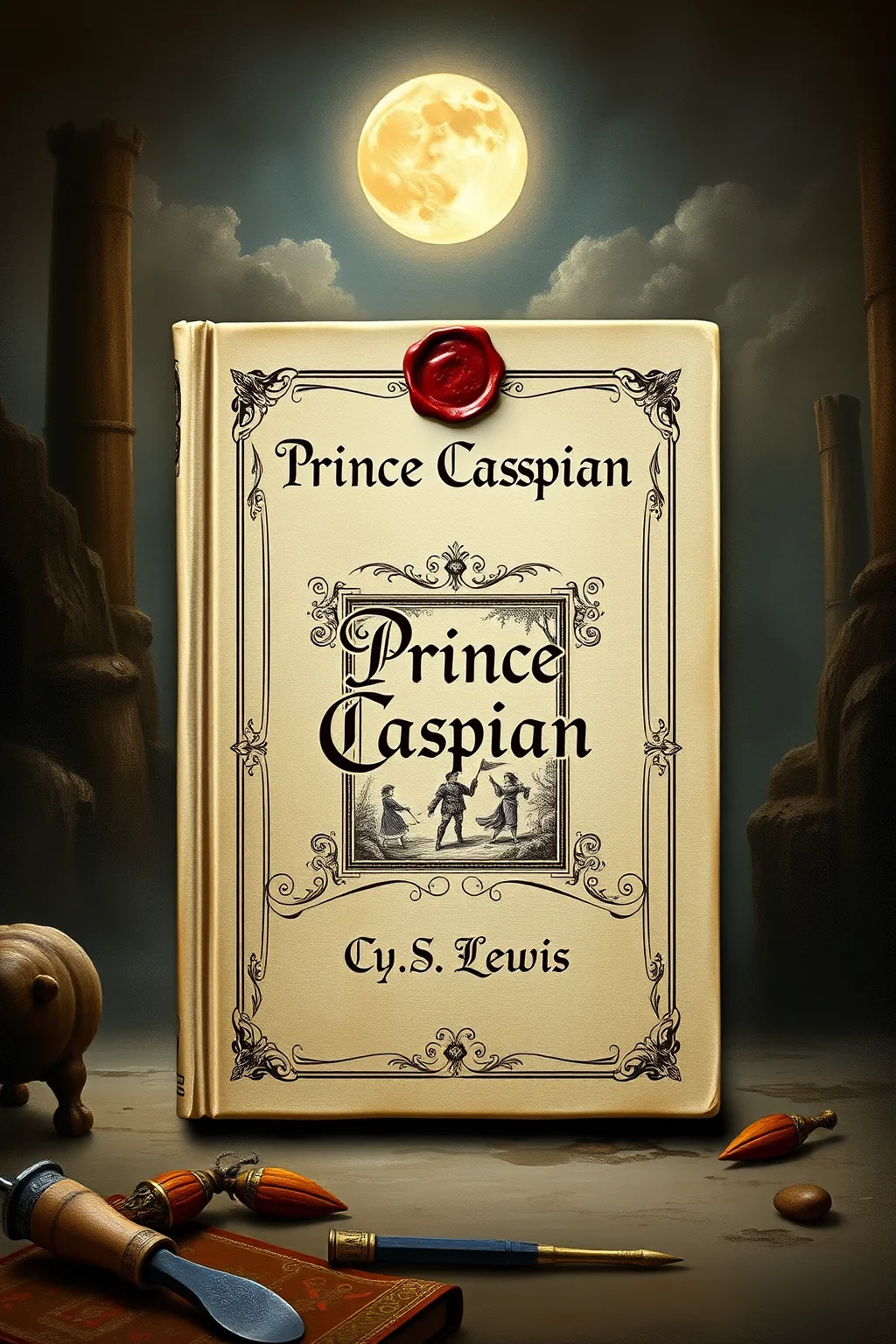
Prince Caspian
 79
79

Prince Caspian
Lewis’s return to Narnia in *Prince Caspian* offers a compelling, if somewhat less immediate, narrative than its predecessor. The reintroduction of the Pevensies, now facing a Narnia stripped of its former glory, provides a potent metaphor for cultural amnesia. The depiction of the Old Narnians – talking beasts and mythical creatures driven underground – is particularly effective, capturing the pathos of a suppressed heritage. However, the pacing occasionally falters, particularly in the early chapters as Lewis establishes the political landscape of the Telmarines. The battle sequences, while spirited, lack the unique inventiveness seen in earlier installments. A standout moment is the summoning of Aslan, a powerful evocation of divine intervention that underpins the book’s theological framework. While not Lewis’s most innovative work, *Prince Caspian* succeeds in exploring themes of restoration and the enduring power of faith. It is a solid, if not spectacular, entry in the Narnia canon.
📝 Description
79
Published in 1951, Prince Caspian is the fourth Narnia book to appear.
Prince Caspian returns readers to Narnia more than 1,300 years after the Pevensie siblings' first adventure. The land is now controlled by the Telmarines, who have pushed aside Narnia's magical history and its creatures. The story follows Prince Caspian X, who escapes his uncle, King Miraz. He seeks to bring back the old Narnia with the help of its original inhabitants and the Pevensie children, who are called back to the land.
The book is suitable for young adults and adults interested in fantasy stories with deeper allegorical meanings. Readers who enjoy narratives about myth, the flow of history, and struggles for power will find it engaging. Those familiar with C. S. Lewis's academic work on literature and theology will recognize his distinct voice and recurring ideas. The story touches on themes of renewal, belief, and the fight against forgetting.
Prince Caspian arrived in 1951, a time when post-war Europe was reassessing its past and looking to ancient stories for meaning. C. S. Lewis, a scholar of old literature, drew heavily on Norse and Greek myths, alongside his Christian faith. This book speaks to a broader trend in children's literature, which was then starting to tackle more complex ideas. Lewis's work sits within a tradition of using fantastical settings to examine moral and spiritual questions, reflecting a desire for order and meaning in a world recovering from conflict.
💡 Why Read This Book?
• Gain insight into the concept of historical suppression by examining the Telmarine regime's efforts to erase Narnia's magical past, mirroring real-world cultural amnesia. • Understand the power of faith and memory through the Old Narnians' persistent belief in Aslan despite his apparent absence, a core tenet Lewis explored. • Experience the cyclical nature of myth and renewal as Prince Caspian fights to restore Narnia, echoing ancient patterns of death and rebirth central to many spiritual traditions.
⭐ Reader Reviews
Honest opinions from readers who have explored this book.
❓ Frequently Asked Questions
What is the primary conflict in Prince Caspian?
The main conflict involves Prince Caspian X and the Old Narnians battling against his tyrannical uncle, King Miraz, who has usurped the throne and suppressed Narnia's magical history and creatures.
How much time has passed between The Lion, the Witch and the Wardrobe and Prince Caspian?
Over 1,300 Narnian years have passed, highlighting the vast temporal and cultural distance between the two stories and the decline of Narnia.
Who are the Old Narnians?
The Old Narnians are the indigenous, magical inhabitants of Narnia—such as talking beasts, dwarfs, and fauns—who have been driven into hiding by the human Telmarines.
What role does Aslan play in Prince Caspian?
Aslan's role is more subtle initially, but he ultimately reappears to rally the Narnians and guide Prince Caspian, representing divine intervention and the restoration of true Narnia.
Is Prince Caspian a direct sequel to The Lion, the Witch and the Wardrobe?
While it is chronologically the fifth book in the Narnia series, *Prince Caspian* follows the Pevensie children's return to Narnia after their initial reign ended centuries prior in Narnian time.
What does the Telmarine rule symbolize?
The Telmarine rule symbolizes the suppression of history, magic, and natural order by a pragmatic, human-centric power that fears and denies the spiritual or mythical.
🔮 Key Themes & Symbolism
The Erasure of History
The Telmarine conquest represents a deliberate act of cultural amnesia, where the magical history and beings of Narnia are systematically suppressed. King Miraz and his regime actively work to forget and deny the existence of Old Narnia, forcing its inhabitants into hiding. This theme explores how dominant powers can attempt to rewrite narratives and erase inconvenient truths, creating a void where memory and identity once resided. The struggle to reclaim this lost history is central to Caspian's quest, highlighting the importance of remembering and honoring one's origins.
Faith and Belief in Absence
A significant thread in *Prince Caspian* is the concept of maintaining faith even when the object of that faith is not immediately apparent. The Old Narnians, particularly Trumpkin the dwarf, struggle with their belief in Aslan's return. Their faith is tested by the apparent reality of Telmarine dominance and the absence of Aslan's direct intervention. This theme underscores Lewis's theological perspective, suggesting that true belief endures trials and that faith is often strongest when it persists through doubt and hardship. The eventual return of Aslan validates this enduring hope.
Restoration and Renewal
The narrative arc of *Prince Caspian* is fundamentally about restoration. Prince Caspian, aided by the Pevensies and Aslan, endeavors to reclaim and restore the true Narnia from the oppressive Telmarine rule. This process involves not just political overthrow but also the reawakening of Narnia's magic and its mythical inhabitants. The theme speaks to cycles of decay and rebirth, suggesting that even after periods of darkness and suppression, a return to an original, purer state is possible through courage, faith, and the intervention of higher powers.
The Conflict of Worlds
Lewis contrasts the pragmatic, often brutal, world of the Telmarines with the latent magic of the Old Narnians. The Telmarines represent a materialistic, human-centric worldview that has forgotten or rejected the spiritual and mythical dimensions of existence. Conversely, the Old Narnians embody the enduring presence of this magical reality. This dichotomy explores the tension between the seen and the unseen, the rational and the mystical, and Lewis suggests that true fulfillment lies in acknowledging and integrating both aspects of reality, rather than allowing one to dominate and suppress the other.
💬 Memorable Quotes
Direct passages from the work, attributed to the author.
““It’s very hard to be a king,” said Caspian.”
— This simple statement from the young prince captures the burden of leadership. It suggests that ruling is not about power or privilege, but about immense responsibility and the inherent difficulties in making just and effective decisions.
““The reason we know so little about the past,” said Caspian, “is that the Telmarines don’t like it.””
— This statement directly addresses the theme of historical suppression. It points out that ignorance of history is often a result of deliberate efforts by those in power to control the narrative and maintain their authority by obscuring inconvenient truths.
💡 Key Ideas
Editorial paraphrase of the work's core concepts — not direct quotes.
“The world is all mud and blood and stinks,” said Mr. Tumnus.
This paraphrase reflects the grim reality of Narnia under Telmarine rule. It conveys a sense of despair and the loss of the land's former beauty and magic, highlighting the oppressive atmosphere created by the human usurpers.
“We have come back,” said Peter.
This line signifies the return of the Pevensie siblings and the re-emergence of hope for Narnia. It marks an important moment where the old magic and the rightful order begin to reassert themselves against the Telmarine regime.
“If you don’t think so,” said Aslan, “don’t say it.”
This quote, attributed to Aslan, emphasizes the power of words and the importance of speaking truthfully or not at all. It suggests that declarations carry weight and should align with genuine conviction, particularly in matters of belief or truth.
🌙 Esoteric Significance
Tradition
While not strictly adhering to a single esoteric lineage, *Prince Caspian* draws heavily from Western esoteric traditions, particularly those influenced by Neoplatonism and Christian mysticism. Lewis’s concept of a hidden, spiritual reality underlying the material world echoes Gnostic ideas of a true, forgotten realm. The cyclical nature of Narnia's history and its potential for renewal also aligns with concepts found in Hermeticism and certain interpretations of ancient mystery religions, where cycles of descent and ascent are paramount.
Symbolism
The most potent symbol is the suppressed magic of Old Narnia itself, representing a forgotten spiritual dimension or primal truth. Aslan, as the divine lion, functions as a Christ-figure but also embodies the Jungian archetype of the Self or the Great Father, a primal creative and redemptive force. The character of Caspian, fleeing his usurping uncle, symbolizes the soul or the true heir seeking to reclaim its rightful spiritual inheritance from the forces of ego and materialist suppression.
Modern Relevance
Contemporary spiritual seekers and comparative religion scholars find value in Lewis’s exploration of mythic consciousness and the perennial philosophy. Modern Jungian analysts might examine the archetypal patterns of the hero’s journey and the return of the repressed. Furthermore, discussions around cultural memory and the fight against historical revisionism in political and social spheres can find parallels in the book's central conflict between the Telmarines and the Old Narnians.
👥 Who Should Read This Book
• Students of comparative mythology and comparative religion, seeking to understand how ancient archetypes and theological concepts are reinterpreted in 20th-century literature. • Aspiring authors and storytellers interested in the craft of allegory and world-building, particularly how to imbue fantasy narratives with profound philosophical and spiritual underpinnings. • Readers grappling with themes of historical memory, cultural amnesia, and the restoration of suppressed traditions, looking for a narrative that explores these concepts through a mythic lens.
📜 Historical Context
Published in 1951, *Prince Caspian* emerged in the fertile ground of post-war Britain, a period marked by a desire for order and a simultaneous questioning of established authority. C. S. Lewis, a respected Oxford scholar specializing in medieval literature, drew heavily on his academic knowledge of mythology and his deep Christian faith. This work arrived when children's literature was evolving, moving beyond simple tales to engage with more complex allegorical and theological themes, a trend also seen in contemporaries like Enid Blyton, though Lewis’s approach was far more erudite. Lewis’s allegorical method, while celebrated by many, also drew criticism; for instance, the Catholic Herald in 1950s Britain often engaged with the theological implications of his popular works. The book's engagement with themes of monarchy, rebellion, and the cyclical nature of history resonated with a public navigating a changing world order. Its publication also occurred during a period of significant intellectual engagement with myth, partly fueled by the work of scholars like Mircea Eliade.
📔 Journal Prompts
The suppression of Old Narnia's history by the Telmarines.
Caspian’s journey from fugitive prince to Narnian king.
The symbolic significance of Aslan’s reappearance.
The contrast between the Old Narnians and the Telmarine society.
The Pevensies’ experience of returning to a changed Narnia.
🗂️ Glossary
Telmarines
The human descendants of shipwrecked sailors who conquered Narnia, characterized by their pragmatic, often brutal, rule and their suppression of Narnia's magical past and inhabitants.
Old Narnians
The indigenous, magical creatures and beings of Narnia (e.g., talking beasts, dwarfs, fauns) who were driven into hiding or became mythical figures under Telmarine rule.
Narnian Years
A unit of time specific to the land of Narnia, which passes at a vastly different rate compared to Earth years, leading to significant temporal discrepancies between stories.
Usurper
In this context, King Miraz is the usurper, having seized the throne from his nephew, Prince Caspian, through treachery and likely murder, disrupting the rightful line of succession.
Aslan
The great Lion and true King of Narnia, a central figure representing divine power, creation, and ultimate justice. His presence and return are important to Narnia's restoration.
The Horn of Queen Susan
A magical artifact given to Queen Susan by Father Christmas. When blown, it is prophesied to bring help from the 'old world,' serving as a symbol of hope and connection to Narnia's past.
Bacchus
The Roman god of wine and revelry, whose followers, the Maenads, are depicted in Narnia as wild revelers awakened by Aslan, symbolizing the return of untamed, primal joy and magic.
🔮 Readers Also Liked
Browse all →







More by C. S. Lewis
All books →




More Free Occult Philosophy Books
View all →