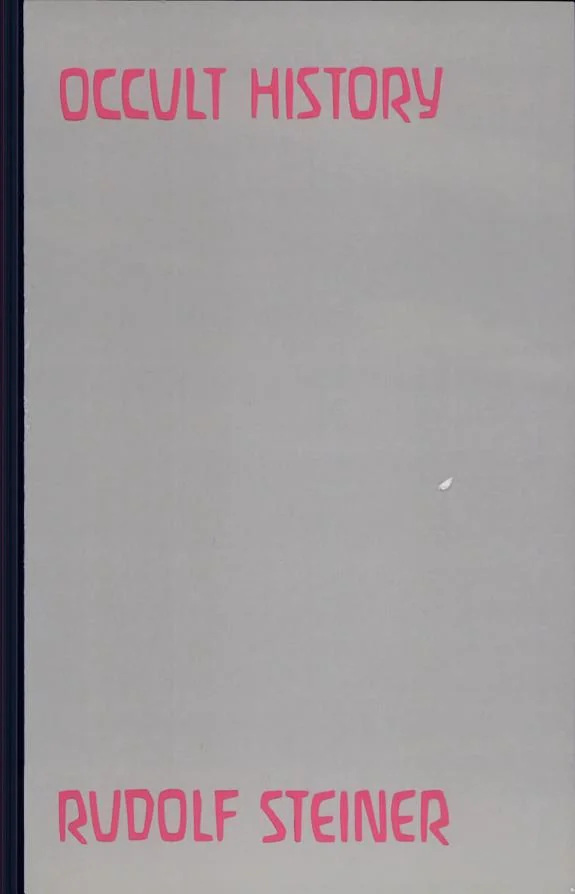
Occult History
 80
80

Occult History
Rudolf Steiner's "Occult History" presents a challenging but rewarding perspective for those interested in spiritual interpretations of human development. Its strength lies in its radical departure from materialist history, offering a comprehensive cosmology that attempts to explain the 'why' behind human and planetary evolution. The work is dense, however, and assumes a significant familiarity with Steiner's broader Anthroposophical framework. A passage discussing the evolution of the human etheric body, for instance, requires considerable prior knowledge of his unique terminology and concepts. While offering a unique lens, its esoteric nature can also be a limitation for readers not already initiated into Steiner's specific spiritual science, making it less accessible than general historical texts. It stands as a monumental, albeit specialized, exploration of cosmic history.
📝 Description
80
Rudolf Steiner's 'Occult History' was published in 1957, presenting a spiritual view of human development.
Rudolf Steiner's 'Occult History' is not a typical history book. Instead, it examines the evolution of human consciousness and the spiritual forces Steiner believed shaped earthly events. He outlines a cosmology that links material history with unseen spiritual realities. Steiner argued that understanding humanity's past and future requires recognizing these hidden dimensions. The book is intended for readers familiar with Anthroposophy or those interested in esoteric philosophy and spiritual science. It is particularly useful for individuals who want to understand history through a non-materialistic perspective. The work touches on concepts like reincarnation, karma, and the role of spiritual beings in human development. It challenges conventional historical views, appealing to those who question purely scientific or materialistic explanations for societal progress.
Rudolf Steiner, a central figure in early 20th-century esoteric thought and the founder of Anthroposophy, developed his spiritual-scientific worldview over many years. 'Occult History' compiles lectures given across his career. His work emerged during a period of growing interest in movements like Theosophy, which he was initially part of. Steiner's unique approach to history focused on spiritual evolution and cosmic influences, distinguishing him from many contemporaries who focused more on magic or divination.
💡 Why Read This Book?
• Gain a unique spiritual-scientific perspective on human history, understanding historical epochs not just as material events but as stages in the evolution of consciousness, as detailed in Steiner's lectures. • Explore the Anthroposophical view of karma and reincarnation as active forces shaping human development and societal progression, a concept central to Steiner's cosmology. • Grasp Steiner's concept of spiritual hierarchies and their role in cosmic evolution, providing a framework for understanding unseen influences on Earthly events as presented in the work.
⭐ Reader Reviews
Honest opinions from readers who have explored this book.
❓ Frequently Asked Questions
What is Rudolf Steiner's "Occult History" fundamentally about?
It's not a conventional history book but an exploration of spiritual science and the evolution of human consciousness, detailing hidden forces and cosmic influences that Steiner believed shaped earthly events and humanity's journey.
When was "Occult History" first published?
The work, which compiles lectures given by Rudolf Steiner, was first published in 1957, though Steiner himself lived from 1861 to 1925.
Is this book suitable for beginners in esoteric studies?
It is best suited for those with some background in Anthroposophy or similar esoteric philosophies. The dense concepts and specific terminology may be challenging for absolute beginners.
What is "spiritual science" according to Steiner?
Spiritual science, or Geisteswissenschaft, is Steiner's term for a method of perceiving and understanding supersensible realities through disciplined inner development and observation.
Does the book discuss specific historical events or figures?
Yes, Steiner interprets historical events and figures through the lens of spiritual evolution, karma, and the influence of spiritual beings, rather than through purely materialistic causes.
Where does "Occult History" fit within Steiner's larger body of work?
It draws upon and elaborates on core Anthroposophical concepts, particularly concerning cosmic and human evolution, making it a significant text for understanding his worldview on history.
🔮 Key Themes & Symbolism
Evolution of Consciousness
The work posits that human history is fundamentally the history of evolving consciousness. Steiner traces this development through various planetary incarnations and distinct human epochs, emphasizing the gradual emergence of individual self-awareness and freedom. He details how consciousness shifted from a collective, instinctual state to the potential for individual, rational thought, driven by spiritual impulses and the influence of spiritual beings guiding this process across vast cosmic timescales.
Spiritual Science (Geisteswissenschaft)
Steiner presents 'spiritual science' as a rigorous, disciplined approach to understanding the supersensible realms, distinct from both materialism and traditional religion. This method involves developing specific faculties of inner perception, allowing one to observe spiritual realities and their interactions with the physical world. The book itself is an application of this science to historical phenomena, seeking to reveal the underlying spiritual dynamics that material science overlooks.
Karma and Reincarnation
Central to Steiner's interpretation of history are the concepts of karma and reincarnation. He argues that individual lives and collective human destiny are shaped by karmic processes unfolding across multiple lifetimes. "Occult History" examines how past actions and spiritual predispositions influence present circumstances and future possibilities, providing a framework for understanding the intricate web of cause and effect that operates on both personal and cosmic levels.
Spiritual Hierarchies
Steiner details the involvement of various orders of spiritual beings, or hierarchies, in the creation and governance of the cosmos and the evolution of humanity. These beings, ranging from Archangels to Seraphim, are presented not as distant deities but as active participants in the developmental processes of planets and humankind. Their work is essential for understanding the impulses and challenges faced by humanity throughout its history.
💬 Memorable Quotes
Direct passages from the work, attributed to the author.
“Human evolution must be understood as a spiritual process.”
— This statement expresses Steiner's core thesis: that the visible changes in human civilization and biology are secondary effects of deeper, unseen spiritual transformations driving consciousness forward.
“The development of the human ego is the culmination of earthly evolution.”
— Steiner highlights the significance of the 'I' or ego, seeing its emergence and strengthening as the primary goal of Earth's spiritual-historical mission, leading to true individual freedom.
“Each epoch has its own specific spiritual task for humanity.”
— This suggests that historical periods are not random but are divinely or cosmically ordained phases, each presenting unique challenges and opportunities for spiritual growth and development.
“Matter is the densest expression of spirit.”
— This paradoxical statement reflects the Anthroposophical view that the physical world is not separate from but is a manifestation of, or a condensation of, underlying spiritual realities.
“The future of humanity depends on understanding its spiritual past.”
— Steiner implies that true progress and the resolution of future challenges are contingent upon recognizing and integrating the spiritual forces and lessons from humanity's prior evolutionary stages.
🌙 Esoteric Significance
Tradition
The work is a foundational text within the tradition of Anthroposophy, a spiritual philosophy founded by Rudolf Steiner. While drawing inspiration from Theosophy and other esoteric streams like Hermeticism and Gnosticism, Steiner developed a distinct 'spiritual science' focused on the evolution of consciousness and the cosmic roles of spiritual hierarchies. "Occult History" fits within this lineage by offering a unique cosmological and historical framework that interprets earthly events through the lens of supersensible realities and human spiritual development.
Symbolism
Key symbols in Steiner's work, often alluded to in "Occult History," include the 'Tree of Knowledge' and the 'Tree of Life,' representing different stages or potentials in cosmic and human evolution. The concept of 'Ahriman' and 'Lucifer' represents dualistic forces that challenge and shape human freedom and consciousness – Ahriman tending towards materialism and rigid intellect, Lucifer towards prideful spiritual independence. These symbolic forces are presented as active agents in human history, influencing societal and individual development.
Modern Relevance
Anthroposophy, and by extension "Occult History," continues to influence various contemporary fields. Waldorf education, biodynamic agriculture, and Anthroposophical medicine are practical applications derived from Steiner's teachings. Modern esoteric thinkers and spiritual practitioners still engage with his cosmological models, particularly his views on consciousness evolution, karma, and the spiritual dimensions of history, seeking alternative frameworks to understand global challenges and personal development beyond purely materialistic paradigms.
👥 Who Should Read This Book
• Students of Rudolf Steiner's Anthroposophy seeking a comprehensive overview of his spiritual interpretation of human and planetary history. • Researchers in comparative religion and esoteric traditions interested in non-materialistic models of historical development and consciousness. • Individuals exploring concepts of karma, reincarnation, and the influence of unseen spiritual forces on human destiny and societal progression.
📜 Historical Context
Rudolf Steiner's "Occult History" emerged from a fertile period of esoteric and spiritual exploration in the late 19th and early 20th centuries. As the founder of Anthroposophy, Steiner himself had a complex relationship with the Theosophical Society, eventually departing in 1912 to establish his own distinct path. His work was contemporary with figures like Annie Besant and C.W. Leadbeater within Theosophy, as well as other occultists and philosophers exploring consciousness and hidden realities. While mainstream historical scholarship of the time, influenced by positivism and scientific materialism, focused on empirical evidence and socio-economic factors, Steiner offered a counter-narrative. His lectures, compiled into "Occult History" and first published in 1957, presented a spiritual-scientific interpretation of human and planetary evolution, positing supersensible forces and cosmic influences as primary drivers. This approach stood in stark contrast to prevailing academic historical methods and even diverged from many spiritualist or occult movements focused on mediumship or ceremonial magic, setting his unique spiritual-scientific perspective apart.
📔 Journal Prompts
The evolution of the human ego as described by Steiner.
Spiritual hierarchies and their impact on historical epochs.
The role of Ahrimanic and Luciferic forces in shaping consciousness.
Interpreting a personal challenge through the lens of karma.
The development of spiritual science as a path to knowledge.
🗂️ Glossary
Anthroposophy
A spiritual philosophy founded by Rudolf Steiner, aiming to provide a path for understanding the spiritual world through 'spiritual science' and fostering human development.
Spiritual Science (Geisteswissenschaft)
Steiner's term for a disciplined, observational approach to perceiving and understanding supersensible realities and spiritual processes.
Karma
In Steiner's view, the law of cause and effect governing moral and spiritual consequences across lifetimes, shaping individual and collective destiny.
Reincarnation
The concept that the human soul or spirit undergoes successive earthly lives, learning and evolving through each incarnation.
Epochs (Planetary/Human)
Distinct periods in cosmic and human history characterized by specific evolutionary tasks and the development of particular faculties or forms of consciousness.
Spiritual Hierarchies
Orders of spiritual beings (e.g., Angels, Archangels, Thrones) that are understood to guide and participate in the cosmic and human evolutionary processes.
Ahriman/Lucifer
Dualistic spiritual forces Steiner identified as influencing human consciousness: Ahriman representing materialism and rigid intellect, Lucifer representing prideful spiritual individualism.
🔮 Readers Also Liked
Browse all →









More by Rudolf Steiner
All books →



More Free Occult Philosophy Books
View all →