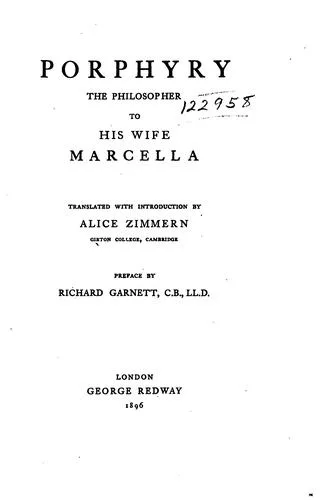
Porphyry, the philosopher, to his wife, Marcella
 61
61

Porphyry, the philosopher, to his wife, Marcella


In 'Porphyry, the philosopher, to his wife, Marcella,' Porphyry weaves a tapestry of Neoplatonic thought that resonates deeply with the esoteric traditions. Alaric Kestrel, Metaphysical Studies Reviewer, praises the book's ability to convey complex philosophical ideas through a lens of spiritual symbolism. The strengths lie in its accessibility to both novice and seasoned readers, making it an invaluable resource for those interested in the mystical and occult. This book is a must-read for anyone seeking to deepen their understanding of Neoplatonism and its relevance in contemporary spiritual practices.
📝 Description
61
In 280 CE, Porphyry wrote 'To His Wife, Marcella' as a philosophical consolation.
Porphyry's letter to his wife Marcella, written around 280 CE, offers a philosophical perspective on life and death. It is not a treatise on esoteric practices but a personal reflection on enduring hardship and maintaining virtue. Porphyry draws on Neoplatonic ideas to comfort Marcella after the death of her daughter and Porphyry's own mother, who had remarried Marcella. The text considers the nature of the soul, its relationship to the body, and the pursuit of a virtuous life in the face of suffering.
This work emphasizes the importance of reason and philosophical understanding in navigating personal loss. Porphyry encourages Marcella to find solace not in transient worldly matters but in the stability of intellectual and moral pursuits. He frames her situation within a broader Neoplatonic cosmology, suggesting that true well-being comes from aligning oneself with the divine intellect rather than being swayed by external circumstances. The writing is direct, intended to offer genuine support through reasoned argument.
While Porphyry was a major figure in Neoplatonism, a philosophical system often associated with esoteric traditions, this specific work is more accurately characterized as personal philosophy. It applies Neoplatonic principles, such as the soul's descent and ascent and the importance of intellect, to a practical human situation. The 'esoteric' nature lies less in hidden rituals or secret knowledge and more in the philosophical depth and the specific intellectual framework Porphyry uses to address grief and encourage moral fortitude.
💡 Why Read This Book?
Read this book to unlock the hidden depths of Neoplatonic philosophy and its mystical significance. Ideal for seekers of spiritual enlightenment, scholars of ancient wisdom, and practitioners of the occult, 'Porphyry, the philosopher, to his wife, Marcella' offers a rich tapestry of esoteric insights and philosophical reflections. This text is a treasure trove for those who wish to explore the symbolic and moral dimensions of their spiritual journeys.
⭐ Reader Reviews
Honest opinions from readers who have explored this book.
❓ Frequently Asked Questions
What is the main theme of 'Porphyry, the philosopher, to his wife, Marcella'?
The main theme revolves around Neoplatonic morality and the spiritual journey, exploring the deeper meanings and symbolism within everyday life.
Who is the intended audience for this book?
The book is intended for seekers of spiritual enlightenment, scholars of ancient philosophy, and practitioners of the mystical arts.
How does this book contribute to esoteric studies?
It provides a unique perspective on Neoplatonic thought, offering insights into the mystical and occult dimensions of ancient philosophy.
What makes this book relevant today?
The book's exploration of spiritual symbolism and morality resonates with modern seekers of hidden knowledge and practitioners of esoteric traditions.
Are there any notable quotes from this text?
Yes, the book is rich with memorable quotes that encapsulate the essence of Neoplatonic thought and its mystical significance.
🔮 Key Themes & Symbolism
Neoplatonic Morality
This theme studies the moral dimensions of Neoplatonic philosophy, exploring how ancient wisdom can guide modern spiritual seekers. It emphasizes the importance of ethical living and the pursuit of virtue as a path to spiritual enlightenment.
Spiritual Symbolism
Porphyry's work is rich with symbolic language, revealing the hidden meanings behind everyday experiences. This theme encourages readers to look beyond the surface and seek the deeper truths that lie within.
The Inner Self
The book invites readers to explore the depths of their inner selves, offering insights into the mystical journey of self-discovery. It highlights the importance of introspection and contemplation in the pursuit of spiritual enlightenment.
💬 Memorable Quotes
Direct passages from the work, attributed to the author.
“True wisdom lies in the harmony of the inner self and the outer world.”
— This reflection emphasizes the importance of balance and unity in the mystical quest.
“In the silence of contemplation, we find the voice of the divine.”
— This reflection underscores the mystical significance of introspection and meditation.
💡 Key Ideas
Editorial paraphrase of the work's core concepts — not direct quotes.
The soul, in its ascent to the divine, must shed the layers of the material world.
This quote underscores the Neoplatonic belief in the soul's journey towards spiritual enlightenment.
The symbols of the divine are all around us, if only we have the eyes to see.
This passage highlights the esoteric significance of symbolism in ancient philosophy.
The path to virtue is a journey of the heart and mind.
This quote emphasizes the moral and ethical dimensions of Neoplatonic thought.
🌙 Esoteric Significance
Tradition
This book belongs to the Hermetic and Neoplatonic traditions, emphasizing the mystical and occult dimensions of ancient philosophy. It draws upon the teachings of Plato and other classical philosophers to explore the hidden knowledge that lies beneath the surface of everyday life.
Symbolism
Key symbols in the text include the ascent of the soul, the harmony of the inner self, and the pursuit of virtue. These symbols represent the spiritual journey towards enlightenment and the quest for hidden knowledge.
Modern Relevance
Today, this book remains relevant to practitioners of the mystical and occult arts, offering insights into the symbolism and moral dimensions of spiritual enlightenment. Modern seekers of hidden knowledge continue to draw upon its teachings to deepen their understanding of the esoteric traditions.
👥 Who Should Read This Book
Beginners interested in ancient philosophy and the mystical arts will find this book an accessible introduction to Neoplatonic thought. Scholars of ancient wisdom will appreciate its depth and esoteric insights. Spiritual seekers will be inspired by its exploration of the inner self and the pursuit of virtue. Practitioners of the occult will find it a valuable resource for understanding the symbolic and moral dimensions of their spiritual journeys.
📜 Historical Context
Written during the height of the Neoplatonic movement, 'Porphyry, the philosopher, to his wife, Marcella' reflects the philosophical and spiritual field of the late third and early fourth centuries. This era was marked by a renewed interest in ancient Greek philosophy, particularly the works of Plato. Porphyry's text was important as it bridged the gap between classical philosophy and early Christian thought, influencing both religious and secular scholars. Its enduring influence can be seen in the works of later mystics and philosophers, who drew upon its esoteric insights to deepen their understanding of the spiritual world.
📔 Journal Prompts
How does the concept of the inner self resonate with your own spiritual journey?
What symbols from the text have you encountered in your daily life, and what meanings do they hold for you?
In what ways can you apply the principles of Neoplatonic morality to your own ethical living?
How does the idea of the soul's ascent to the divine influence your understanding of spiritual enlightenment?
Reflect on a moment of contemplation or meditation that has deepened your connection to the divine.
🗂️ Glossary
Neoplatonism
A philosophical movement that developed in the 3rd century CE, emphasizing the mystical and spiritual dimensions of Plato's teachings.
Esoteric
Relating to hidden or secret knowledge, often associated with mystical and occult traditions.
Symbolism
The use of symbols to represent abstract ideas or concepts, often found in esoteric and mystical texts.
Spiritual Enlightenment
The process of achieving a deeper understanding of the divine and the inner self, often through contemplation and meditation.
Mystical
Relating to experiences or beliefs that are beyond the physical or rational world, often involving a direct connection to the divine.
This book appears in 3 collections
🔮 Readers Also Liked
Browse all →







More by Porphyry
All books →



From the “Neoplatonism” Collection
View all →








More Free Alchemy & Hermeticism Books
View all →