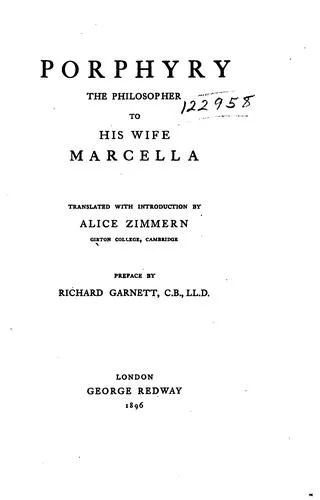
Porphyry, the Philosopher, to Marcella

 62
62

Porphyry, the Philosopher, to Marcella



Review by Aurelia Blackwood (Occult Philosophy Critic) — 'Porphyry's 'To Marcella' is a treasure trove of esoteric insights, blending Neoplatonic philosophy with Hermetic mysticism. The work is a profound exploration of divine wisdom and the ascent to the One, making it an essential read for those delving into the mysteries of the ancient world. Porphyry's eloquent prose and deep philosophical insights make this text a must-have for scholars and practitioners of the occult. The symbolic richness and ethical teachings embedded within the text offer a unique perspective on the nature of the soul and its journey towards spiritual enlightenment. This work is not just a historical artifact but a living testament to the enduring relevance of esoteric thought.'
📝 Description
62
In 260 CE, Porphyry wrote 'To Marcella,' a personal letter on Neoplatonic philosophy.
Porphyry composed 'To Marcella' around 260 CE, addressing a woman named Marcella. This short work focuses on the Neoplatonic path to understanding the divine and achieving spiritual ascent. Porphyry discusses the nature of God, the human soul, and the ethical conduct required for this journey. The text is rich with symbolism drawn from the philosophical traditions Porphyry engaged with. It balances philosophical reasoning with contemplative practices, aiming to guide the reader toward a deeper understanding of spiritual realities. The letter is intended for those interested in the philosophical underpinnings of esoteric traditions.
The work is not a lengthy treatise but a focused exposition. Porphyry's writing style is clear, despite the complex subject matter. He emphasizes the importance of both intellectual grasping and inner disposition in the pursuit of wisdom. The text serves as a concise introduction to key Neoplatonic ideas as filtered through Porphyry's own thought. It is a valuable document for understanding the personal and didactic aspects of late antique philosophy.
Porphyry's 'To Marcella' is situated within the Neoplatonic school, which emerged in the 3rd century CE. This tradition, building on Plato's philosophy, sought to explain the nature of reality through a hierarchical system emanating from a supreme, ineffable principle often called 'The One'. Porphyry, a student of Plotinus, was a key figure in systematizing and disseminating Neoplatonic thought. His work often engaged with other contemporary philosophical and religious currents, including Hermeticism and Gnosticism, though 'To Marcella' remains primarily focused on core Neoplatonic principles. The letter reflects the broader esoteric interest in spiritual purification and intellectual ascent to the divine.
💡 Why Read This Book?
Read 'To Marcella' to immerse yourself in the mystical depths of Neoplatonic philosophy. This book is ideal for seekers of hidden knowledge, scholars of ancient ethics, and practitioners of the esoteric arts. It offers profound insights into the nature of God, the soul, and the path to spiritual enlightenment, making it a valuable resource for those on a spiritual journey.
⭐ Reader Reviews
Honest opinions from readers who have explored this book.
❓ Frequently Asked Questions
What is the primary theme of 'To Marcella'?
The primary theme of 'To Marcella' is the mystical ascent to the One, exploring the nature of God, the soul, and the path to spiritual enlightenment through Neoplatonic philosophy and Hermetic symbolism.
Who is the intended audience for this book?
The intended audience includes scholars of ancient philosophy, practitioners of the occult, and seekers of hidden knowledge. It is particularly valuable for those interested in Neoplatonic thought and its influence on Western mysticism.
What makes 'To Marcella' significant in the realm of esoteric literature?
'To Marcella' is significant for its blend of Neoplatonic philosophy and Hermetic mysticism, offering deep insights into divine wisdom and the ascent to the One. It is a key text for understanding the esoteric traditions of the ancient world.
How does Porphyry's writing style contribute to the book's mystical atmosphere?
Porphyry's writing style is rich with symbolism and philosophical depth, creating an atmosphere of profound spiritual inquiry. His eloquent prose weaves together ethical teachings and mystical contemplation, making the text both intellectually stimulating and spiritually enlightening.
Are there any modern practitioners who use 'To Marcella' in their work?
Yes, modern practitioners of Neoplatonic philosophy, Hermeticism, and other esoteric traditions often refer to 'To Marcella' for its insights into divine wisdom and the nature of the soul. It remains a valuable resource for those seeking to understand the mystical aspects of ancient thought.
🔮 Key Themes & Symbolism
The Mystical Ascent
The mystical ascent to the One is a central theme in 'To Marcella,' exploring the journey of the soul towards divine union. Porphyry's text examines the hidden areas of spiritual enlightenment, offering insights into the nature of God and the soul's quest for unity with the divine.
Neoplatonic Philosophy
This work is a profound exploration of Neoplatonic thought, blending philosophical inquiry with mystical contemplation. Porphyry's discussions on the nature of the One, the soul, and the hierarchy of being provide a body of esoteric wisdom.
Symbolism and Ethical Teachings
Rich with symbolism, 'To Marcella' combines ethical teachings and mystical insights. Porphyry's use of allegory and symbolism creates a layered narrative that invites deep reflection and spiritual growth. The text's ethical dimensions highlight the importance of virtuous living in the journey towards divine union.
💬 Memorable Quotes
Direct passages from the work, attributed to the author.
“Divine wisdom is hidden in the depths of the esoteric.”
— Porphyry emphasizes the need for seekers to look at the hidden areas of knowledge to uncover divine truths.
“Symbolism is the language of the divine.”
— Porphyry's use of symbolism reflects the esoteric nature of his teachings, inviting readers to interpret the deeper meanings hidden within his words.
💡 Key Ideas
Editorial paraphrase of the work's core concepts — not direct quotes.
The soul's journey is a mystical ascent to the divine.
This line underscores the central theme of the soul's quest for union with the One, highlighting the mystical nature of spiritual enlightenment.
The path to enlightenment is paved with ethical virtue.
This quote highlights the importance of ethical living in the journey towards spiritual enlightenment, blending philosophy and mysticism.
The One is the source of all existence.
This line underscores the central role of the One in Neoplatonic thought, emphasizing the divine origin of all being.
🌙 Esoteric Significance
Tradition
Belonging to the Hermetic and Neoplatonic traditions, 'To Marcella' is an important work in the study of esoteric philosophy. It explores the mystical ascent to the One, blending philosophical inquiry with spiritual contemplation. This text is a core part of Western mysticism, influencing generations of seekers and scholars.
Symbolism
Key symbols in 'To Marcella' include the One, the soul, and the hierarchy of being. These symbols represent the divine, the individual's spiritual journey, and the structured path to enlightenment. Porphyry's use of allegory and metaphor enriches the text's esoteric depth, inviting readers to explore its hidden meanings.
Modern Relevance
Today, 'To Marcella' remains relevant for practitioners of Neoplatonic philosophy, Hermeticism, and other esoteric traditions. Modern scholars and seekers refer to this text for its insights into divine wisdom and the nature of the soul. Its timeless themes continue to inspire spiritual inquiry and mystical exploration.
👥 Who Should Read This Book
Beginners interested in esoteric literature will find 'To Marcella' an accessible introduction to Neoplatonic thought and Hermetic mysticism. Scholars of ancient philosophy will appreciate its deep philosophical insights and historical significance. Spiritual seekers will be drawn to its mystical themes and ethical teachings, while practitioners of the occult will value its esoteric wisdom and symbolic richness.
📜 Historical Context
Written in the third century CE, 'To Marcella' reflects the intellectual and spiritual climate of the late Roman Empire. Porphyry, a student of Plotinus, was a key figure in the development of Neoplatonic thought, which sought to reconcile Plato's philosophy with the mystical traditions of the ancient world. This work was influential in shaping the esoteric traditions of the Middle Ages and Renaissance, offering a bridge between ancient wisdom and medieval mysticism.
📔 Journal Prompts
Reflect on the concept of the mystical ascent to the One. How does this idea resonate with your own spiritual journey?
Consider the role of symbolism in Porphyry's teachings. What symbols in the text speak to you personally?
How does Porphyry's blend of philosophy and mysticism influence your understanding of spiritual enlightenment?
Explore the ethical dimensions of 'To Marcella.' How do these teachings apply to your daily life?
Imagine the soul's journey towards divine union. What obstacles and rewards might this journey entail?
🗂️ Glossary
Neoplatonism
A philosophical and mystical tradition that combines Plato's ideas with elements of Eastern thought, emphasizing the ascent of the soul to the divine.
The One
In Neoplatonic thought, the ultimate principle of reality, the source of all existence and the goal of spiritual ascent.
Hermeticism
An esoteric tradition based on the writings attributed to Hermes Trismegistus, blending Egyptian, Greek, and Jewish mystical ideas.
Divine Wisdom
The hidden knowledge of the divine, sought through mystical contemplation and philosophical inquiry.
Mystical Ascent
The spiritual journey of the soul towards union with the divine, often involving stages of purification and illumination.
This book appears in 2 collections
🔮 Readers Also Liked
Browse all →







More by Porphyry
All books →


From the “Neoplatonism” Collection
View all →





More Free Alchemy & Hermeticism Books
View all →