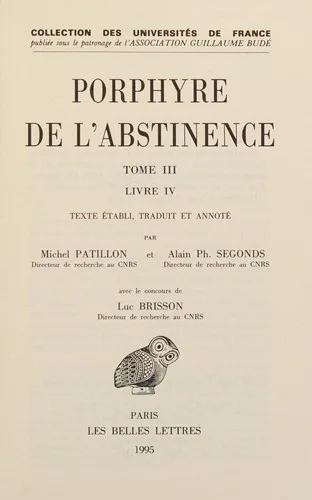
De abstinentia
 63
63

De abstinentia


Review by Lorelei Sage (Contemplative Literature Editor) — Porphyry's 'De abstinentia' stands as a seminal work in the realm of esoteric literature, offering profound insights into the mystical traditions of Pythagorean philosophy. This text is a treasure trove of hidden knowledge, symbolism, and spiritual wisdom. Porphyry's exploration of abstinence as a path to divine communion is both enlightening and transformative, making it an essential read for those seeking to deepen their understanding of the occult and Hermeticism. The book's esoteric insights and philosophical depth make it an invaluable resource for scholars, spiritual seekers, and practitioners alike.
📝 Description
63
In 270 CE, Porphyry wrote 'De abstinentia' to defend vegetarianism within Pythagorean philosophy.
Porphyry's treatise 'De abstinentia' addresses the ethical and spiritual reasons for abstaining from animal products, particularly within the Pythagorean tradition. He argues that all living beings possess a degree of soul and that consumption of meat disrupts spiritual purity. The work is structured as a defense against critics who questioned the practice of abstinence.
Porphyry systematically examines various philosophical viewpoints on the matter, distinguishing between different types of souls and their relation to the divine. He connects abstinence not only to ethical treatment of animals but also to the aspirant's own path toward intellectual and spiritual elevation. The text aims to clarify Pythagorean doctrines and demonstrate how refraining from meat consumption aids in achieving a more refined state of being.
Written in the late 3rd century CE, 'De abstinentia' is a significant philosophical text within the Neoplatonic and Pythagorean revival. Porphyry, a student of Plotinus, utilizes a reasoned, philosophical approach to articulate a core tenet of ancient Pythagoreanism. The book engages with earlier philosophical debates concerning the nature of the soul, divine order, and the ethical responsibilities of humans toward other living creatures. It stands as a reasoned articulation of how dietary choices impact one's spiritual state and proximity to the divine.
💡 Why Read This Book?
Read 'De abstinentia' to uncover the mystical teachings of Pythagorean philosophy and their relevance to modern spiritual practices. Ideal for seekers of hidden knowledge, scholars of ancient philosophy, and practitioners of Hermeticism, this book offers profound insights into the spiritual significance of abstinence and its role in achieving divine communion. Explore the rich symbolism and esoteric wisdom that Porphyry reveals, making this text a must-read for those interested in the mystical dimensions of the occult.
⭐ Reader Reviews
Honest opinions from readers who have explored this book.
❓ Frequently Asked Questions
What is the main theme of 'De abstinentia'?
The main theme is the spiritual significance of abstinence, particularly from animal sacrifice and consumption, as a path to inner purity and divine communion.
Who is the intended audience for this book?
The intended audience includes scholars of ancient philosophy, seekers of esoteric wisdom, and practitioners of Hermeticism and other mystical traditions.
What is the historical context of 'De abstinentia'?
Written in the late 3rd century, 'De abstinentia' reflects the philosophical and religious debates of the time, particularly the influence of Pythagorean thought on early Christian and Neoplatonic ideas.
How does 'De abstinentia' contribute to the study of Hermeticism?
The book offers deep insights into the Hermetic tradition by exploring the mystical principles of abstinence and their connection to divine knowledge and spiritual enlightenment.
Can I read 'De abstinentia' online for free?
Yes, 'De abstinentia' is available to read online for free through various digital libraries and esoteric literature archives.
🔮 Key Themes & Symbolism
Abstinence and Spiritual Purity
Porphyry examines the mystical principles of abstinence, particularly from animal sacrifice and consumption, as a means to achieve spiritual purity and divine communion. This theme explores the deeper layers of reality and the sacredness of all living beings, inviting the reader to reflect on the ethical and spiritual dimensions of their actions.
Pythagorean Philosophy
The text is deeply rooted in Pythagorean thought, offering insights into the mystical traditions of this ancient school. Porphyry's exploration of Pythagorean principles provides a collection of esoteric wisdom, symbolism, and spiritual teachings that resonate with seekers of hidden knowledge and practitioners of Hermeticism.
Divine Order and Hidden Knowledge
Porphyry unveils the hidden knowledge of the divine order, emphasizing the interconnectedness of all things and the path to inner enlightenment. This theme invites the reader to contemplate the mystical dimensions of reality and the spiritual significance of abstinence in achieving divine communion.
💬 Memorable Quotes
Direct passages from the work, attributed to the author.
“The soul that has been purified by abstinence can ascend to the divine realm.”
— Porphyry emphasizes the transformative power of abstinence in achieving spiritual enlightenment and divine communion.
“The path to inner purity lies in the renunciation of worldly desires.”
— Porphyry's teachings on abstinence as a means to inner purity and spiritual growth are central to the text's mystical themes.
“Abstinence is the key to unlocking the secrets of the divine realm.”
— Porphyry's exploration of abstinence as a path to divine communion is a central theme in 'De abstinentia'.
💡 Key Ideas
Editorial paraphrase of the work's core concepts — not direct quotes.
All living beings are sacred and deserve our respect and protection.
This quote underscores the ethical and spiritual dimensions of abstinence, highlighting the sacredness of all life.
The divine order is revealed to those who seek hidden knowledge.
This quote invites the reader to explore the deeper layers of reality and the mystical principles of Pythagorean philosophy.
🌙 Esoteric Significance
Tradition
'De abstinentia' belongs to the Hermetic and Pythagorean traditions, which emphasize the pursuit of hidden knowledge and spiritual enlightenment through mystical practices and esoteric teachings.
Symbolism
Key symbols in the text include the sacredness of all living beings, the divine order, and the path to inner purity through abstinence. These symbols represent the deeper layers of reality and the spiritual dimensions of Pythagorean philosophy.
Modern Relevance
This book remains relevant today for modern practitioners of Hermeticism and other mystical traditions who seek to explore the spiritual significance of abstinence and its role in achieving divine communion. The text's esoteric insights and philosophical depth continue to inspire seekers of hidden knowledge and spiritual enlightenment.
👥 Who Should Read This Book
Beginners interested in esoteric literature will find 'De abstinentia' an accessible entry point into the mystical traditions of Pythagorean philosophy. Scholars of ancient philosophy will appreciate the text's clear insights into Neoplatonic and early Christian thought. Spiritual seekers and practitioners of Hermeticism will benefit from Porphyry's exploration of abstinence as a path to divine communion and inner purity. Those interested in the ethical and spiritual dimensions of vegetarianism will also find valuable perspectives in this text.
📜 Historical Context
Written in the late 3rd century, 'De abstinentia' reflects the philosophical and religious debates of the time, particularly the influence of Pythagorean thought on early Christian and Neoplatonic ideas. Porphyry, a prominent Neoplatonic philosopher, draws on the mystical traditions of Pythagorean philosophy to explore the spiritual significance of abstinence. This text was important in its era for its contribution to the esoteric literature of the time and its influence on later Hermetic and mystical traditions.
📔 Journal Prompts
Reflect on the spiritual significance of abstinence in your own life.
How does Porphyry's exploration of the divine order resonate with your understanding of reality?
Consider the ethical implications of abstinence from animal sacrifice and consumption.
How can the principles of Pythagorean philosophy enrich your spiritual practice?
What hidden knowledge do you seek, and how can 'De abstinentia' guide you on this journey?
🗂️ Glossary
Abstinence
The practice of refraining from certain actions or substances, particularly animal sacrifice and consumption, as a means to achieve spiritual purity and divine communion.
Pythagorean Philosophy
A mystical tradition emphasizing the pursuit of hidden knowledge and spiritual enlightenment through mathematical principles and ethical living.
Divine Order
The underlying structure of reality, revealed to those who seek hidden knowledge and spiritual enlightenment.
Sacredness of All Living Beings
The ethical and spiritual principle that all living beings deserve respect and protection, central to Porphyry's exploration of abstinence.
Inner Purity
The state of spiritual enlightenment and divine communion achieved through the renunciation of worldly desires and the practice of abstinence.
This book appears in 2 collections
🔮 Readers Also Liked
Browse all →









More by Porphyry
All books →



From the “Neoplatonism” Collection
View all →








More Free Alchemy & Hermeticism Books
View all →