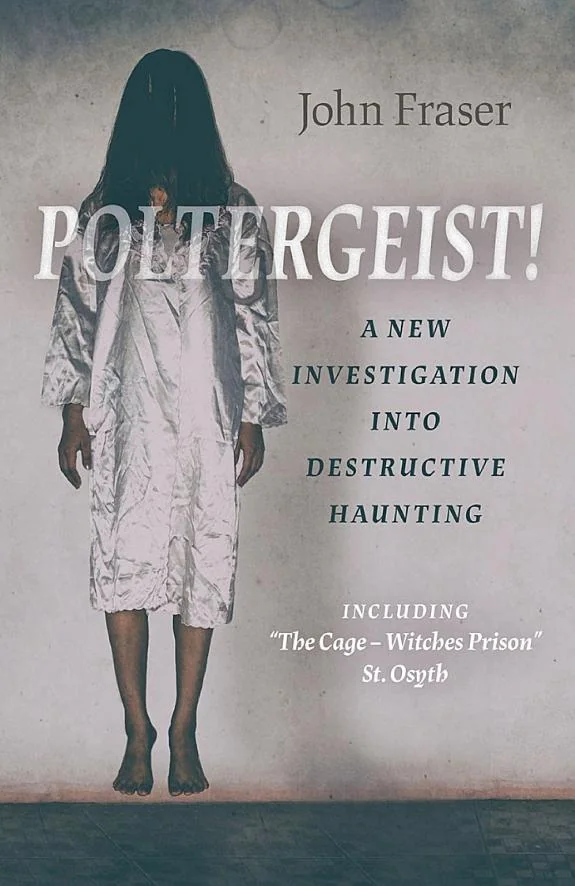
Poltergeist! A New Investigation Into Destructive Haunting
 73
73

Poltergeist! A New Investigation Into Destructive Haunting
Fraser's "Poltergeist!" offers a much-needed empirical approach to a topic often mired in lurid speculation. The strength of the book lies in its meticulous cataloging of historical cases and its attempt to connect them to broader theories of psychokinesis, particularly the concept of Recurrent Spontaneous Psychokinesis (RSPK). Fraser's analysis of the Borley Rectory, for instance, provides a sober look at a famous case. However, the work sometimes feels overly academic, occasionally sacrificing narrative momentum for theoretical exploration. The discussion around the Isle of Man cases, while informative, could benefit from a more direct engagement with the emotional impact on those involved. Despite this, Fraser provides a valuable update to the field, synthesizing decades of research into a coherent framework.
📝 Description
73
John Fraser's 1985 book investigates destructive hauntings, moving beyond anecdotes to structured analysis.
John Fraser's "Poltergeist! A New Investigation Into Destructive Haunting" confronts the persistent, often sensationalized, paranormal phenomenon of poltergeists. This work moves beyond simple anecdotal accounts to offer a structured examination of events characterized by physical disturbances. Fraser attempts to categorize and understand these occurrences, differentiating them from other spectral manifestations. The book suggests that poltergeist activity, despite its chaotic appearance, may follow recognizable patterns and psychological correlations.
This book targets individuals seeking a deeper, more analytical understanding of poltergeist phenomena, rather than fleeting sensationalism. It speaks to those who have encountered or studied anomalous physical events and wish to examine established theories and historical cases. Readers who value rigorous analysis and historical grounding in paranormal research will find this study useful. It is for the dedicated researcher who requires more than folklore.
Fraser situates his work within the broader history of paranormal investigation, referencing Colin Wilson's earlier text, "Poltergeist!". The book traces the lineage of poltergeist research, acknowledging early explorations of unexplained physical disturbances. It provides an overview of how the concept evolved from folklore to more systematic investigations in the 20th century, setting the stage for contemporary analysis.
This work engages with the spiritualist tradition's long-standing interest in disembodied intelligence and its potential to interact physically with the world. It specifically addresses the poltergeist phenomenon, a subset of spiritualist and parapsychological inquiry focused on unexplained physical disturbances. By examining potential psychological triggers and patterns, Fraser connects these manifestations to broader discussions within esoteric thought about the mind's influence on reality and the nature of subtle energies.
💡 Why Read This Book?
• Learn about the specific criteria that distinguish poltergeist activity from other hauntings, as detailed in Fraser's comparative analysis of phenomena like the Drummer of Tedworth case. • Understand the historical evolution of poltergeist research, tracing its development from early accounts to the RSPK theory developed by figures like Colin Wilson. • Gain insight into the psychological correlations often observed in poltergeist cases, examining how adolescent agents and environmental factors are presented in the book's case studies.
⭐ Reader Reviews
Honest opinions from readers who have explored this book.
❓ Frequently Asked Questions
What is the primary difference between a poltergeist and a ghost according to John Fraser?
Fraser distinguishes poltergeists from typical ghosts by focusing on physical disturbances and movement of objects, often linked to a living human agent, rather than apparitions or residual hauntings.
What historical locations are discussed in "Poltergeist! A New Investigation"?
The book examines significant locations in poltergeist research, including the infamous Borley Rectory and phenomena reported from the Isle of Man.
What is RSPK and how does it relate to poltergeist activity?
RSPK, or Recurrent Spontaneous Psychokinesis, is a key concept Fraser explores. It posits that poltergeist phenomena are generated by a living individual's subconscious psychic energy.
Does the book offer practical advice for dealing with poltergeist activity?
While grounded in investigation, the book primarily focuses on theoretical and historical analysis rather than providing direct practical guidance for dealing with hauntings.
How does Fraser's work update Colin Wilson's research?
Fraser advances Wilson's foundational work by incorporating more recent case studies and theoretical developments in parapsychology, offering an updated perspective on poltergeist phenomena.
What is the author's stance on the cause of poltergeist events?
Fraser leans towards a psychokinetic explanation, suggesting that the phenomena are often generated by human agents, though he acknowledges the complexity and ongoing debate.
🔮 Key Themes & Symbolism
The Human Agent in Poltergeists
Fraser dedicates significant attention to the role of the 'human agent' in poltergeist phenomena. This concept, central to RSPK theory, suggests that a living individual, often an adolescent experiencing emotional turmoil, is the source of the physical disturbances. The book explores how this individual acts as an unconscious conduit for psychokinetic energy, leading to objects moving, noises, and other disruptive events. Fraser contrasts this with theories positing external spirits, grounding the explanation in observable psychological and energetic patterns.
Distinguishing Poltergeist Phenomena
A core theme is the precise definition and categorization of poltergeist activity. Fraser meticulously outlines how these events differ from typical hauntings involving apparitions or residual energy. He focuses on the characteristic physical manifestations: rappings, furniture movement, and object displacement. By isolating these specific features, the book aims to bring clarity to a complex area of parapsychology, separating genuine physical disturbances from more subtle or visual spectral encounters.
Historical Case Studies and Analysis
The work provides a detailed historical overview, referencing classic cases like the Drummer of Tedworth and the phenomena at Borley Rectory. Fraser analyzes these historical accounts through the lens of contemporary parapsychological theories, particularly RSPK. He examines how earlier interpretations might align with or diverge from modern understandings, demonstrating the evolution of thought on destructive hauntings. This historical grounding is crucial for understanding the development of the field.
Psychokinesis and Energy Dynamics
Fraser explores the underlying mechanisms of psychokinesis (PK) as a potential explanation for poltergeist activity. The book examines theories suggesting that PK is not necessarily a supernatural force but an extension of human consciousness or bio-energy. It examines how intense emotional states or psychological pressures might facilitate the release of this energy, leading to physical effects in the environment. This perspective frames poltergeist events as complex energetic interactions.
💬 Memorable Quotes
Direct passages from the work, attributed to the author.
“The study of poltergeist phenomena is often obscured by sensationalism and folklore.”
— This statement highlights Fraser's intention to provide a factual, investigative approach to a subject frequently distorted by sensationalized media and unsubstantiated tales, aiming for a more grounded understanding.
“Distinguishing between a poltergeist and a residual haunting is crucial for accurate analysis.”
— This points to the book's focus on categorization, emphasizing that understanding the specific nature of paranormal events—whether a poltergeist's physical disturbances or a ghost's residual energy—is key to proper investigation.
“The concept of the human agent offers a coherent framework for understanding recurrent psychokinetic events.”
— Fraser presents the 'human agent' theory as a primary explanatory model, suggesting that a living person's psychological state is central to triggering the physical phenomena associated with poltergeists.
“Historical accounts must be critically re-examined through modern parapsychological lenses.”
— This reflects the book's methodology: applying current scientific and theoretical understanding to historical paranormal cases, such as those from the Borley Rectory, to derive new insights.
“Poltergeist activity is characterized by physical disturbances rather than mere spectral apparitions.”
— This concise definition emphasizes the empirical focus of the book, prioritizing observable physical effects over visual manifestations in defining and studying poltergeist phenomena.
🌙 Esoteric Significance
Tradition
While not strictly confined to a single esoteric lineage, Fraser's work intersects with traditions that explore the power of consciousness and subtle energies. It aligns with aspects of Western Esotericism that investigate mind-matter interaction, such as certain branches of psychical research influenced by Theosophy or later New Age thought, which posit that human consciousness can directly affect the physical world. Fraser's focus on the 'human agent' echoes Gnostic ideas about hidden potentials within humanity, though his approach is framed within a parapsychological rather than purely spiritual context.
Symbolism
The primary 'symbol' within the book is the poltergeist itself, representing uncontrolled, disruptive psychic energy, often manifesting unconsciously. The 'human agent,' particularly adolescents, becomes a symbol of untapped potential and emotional turbulence interacting with the physical plane. Locations like Borley Rectory function as symbolic sites of concentrated anomalous energy or historical psychic residue, serving as focal points for investigation into the nature of hauntings.
Modern Relevance
Fraser's work remains relevant to contemporary parapsychological researchers, occult investigators, and those exploring consciousness studies. Thinkers in fields like consciousness science and parapsychology continue to reference and debate the theories of RSPK and the human agent. Modern practitioners exploring energy healing or psychic development might find Fraser's analysis of consciousness influencing matter informative, even if they approach it from different theoretical frameworks than the book's specific parapsychological stance.
👥 Who Should Read This Book
• Dedicated paranormal investigators seeking to understand the specific dynamics of physical hauntings beyond anecdotal accounts. • Students of parapsychology interested in the historical development and theoretical frameworks of poltergeist research, particularly RSPK. • Readers fascinated by the intersection of psychology and anomalous phenomena, exploring how human consciousness might influence the material world.
📜 Historical Context
Published in 2020, John Fraser's "Poltergeist! A New Investigation Into Destructive Haunting" emerges in an era where parapsychology continues to grapple for mainstream acceptance, decades after its peak of public fascination. The work directly engages with the legacy of Colin Wilson, whose influential "Poltergeist!" predates Fraser's by over thirty-eight years. Fraser's study updates the discourse, referencing key developments in psychokinesis research and the RSPK theory, which gained traction in the mid-20th century through researchers like G.W. Meek and later William Roll. While Wilson's work was a broad exploration, Fraser's seeks a more focused, analytical approach, attempting to synthesize case studies and theoretical frameworks that have evolved since the 1980s. The intellectual currents influencing Fraser include ongoing debates within parapsychology regarding the validity of psychical phenomena and the challenge of empirical verification in a field often resistant to conventional scientific methods.
📔 Journal Prompts
The concept of the human agent and its potential role in poltergeist phenomena.
Historical accounts of the Borley Rectory and their interpretation.
The distinction between poltergeist activity and residual hauntings.
Theories of Recurrent Spontaneous Psychokinesis (RSPK) and their implications.
Personal reflections on unexplained physical disturbances.
🗂️ Glossary
Poltergeist
A type of paranormal phenomenon characterized by physical disturbances such as loud noises, moving objects, and physical assaults, often attributed to a living human agent.
RSPK
Recurrent Spontaneous Psychokinesis; a theory proposing that poltergeist phenomena are caused by the subconscious psychic energy of a living person.
Human Agent
The individual, often an adolescent, believed to be the source of RSPK phenomena due to their psychological state or emotional turmoil.
Psychokinesis (PK)
The purported ability to influence a physical system by thought alone, without physical intervention. A central concept in poltergeist explanations.
Residual Haunting
A type of haunting believed to be caused by an imprint of past events or energies, distinct from intelligent or interactive hauntings like poltergeists.
Apparition
A visual manifestation of a spirit or ghost, typically considered a different category of paranormal event than physical poltergeist activity.
Borley Rectory
A famous allegedly haunted location in England, frequently cited in the history of paranormal investigations and discussed within the context of poltergeist studies.
This book appears in 1 collection
🔮 Readers Also Liked
Browse all →








From the “Poltergeist” Collection
View all →








More Free Occult Philosophy Books
View all →