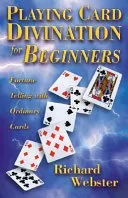
Playing Card Divination for Beginners
 74
74

Playing Card Divination for Beginners
Richard Webster’s "Playing Card Divination for Beginners" offers a refreshingly grounded approach to a practice often shrouded in mystique. Its strength lies in its directness; Webster assumes no prior knowledge, patiently guiding readers through the meanings of each card and how they interact. The emphasis on using a standard deck is particularly effective, removing the barrier of specialized equipment. However, the book’s primary limitation is its occasional brevity on nuanced interpretations. While it covers the basics thoroughly, seasoned practitioners might find the depth wanting. A passage detailing the Queen of Spades as representing a 'tall, dark, handsome man' or a 'widow' is a good example of the straightforward, if sometimes generalized, advice provided. Ultimately, this is a solid, no-frills introduction for the absolute beginner.
📝 Description
74
Richard Webster's 2005 book teaches divination using a standard 52-card deck.
Playing Card Divination for Beginners provides a clear introduction to cartomancy with common playing cards. Author Richard Webster, known for his writings on occult subjects, simplifies the process for newcomers. The book details the individual meanings of each card and how they interact when laid out. It also covers how to interpret card combinations and use different spread layouts for readings. The guide is written for those who already possess a deck of playing cards and are interested in learning predictive techniques.
Webster explains the specific meanings assigned to the four suits—Hearts, Diamonds, Clubs, and Spades—and to each individual card. Readers learn to construct readings by understanding how card combinations influence interpretations. The book also addresses how to read cards that appear in a reversed position and introduces various spread patterns. Specific layouts focused on relationship and romance readings are included, offering a methodical way to approach predictive questions in these areas.
Cartomancy, the practice of divination using cards, has a history dating back to the late 14th century. While Tarot decks evolved their own elaborate systems, the use of everyday playing cards for fortune-telling remained a common folk practice. This tradition continues alongside the development of more specialized decks. Richard Webster's book connects with this enduring and accessible lineage, bridging the gap between casual card play and esoteric interpretation.
💡 Why Read This Book?
• Learn to interpret the 52 standard playing cards for divination, a practice with roots in the late 14th century, enabling you to use a deck you likely already own. • Discover specific spreads designed by Richard Webster to answer questions about love and romance, offering practical applications for personal relationships. • Gain a foundational understanding of cartomancy that moves beyond complex esoteric systems, making divination accessible through familiar playing cards.
⭐ Reader Reviews
Honest opinions from readers who have explored this book.
❓ Frequently Asked Questions
Can I use any deck of playing cards for divination?
Yes, Richard Webster emphasizes that any standard 52-card deck can be used for divination. The book focuses on the inherent meanings of the cards themselves, rather than specific artistic interpretations found in specialized decks.
What is cartomancy?
Cartomancy is the practice of fortune-telling or divination using a deck of cards. While often associated with Tarot, it can also be performed with a standard deck of playing cards, as detailed in this book.
How does playing card divination differ from Tarot?
Playing card divination utilizes the meanings assigned to the 52 cards of a standard deck, often mirroring the suits and numbers of Tarot's Minor Arcana. Tarot, however, includes the Major Arcana, offering a broader range of archetypal meanings.
Does the book explain how to read card combinations?
Yes, 'Playing Card Divination for Beginners' covers how to interpret groups of cards, moving beyond single-card meanings to understand the narrative and predictive insights revealed by their interaction in a spread.
Is this book suitable for someone with no prior divination experience?
Absolutely. The book is titled 'for Beginners' and is designed to introduce the gentle art of card reading step-by-step, explaining card meanings and reading techniques in an accessible manner.
When was 'Playing Card Divination for Beginners' first published?
The book 'Playing Card Divination for Beginners' by Richard Webster was first published in 2002, making it a contemporary guide to an ancient practice.
🔮 Key Themes & Symbolism
Accessible Cartomancy
This theme centers on explaining divination by grounding it in the familiar structure of a standard playing card deck. Unlike more complex systems, Webster emphasizes that the tools for prediction are readily available. The work highlights how the 52 cards, through their suits and numbers, carry distinct energies and predictive messages. This approach makes the esoteric practice of cartomancy approachable, encouraging readers to see the potential for insight within everyday objects and routines, rather than requiring specialized or expensive equipment.
Card Meaning Interpretation
A fundamental aspect explored is the assignment and interpretation of meaning to each individual playing card. The book systematically breaks down the symbolism of Hearts, Diamonds, Clubs, and Spades, and then details the nuances of each numbered card and court card. It teaches how these individual meanings shift and combine when placed together in a spread, fostering an understanding of how cards interact to form a coherent narrative or prediction. This structured approach builds confidence for beginners.
Predictive Spreads
The book offers practical applications of card interpretation through various 'spreads' or layouts. It moves beyond simple one-card readings to demonstrate how to ask specific questions and arrange cards to find answers. Particular focus is given to spreads tailored for inquiries about relationships and romance, providing readers with concrete methods to explore personal connections and future possibilities using their playing cards.
Divination as a Skill
Webster presents card reading not as an innate magical gift, but as a learnable skill. The emphasis is on systematic study and practice. By providing clear guidelines and techniques, the book encourages readers to develop their own intuitive abilities through a structured framework. This perspective empowers individuals to take an active role in understanding and utilizing divination as a tool for self-reflection and guidance.
💬 Memorable Quotes
Direct passages from the work, attributed to the author.
“The gentle art of card reading.”
— This phrase captures the book's approach to divination, suggesting it's a soft, approachable skill rather than a daunting or forceful practice. It implies ease and grace in learning and applying card reading.
“Now anyone can practice a six-hundred-year-old tradition of fortune-telling.”
— This highlights the accessibility of cartomancy and its deep historical roots. It reassures potential readers that the practice is established and that the necessary tools are common, making it achievable for novices.
“Chances are you already own the necessary oracle.”
— This statement directly addresses the reader, pointing out that a standard deck of playing cards, a common household item, serves as the primary tool for divination, lowering the barrier to entry.
“Start reading the future for your family and friends.”
— This encourages practical application of the learned skills, positioning divination as a way to offer guidance and insight within one's social circle, fostering a sense of community and helpfulness.
💡 Key Ideas
Editorial paraphrase of the work's core concepts — not direct quotes.
You will learn the meaning of each card, how to interpret groups of cards, how to read your own cards, special spreads to answer questions about love and romance...
This summarizes the core learning objectives of the book, detailing the structured curriculum from individual card meanings to specific applications like relationship readings, promising a comprehensive beginner's guide.
🌙 Esoteric Significance
Tradition
While playing cards lack the explicit Kabbalistic or Hermetic structure of Tarot, their use in divination aligns with the broader Western Esoteric tradition of seeking knowledge through symbolic systems. Cartomancy can be seen as a practical, folk-magic manifestation, drawing on archetypal associations that echo across various divinatory arts. Webster's approach simplifies these connections, making esoteric principles accessible through the universally recognized symbols of a playing card deck.
Symbolism
The four suits—Hearts (emotions, relationships), Diamonds (material world, finances), Clubs (work, intellect), and Spades (challenges, transformation)—represent fundamental aspects of human experience. Each numbered card, from Ace to Ten, carries numerological significance, while the court cards (Jack, Queen, King) often symbolize personality types or specific individuals. The symbolism is less layered than Tarot's Major Arcana but provides a direct, intuitive language for reading.
Modern Relevance
Webster's work remains relevant today as a gateway to divination for a generation accustomed to digital immediacy and practical application. Contemporary practitioners interested in accessible forms of mindfulness, self-reflection, and predictive guidance may turn to playing card divination. Its simplicity makes it a useful tool for developing intuitive skills, often serving as a stepping stone towards more complex systems like Tarot or other forms of symbolic interpretation.
👥 Who Should Read This Book
• Aspiring diviners seeking a straightforward entry into card reading, who possess a standard deck of playing cards and want to learn practical interpretation techniques. • Individuals interested in the history of divination and folk magic, looking for a guide that connects modern practice to a long-standing tradition dating back centuries. • Those curious about love and relationship readings, who desire specific, actionable spreads designed to provide insight into romantic and interpersonal matters.
📜 Historical Context
Richard Webster's "Playing Card Divination for Beginners," first published in 2002, entered a landscape where esoteric practices were increasingly accessible but often still perceived as complex or requiring specialized tools. Cartomancy, the use of playing cards for divination, has a history intertwined with card games dating back to the late 14th century, developing independently from the more elaborate Tarot systems. While figures like A.E. Waite were codifying Tarot in the early 20th century, Webster’s work taps into the simpler, more widespread folk tradition of using standard decks. This book emerged during a period of renewed interest in practical occultism, following the New Age boom of the 1980s. It offered a user-friendly alternative to more intricate systems, resonating with a growing audience seeking tangible spiritual or predictive tools without extensive academic study.
📔 Journal Prompts
The interpretation of the Queen of Spades in a love reading.
Reflecting on the numerological significance of the Ace of Hearts.
Mapping the assigned meanings of the four suits to recent life events.
How the concept of 'gentle art' applies to your own divination practice.
Exploring the predictive potential of court cards for understanding personality dynamics.
🗂️ Glossary
Cartomancy
The practice of divination or fortune-telling using a deck of cards, typically a standard 52-card playing deck or a Tarot deck.
Spread
A specific arrangement or layout of cards used in divination to answer a particular question or explore a situation. Different spreads have different meanings for each card position.
Suits
The four divisions of a standard playing card deck: Hearts, Diamonds, Clubs, and Spades. Each suit is associated with specific themes and areas of life.
Court Cards
The Jack, Queen, and King cards within a deck. They often represent people, personality traits, or specific roles within a reading.
Divination
The practice of seeking knowledge of the future or the unknown by supernatural means. In this context, it refers specifically to using cards for insight.
Oracle
A medium or source of divine wisdom or prophecy. In this book, a deck of playing cards serves as the oracle.
Cartomancy Tradition
The historical lineage and evolving practices of using playing cards for divination, dating back to at least the late 14th century.