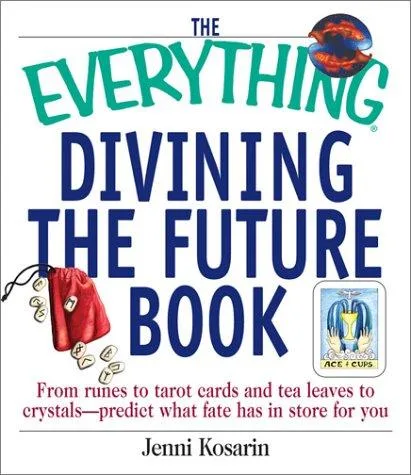
The Everything Divining the Future Book
 81
81

The Everything Divining the Future Book
Jenni Kosarin’s approach in The Everything Divining the Future Book is commendably broad, offering a survey of practices that range from the celestial mechanics of astrology to the tactile interpretation of tea leaves. The strength lies in its sheer scope; it’s a veritable compendium for the curious neophyte. However, this breadth occasionally sacrifices depth. For instance, the section on I Ching, while mentioning the hexagrams, doesn't fully articulate the nuanced philosophical underpinnings that make it more than just a random number generator. Kosarin’s attempt to demystify divination is successful in making the subject accessible, but some readers might wish for more detailed guidance on developing personal interpretive skills within specific traditions. The work is a solid introductory resource, particularly for its coverage of less common methods, but seasoned practitioners may find it a little too generalized. It provides a good map, but the detailed terrain is left for further exploration.
📝 Description
81
Jenni Kosarin's 2003 book examines human methods for glimpsing the future.
First published in 2003, The Everything Divining the Future Book by Jenni Kosarin details the many ways humans have attempted to understand what is to come. It goes beyond simple fortune telling to consider the principles and history behind divination across different cultures and time periods. Kosarin aims to make these practices understandable, showing them as learnable skills rather than hidden knowledge.
The book suits anyone curious about predictive arts, regardless of their starting point. It offers an introduction for newcomers to various tools and traditions, and also for those with existing knowledge seeking to expand their understanding. It addresses the fundamental human question of what the future holds and how we try to interpret it.
This work is situated within a long human history of seeking foresight, a practice evident from ancient Mesopotamia onwards. The early 2000s, when Kosarin wrote, saw renewed interest in esoteric subjects, partly fueled by New Age ideas and a search for personal meaning outside established systems. The growth of online resources at the time facilitated comparative studies of global divinatory traditions, making such a comprehensive overview possible.
💡 Why Read This Book?
• Gain a foundational understanding of numerous divinatory systems, from the symbolic language of tarot cards to the predictive cycles of astrology, presented in an accessible manner. • Explore the historical evolution of future-telling practices, understanding how techniques like palmistry have been interpreted across different cultures and time periods since antiquity. • Develop a framework for interpreting symbolic language and pattern recognition, applicable to understanding various divinatory tools discussed, including the specific meanings of runes.
⭐ Reader Reviews
Honest opinions from readers who have explored this book.
❓ Frequently Asked Questions
What is the primary focus of The Everything Divining the Future Book?
The book primarily focuses on providing a broad overview of various methods of divination used throughout history and across different cultures to understand or predict future events.
Does Jenni Kosarin explain how to perform divination or just what it is?
Kosarin explains what divination is and provides introductory information on how various methods work, aiming to demystify the practices for beginners. It offers a foundational understanding rather than advanced training.
What types of divination are covered in the book?
The book covers a wide range, including astrology, tarot, runes, palmistry, dream interpretation, scrying, numerology, and the I Ching, among others.
Is this book suitable for absolute beginners in divination?
Yes, it is specifically designed for beginners who are curious about the subject and want to learn about the different forms divination can take.
When was The Everything Divining the Future Book first published?
The book was first published in 2003, reflecting a period of renewed interest in esoteric and self-help topics.
Does the book discuss the history of divination?
Yes, it explores the historical context and evolution of divinatory practices, tracing their roots in ancient civilizations and their development over time.
🔮 Key Themes & Symbolism
Methods of Prediction
The book systematically details a wide array of divinatory techniques. It moves beyond superficial descriptions to explain the fundamental principles and interpretive frameworks for each. Readers can learn about the symbolic language of tarot cards, the celestial calculations of astrology, the ancient wisdom of runes, and the tactile interpretations found in palmistry. It also touches upon less common methods like scrying and dream analysis, presenting a broad spectrum of human attempts to understand future possibilities.
Historical Evolution
Kosarin situates divinatory practices within their historical and cultural contexts. The work traces the lineage of these methods from ancient civilizations, such as Mesopotamia and Egypt, through medieval Europe and into modern times. Understanding this evolution helps readers appreciate how societal changes, philosophical shifts, and technological advancements have influenced the way humans seek knowledge about the future. This historical perspective adds depth to the understanding of each practice.
Symbolic Language
A core theme is the reliance of divination on symbolic systems. The book explores how objects, patterns, and celestial movements are imbued with meaning that can be interpreted to reflect future potentials. Whether examining the archetypal imagery of tarot cards, the planetary correspondences in astrology, or the pictographic nature of runes, the emphasis is on decoding these symbolic languages. This theme highlights the human capacity for pattern recognition and symbolic interpretation.
Philosophy of Fate and Free Will
The book engages with the philosophical questions surrounding divination, particularly the interplay between fate and free will. It explores how different divinatory systems conceptualize destiny and the extent to which individuals can influence their future outcomes. By presenting various viewpoints, Kosarin encourages readers to consider their own beliefs about determinism, personal agency, and the nature of time itself as they engage with predictive arts.
💬 Memorable Quotes
Direct passages from the work, attributed to the author.
“Divination is not about immutable destiny, but about understanding the currents of potential.”
— This interpretation emphasizes that divinatory practices are often viewed not as fixed predictions, but as tools for gaining insight into probabilities and influences, empowering individuals to make informed choices.
“The language of the future is spoken in symbols, patterns, and alignments.”
— This highlights the core concept that understanding the future requires learning to interpret the symbolic messages and recurring patterns that divinatory systems present, whether through cards, stars, or other means.
“Each divinatory tool offers a unique lens through which to view the unfolding of time.”
— This suggests that different methods, such as tarot versus astrology, provide distinct perspectives and analytical frameworks for exploring future possibilities, rather than offering conflicting absolute truths.
“The interpretation of signs is a skill honed through practice and intuition.”
— This points to the active role of the diviner, suggesting that proficiency in reading omens or symbols develops over time through dedicated effort and the cultivation of one's intuitive faculties.
💡 Key Ideas
Editorial paraphrase of the work's core concepts — not direct quotes.
To divine is to seek clarity, not certainty.
This paraphrase underscores the idea that the purpose of divination is to gain greater understanding and perspective on potential future events, rather than to receive definitive, unchangeable pronouncements.
🌙 Esoteric Significance
Tradition
This work broadly fits within the Western Esoteric Tradition, particularly its modern, syncretic forms that emerged from the 19th century onward. While not strictly tied to Hermeticism or Kabbalah, it draws upon the impulse within these traditions to find hidden order and meaning in the cosmos and human experience. It represents a popularization and democratization of esoteric inquiry, making concepts previously confined to smaller circles accessible to a wider audience.
Symbolism
Key symbols explored include the archetypal imagery of the tarot cards, such as The Fool and The World, representing stages of a journey and completion. Astrological symbols, like planetary glyphs and zodiac signs, are presented as representations of cosmic forces and influences. Runes, with their ancient Germanic origins, are discussed as potent symbols carrying inherent meaning and predictive power, each a unique sigil of cosmic or earthly forces.
Modern Relevance
In contemporary practice, Kosarin's book serves as a foundational text for many exploring personal growth and spiritual seeking outside traditional religious frameworks. Its accessible overview influences modern practitioners of tarot, astrology, and rune casting, providing a common reference point. The book's emphasis on interpreting symbolic language speaks to current trends in mindfulness and self-awareness, where understanding personal symbols is often key.
👥 Who Should Read This Book
• Curious individuals seeking an accessible introduction to the diverse world of divination, wanting to understand the principles behind tools like tarot, astrology, and runes. • Students of comparative religion or cultural history interested in how different societies have historically approached the concept of fate and future prediction. • Aspiring practitioners of esoteric arts who wish to survey various methods before committing to deeper study in a specific area, such as dream interpretation or palmistry.
📜 Historical Context
Published in 2003, The Everything Divining the Future Book arrived during a period of significant public engagement with esoteric subjects, fueled in part by the burgeoning internet and a general trend toward personal development and alternative spirituality. This era saw a broader acceptance and accessibility of occult and metaphysical literature. Kosarin’s work can be seen as part of a lineage that includes authors like Dion Fortune and the Theosophical Society's exploration of ancient wisdom, but it aimed for a more mainstream, encyclopedic approach. Unlike earlier, more specialized texts, its 'everything' title signaled an ambition to cover a vast array of practices. While not facing significant censorship, the field of divination often operated in parallel to mainstream academic and religious discourse, sometimes viewed with skepticism by established institutions.
📔 Journal Prompts
The symbolic language of the tarot's Major Arcana and its connection to personal life.
Reflect on the historical evolution of a chosen divinatory practice, such as astrology, and its societal reception.
Consider the concept of 'currents of potential' versus immutable destiny in your own life experiences.
Analyze a recurring dream using the principles of dream interpretation discussed in the book.
Explore the potential predictive power of runes and how their ancient meanings might apply today.
🗂️ Glossary
Divination
The practice of seeking knowledge of the future or the unknown by supernatural means, often through interpreting signs, symbols, or patterns.
Astrology
A system of divination that claims to interpret the positions and movements of celestial bodies (planets, stars) to understand human affairs and predict future events.
Tarot
A deck of cards, typically containing 78 cards, used for divination. It includes Major and Minor Arcana, each with symbolic imagery interpreted to provide insight.
Runes
Characters of an ancient Germanic alphabet, used historically for writing and also for divination. Each rune possesses symbolic meaning and predictive significance.
Scrying
A form of divination involving gazing into a reflective surface, such as a crystal ball or mirror, to perceive visions or gain insights into the past, present, or future.
Synchronicity
A concept coined by Carl Jung, referring to the occurrence of meaningful coincidences that appear to be causally unrelated but are perceived as having a significant connection.
I Ching
An ancient Chinese divination text and method, also known as the Book of Changes, which uses hexagrams to offer guidance and insights into situations and future possibilities.
🔮 Readers Also Liked
Browse all →








More by Jenni Kosarin
All books →
More Free Divination & Tarot Books
View all →