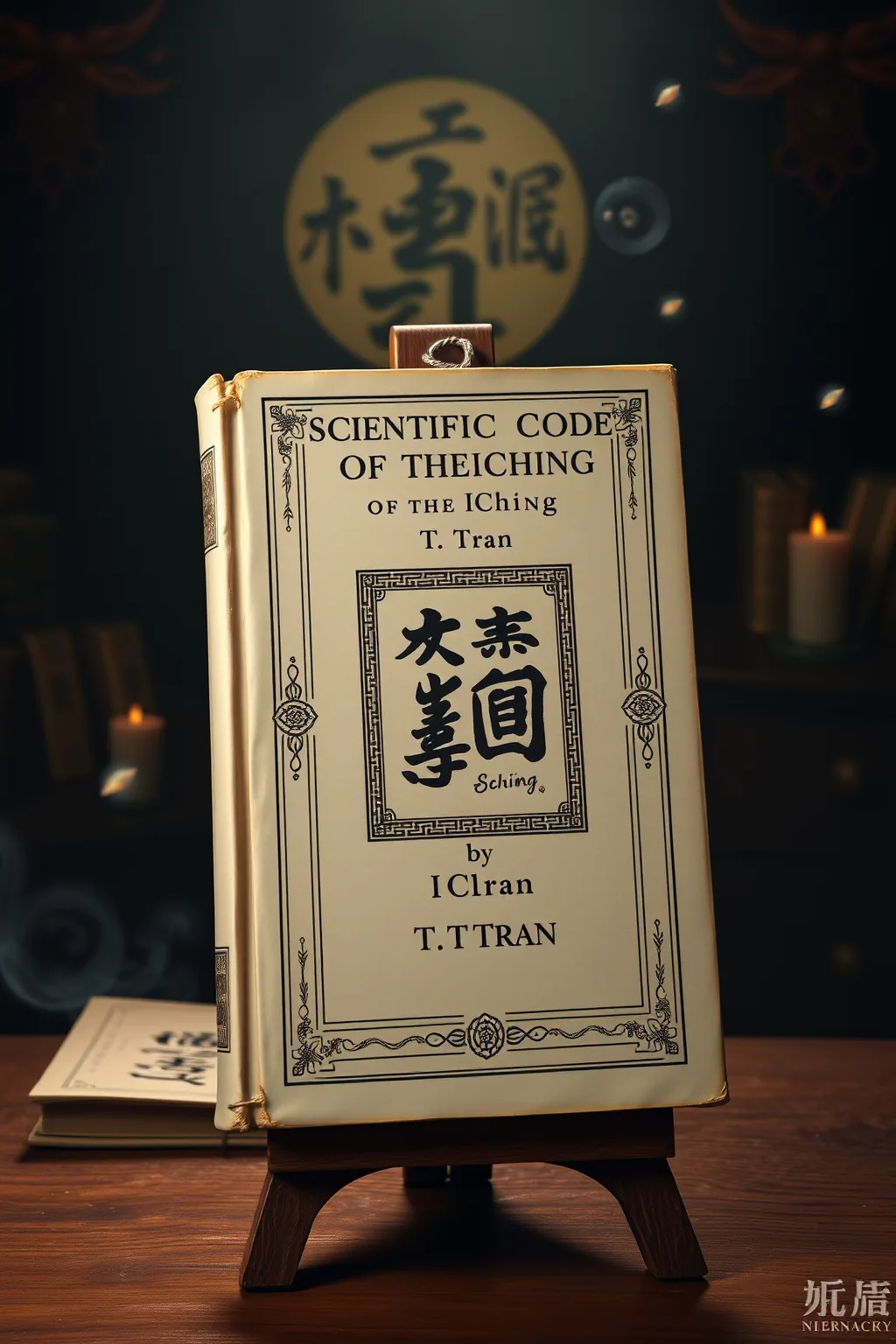
Scientific Code of the I-Ching
 61
61

Scientific Code of the I-Ching



Sophia Crane, Associate Editor — T. Tran's 'Scientific Code of the I-Ching' is a revelation for anyone interested in the deeper currents of the Yi Jing. Tran's rigorous approach demystifies the ancient oracle, presenting it as a profound system of logic and cosmic mathematics. This work is not for the casual dabbler; it is for the serious seeker who wishes to grasp the underlying principles of change and interconnectedness. The author’s ability to weave together philosophical depth with practical application is exceptional. It offers invaluable insights for practitioners and scholars alike, illuminating the I-Ching's enduring power as a guide to understanding the universe's intricate design.
📝 Description
61
T. Tran's 'Scientific Code of the I-Ching' presents the ancient text as a system of logic.
Published by T. Tran, 'Scientific Code of the I-Ching' examines the Yi Jing beyond fortune-telling. Tran argues the text functions as a logical framework for understanding universal order. The book deciphers the symbolic language of the hexagrams and their lines. It shows how these elements represent fundamental principles that govern existence, rather than simply mystical messages.
This work invites readers to consider the interplay of Yin and Yang. It also discusses the origins of change and the mathematical structures that underlie reality. The book connects ancient esoteric knowledge with contemporary scientific thought. Readers interested in the underlying codes of the universe will find a connection between historical traditions and modern inquiry.
This book fits within a tradition that seeks to find rational or scientific explanations for esoteric systems. Many thinkers have attempted to decode the I-Ching, seeing it not just as a divinatory tool but as a repository of ancient cosmology and philosophical principles. Tran's work continues this effort, aiming to reveal a systematic, almost mathematical, structure within the text that reflects universal laws.
💡 Why Read This Book?
Uncover the I-Ching as a universal code of logic and cosmic order. This book offers a unique perspective, bridging ancient wisdom with scientific principles. Ideal for seekers of profound truth, scholars of ancient systems, and practitioners wishing to deepen their understanding of change and causality. Discover the hidden patterns that govern existence and gain a new lens through which to view the world.
⭐ Reader Reviews
Honest opinions from readers who have explored this book.
❓ Frequently Asked Questions
Is this book suitable for beginners to the I-Ching?
While 'Scientific Code of the I-Ching' offers profound insights, its rigorous approach may be best appreciated by those with some foundational understanding of the I-Ching. However, dedicated beginners will find a unique and logical entry point into its complexities.
What distinguishes this book from other I-Ching guides?
This work uniquely positions the I-Ching as a scientific system of logic and universal principles, moving beyond purely divinatory interpretations. It emphasizes mathematical structures and interconnectedness, offering a fresh, analytical perspective.
Does the book require prior knowledge of advanced mathematics?
No, advanced mathematical knowledge is not a prerequisite. T. Tran presents the 'scientific code' in an accessible manner, focusing on the logical structures and symbolic representations rather than complex equations.
What kind of 'scientific' aspect is explored in relation to the I-Ching?
The book explores the inherent logical, structural, and pattern-based aspects of the I-Ching, drawing parallels to principles found in systems theory, information theory, and emergent complexity, viewing it as a profound model of natural processes.
How does this book enhance one's practice of the I-Ching?
By understanding the underlying 'scientific code,' practitioners can approach readings with greater analytical depth, discerning the logical flow of change and the systemic interactions between hexagrams, leading to more nuanced interpretations.
🔮 Key Themes & Symbolism
The I-Ching as a System of Cosmic Logic
This theme examines the I-Ching not merely as a tool for fortune-telling, but as a sophisticated operating system for reality itself. It explores how the sixty-four hexagrams, derived from the interplay of Yin and Yang, represent fundamental patterns of interaction, transformation, and potential within the universe. The book argues for a view of the I-Ching as a codified language of natural law, where each symbol and line holds intrinsic logical meaning, mirroring the processes of growth, decay, and equilibrium observed across all phenomena. It invites readers to perceive the Yi Jing as a profound blueprint for understanding causality and the interconnectedness of all things.
Symbolism as Universal Language
The 'Scientific Code' posits that the symbols of the I-Ching are not arbitrary but are deeply resonant with universal archetypes and principles. Each trigram and hexagram acts as a nexus of meaning, a point of convergence for myriad natural forces and human experiences. This section unpacks the layered symbolism, revealing how these ancient glyphs encode insights into psychological states, societal dynamics, and cosmic cycles. It explores how understanding this symbolic language allows for a more profound perception of the world, enabling one to read the subtle messages embedded within everyday occurrences and the grand sweep of history.
The Cyclical Nature of Change and Transformation
Central to the 'Scientific Code' is the exploration of the I-Ching's inherent understanding of continuous change and transformation. The book elucidates how the hexagrams depict the dynamic flux of existence, illustrating the inevitable cycles of rise and fall, beginning and end, and the constant interplay between opposing forces. It presents the I-Ching as a guide to navigating these transformations with wisdom and foresight, emphasizing that understanding the underlying patterns of change is key to harmonizing with the natural flow of the cosmos. This theme highlights the I-Ching's relevance in understanding personal growth, societal evolution, and the very pulse of the universe.
💬 Memorable Quotes
Direct passages from the work, attributed to the author.
“Within the sixty-four forms lies the blueprint of becoming.”
— This highlights the comprehensive nature of the I-Ching, suggesting that its structured symbolism encompasses the entirety of potential transformations and developmental pathways in existence.
“The lines are the algorithms of the ancient world.”
— This powerful analogy positions the changing lines of the hexagrams as the operational instructions or logical steps that govern the unfolding of events, akin to modern computational code.
“The universe speaks in patterns, and the I-Ching is its grammar.”
— This asserts that the I-Ching provides the fundamental rules and structure for interpreting the cosmic language of order and interconnectedness that pervades all existence.
💡 Key Ideas
Editorial paraphrase of the work's core concepts — not direct quotes.
The hexagrams are not prophecies, but probabilities.
This quote reframes the I-Ching from a deterministic oracle to a system that outlines potential outcomes based on underlying principles and current energies, emphasizing the role of logic and pattern.
Harmony is found not in stillness, but in understanding flux.
This quote emphasizes that true peace and equilibrium are achieved by comprehending and aligning with the dynamic nature of reality, rather than resisting its inherent movement.
🌙 Esoteric Significance
Tradition
This work deeply engages with the esoteric traditions of Taoism and ancient Chinese philosophy, particularly the concepts of Yin and Yang, the Five Elements, and the cyclical nature of the Tao. It aligns with hermetic principles of 'As Above, So Below,' viewing the I-Ching as a microcosm reflecting macrocosmic order. The esoteric significance lies in its potential for self-transformation and alignment with universal principles, offering a pathway to understanding one's place within the cosmic dance.
Symbolism
The core symbolism of the I-Ching revolves around the binary of Yin (passive, dark, feminine) and Yang (active, light, masculine), their combination forming the eight trigrams, and further their sixty-four hexagrams. These symbols represent elemental forces, natural phenomena, human relationships, and stages of development. The esoteric interpretation sees these symbols as keys to unlocking the underlying energetic and logical structures of reality, providing a framework for understanding the dynamics of change and the interconnectedness of all things.
Modern Relevance
In the modern era, the 'Scientific Code of the I-Ching' finds relevance in its ability to offer a holistic framework for understanding complex systems, emergent behavior, and the nature of information. Its emphasis on patterns, interconnectedness, and dynamic equilibrium speaks to fields like chaos theory, systems thinking, and even artificial intelligence. For individuals, it provides a timeless guide for navigating uncertainty, fostering adaptability, and cultivating a deeper awareness of the subtle forces that shape our lives and the world around us.
👥 Who Should Read This Book
This book is essential for scholars of Eastern philosophy and ancient systems seeking a rigorous, analytical perspective on the I-Ching. It is important for practitioners of divination who wish to move beyond rote memorization to a deeper understanding of the oracle's logical underpinnings. Seekers of universal truths will find a profound exploration of cosmic order and interconnectedness. Even those new to the I-Ching but intrigued by the interplay of logic and mysticism will discover a unique and compelling entry point into this ancient wisdom tradition.
📜 Historical Context
The I-Ching, or 'Book of Changes,' boasts a lineage stretching back over three millennia, making it one of the oldest and most influential texts in Chinese civilization. Originating as a method of divination, its philosophical depth deepened significantly during the Spring and Autumn period (771–476 BCE) and the Warring States period (475–221 BCE), particularly through the commentaries attributed to Confucius and his disciples. These additions transformed the I-Ching from a simple oracle into a profound treatise on cosmology, ethics, and governance. Its influence permeated Chinese thought, art, science, and medicine, shaping the worldview of scholars, emperors, and commoners alike. The text's adaptability allowed it to be reinterpreted through various philosophical lenses, including Taoism and Buddhism, ensuring its enduring relevance and its journey across cultures, where it continues to be studied for its intricate wisdom.
📔 Journal Prompts
Reflect on a recent significant change in your life. How might the principles of a specific hexagram described in the book illuminate its underlying logic and potential outcomes?
Consider the concept of Yin and Yang in your daily interactions. Where do you observe a balance or imbalance, and how does the 'scientific code' suggest navigating these dynamics?
What does the idea of the I-Ching as a 'scientific code' mean to you personally? How does this perspective alter your understanding of divination or universal principles?
Explore the symbolism of a hexagram that speaks to you. What universal truths or patterns of existence does its imagery convey according to the book's analysis?
How can the I-Ching's emphasis on cyclical change and transformation be applied to foster greater resilience and adaptability in your personal or professional life?
🗂️ Glossary
Hexagram
A symbol composed of six stacked horizontal lines, each of which is either Yang (solid) or Yin (broken). There are 64 unique hexagrams in the I-Ching, representing fundamental states and processes.
Trigram
A symbol composed of three stacked horizontal lines, each being either Yang or Yin. There are eight basic trigrams, which form the building blocks of the hexagrams.
Yin
In I-Ching philosophy, Yin represents the passive, dark, feminine, receptive, and yielding principle, often associated with the moon, earth, and stillness.
Yang
In I-Ching philosophy, Yang represents the active, light, masculine, creative, and assertive principle, often associated with the sun, heaven, and movement.
Yi Jing
The original Chinese name for the 'Book of Changes,' a foundational text of Chinese philosophy and divination, renowned for its exploration of change and cosmic order.
This book appears in 5 collections
🔮 Readers Also Liked
Browse all →







From the “Remote Viewing” Collection
View all →






More Free Divination & Tarot Books
View all →