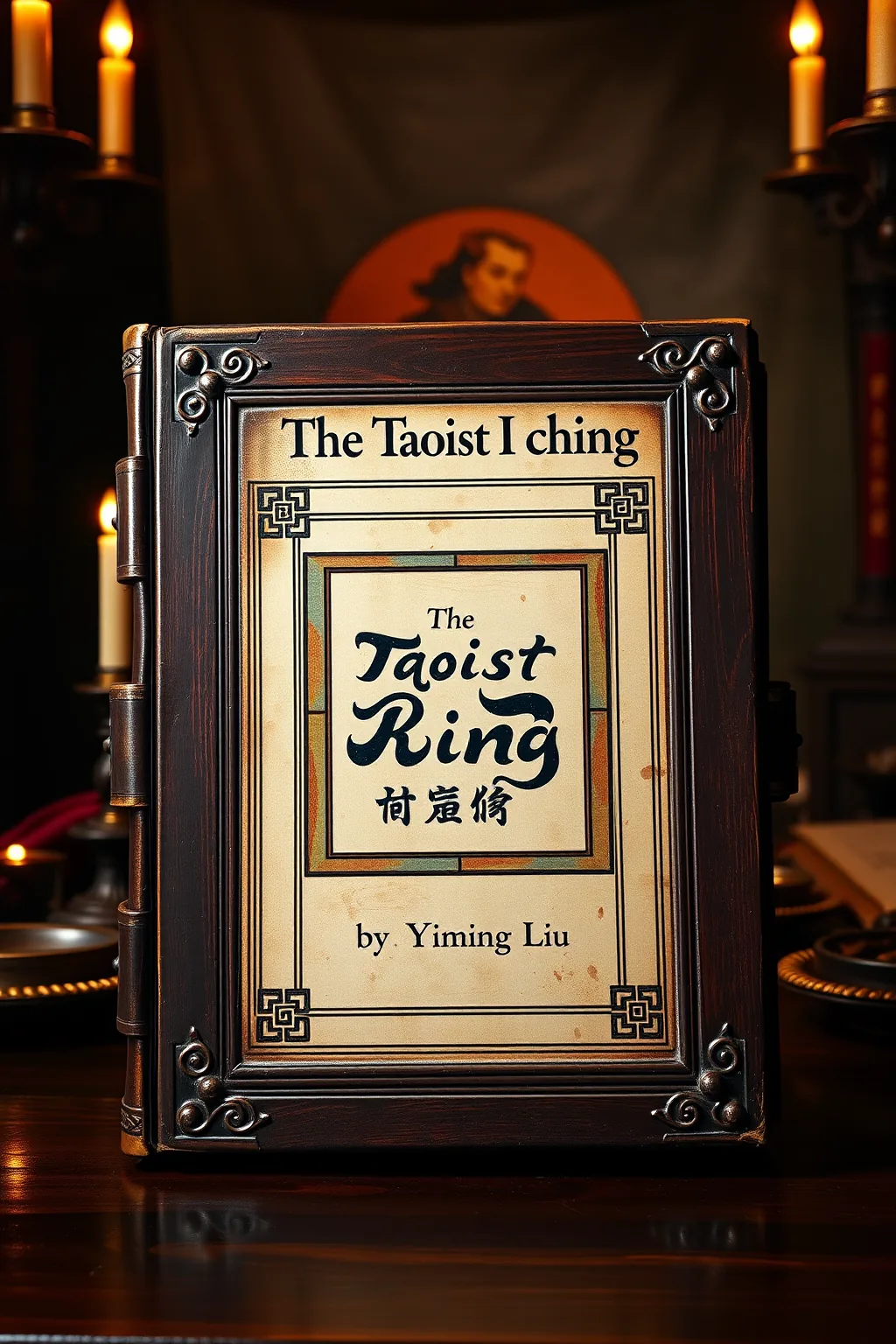
The Taoist I ching
 61
61

The Taoist I ching



Silas Hawthorne (Hermetic Studies Editor) — Yiming Liu's 'The Taoist I Ching' is a luminous beacon in the often-murky waters of divinatory texts. Liu masterfully distills the esoteric essence of this ancient oracle, presenting its complex philosophy with clarity and profound respect. Readers will find not just interpretations, but a living dialogue with the forces of change. The author's deep immersion in Taoist thought shines through, offering unique perspectives on the hexagrams' energetic flows and their implications for spiritual cultivation. This work transcends simple fortune-telling, providing a robust framework for self-understanding and alignment with the natural order. Essential reading for anyone serious about exploring the profound interconnectedness of the cosmos and the human psyche.
📝 Description
61
Yiming Liu's 'The Taoist I Ching' (2023) presents the ancient Chinese oracle through a Taoist lens.
This book examines the I Ching not simply as a divination tool, but as a system reflecting Taoist principles. Liu details how the hexagrams map the dynamic interplay of yin and yang, aligning them with the Taoist concept of the natural flow of existence. The text explains each hexagram as a gateway to comprehending the subtle forces influencing both universal patterns and individual development. It positions the I Ching as a practical guide for understanding change and cultivating personal transformation.
The work connects the I Ching’s imagery to core Taoist ideas, such as wu wei (non-action) and the cyclical nature of the cosmos. Liu demonstrates how studying the oracle can foster inner peace and a grounded approach to life’s uncertainties. The book aims to provide readers with a framework for aligning themselves with the Tao, using the I Ching as a means to this end. It is intended for those interested in the philosophical underpinnings of the I Ching and its relevance within Taoist thought.
Within the esoteric tradition, the I Ching stands as a foundational text for divination and philosophical inquiry. Yiming Liu’s work places this ancient oracle firmly within the Taoist philosophical framework. Unlike purely divinatory approaches, this book emphasizes the I Ching as a map of cosmic processes and a tool for aligning with the Tao. It draws connections between the oracle’s symbolism and core Taoist concepts, offering a perspective that integrates the I Ching’s wisdom with the principles of natural harmony and effortless action.
💡 Why Read This Book?
Unravel the ancient secrets of the I Ching through a distinctly Taoist lens. 'The Taoist I Ching' offers a profound exploration of universal principles and personal transformation, making it ideal for spiritual seekers, philosophical scholars, and practitioners of ancient wisdom traditions. Discover a path to greater insight and harmony with the natural flow of life.
⭐ Reader Reviews
Honest opinions from readers who have explored this book.
❓ Frequently Asked Questions
What is the I Ching?
The I Ching, or Book of Changes, is one of the oldest Chinese classic texts. It's a system of divination and philosophical inquiry based on 64 hexagrams, each representing a fundamental situation or transformation in life.
How does this book approach the I Ching?
This edition emphasizes the Taoist philosophical underpinnings of the I Ching, focusing on its role as a guide to understanding and harmonizing with the universal principles of change, yin and yang, and the Tao.
Is this book suitable for beginners?
Yes, while rich in depth, the book is presented in a way that makes its profound concepts accessible to those new to the I Ching, offering a solid foundation for study.
What is the significance of the Taoist perspective?
The Taoist perspective highlights the cyclical nature of existence, the importance of balance, and the wisdom of yielding, offering a unique framework for interpreting the I Ching's guidance.
Can I use this book for practical divination?
Absolutely. The book provides clear interpretations and guidance on how to consult the I Ching for insights into personal situations and decision-making.
🔮 Key Themes & Symbolism
The Cosmic Dance of Yin and Yang
This theme looks at the fundamental Taoist concept of yin and yang as the primal forces animating the universe. The I Ching's hexagrams are presented as dynamic manifestations of this interplay, illustrating how opposing yet complementary energies drive all change and creation. Understanding this balance is presented as key to navigating life's complexities and achieving inner harmony, revealing the subtle interconnectedness of all phenomena through the lens of this ancient oracle.
The Oracle of Transformation
The I Ching is explored not merely as a tool for prediction, but as a profound guide to the constant flux inherent in existence. This theme emphasizes how each hexagram offers insight into specific stages of change, providing wisdom on how to adapt, grow, and align oneself with the natural unfolding of events. It highlights the I Ching's capacity to illuminate turning points and offer strategies for conscious evolution, fostering resilience and proactive engagement with life's challenges.
Taoist Philosophy and Self-Cultivation
This theme examines the deep resonance between Taoist principles and the wisdom of the I Ching. It explores how the oracle serves as a practical manual for self-cultivation, encouraging a life lived in accordance with the Tao—effortless action, acceptance, and inner peace. The book provides guidance on how to apply these philosophical insights to daily life, promoting a deeper understanding of one's place in the cosmos and fostering a path towards spiritual enlightenment and balanced living.
💬 Memorable Quotes
Direct passages from the work, attributed to the author.
“The I Ching is not a static pronouncement, but a living dialogue with the cosmos.”
— This highlights the dynamic and interactive nature of the I Ching, emphasizing that its wisdom unfolds through engagement and reflection, not as fixed dogma.
“Within the hexagrams lie the elements of creation and dissolution.”
— This evocative phrase points to the I Ching's comprehensive scope, encompassing the entire spectrum of existence from genesis to entropy.
“Harmony is found not in resistance, but in flowing with the currents of change.”
— This captures a core Taoist principle, suggesting that true peace and efficacy come from embracing, rather than fighting, the inevitable shifts in life.
“The wisdom of the sage is to perceive the seed of change within the present moment.”
— This emphasizes foresight and awareness, suggesting that understanding the subtle beginnings of transformation allows for informed action and preparation.
“To know the hexagram is to know a facet of the Universal Tao.”
— This connects the specific insights of the I Ching to the overarching, ineffable principle of the Tao, suggesting the oracle as a microcosm of the macrocosm.
🌙 Esoteric Significance
Tradition
This work is deeply rooted in the Taoist tradition, a philosophical and spiritual system that emphasizes living in harmony with the Tao, the fundamental, ineffable principle of the universe. The I Ching, from a Taoist perspective, serves as a divinely inspired map of this universal flow, revealing the constant interplay of yin and yang and guiding practitioners toward effortless action (wu wei) and natural alignment with cosmic rhythms.
Symbolism
The core symbolism of the I Ching lies in its 64 hexagrams, each composed of six lines that are either solid (yang) or broken (yin). These lines and their combinations represent archetypal situations, forces, and transformations. The trigrams (three-line figures) within the hexagrams further symbolize fundamental elements of nature and human experience, offering a wide range of interconnected symbols that provide useful insights into the dynamics of change and the underlying order of reality.
Modern Relevance
In an era marked by rapid change and uncertainty, the I Ching's wisdom remains profoundly relevant. Its emphasis on adaptability, balance, and understanding the natural cycles of life offers a powerful antidote to modern anxieties. The book provides a framework for navigating personal and collective challenges with greater insight and equanimity, fostering a sense of interconnectedness and purpose. It serves as a timeless guide for self-discovery, ethical conduct, and cultivating inner peace amidst the complexities of contemporary existence.
👥 Who Should Read This Book
This profound exploration of the I Ching is ideally suited for a diverse audience. Spiritual seekers will find it a rich source of wisdom for personal growth and understanding life's deeper currents. Philosophical scholars will appreciate its rigorous examination of Taoist principles and their application within the oracle. Practitioners of divination and ancient wisdom traditions will discover new layers of interpretation and practical guidance. Beginners to the I Ching will find the accessible yet profound presentation a welcoming entry point, while seasoned students will uncover subtle nuances and advanced insights. Ultimately, anyone yearning for deeper self-awareness and a more harmonious connection with the universe will benefit immensely.
📜 Historical Context
Emerging from the crucible of ancient Chinese civilization, the I Ching's origins are shrouded in the mists of antiquity, likely predating written records. Its development spanned millennia, evolving from early oracle bone inscriptions and divinatory practices to the sophisticated philosophical and cosmological text we recognize today. During the Han Dynasty (206 BCE – 220 CE), it was canonized as one of the Five Classics, solidifying its central role in Chinese intellectual and spiritual life. Taoist philosophers, from Lao Tzu and Zhuang Zhou onwards, found in its cyclical patterns and emphasis on natural flow a profound resonance with their own teachings. The I Ching became an indispensable tool for understanding the Tao, guiding governance, personal conduct, and spiritual cultivation. Its influence extended beyond China, permeating East Asian thought and eventually captivating Western scholars and mystics, cementing its status as a timeless repository of wisdom.
📔 Journal Prompts
Reflect on a recent situation where you experienced a significant shift or change. How did the principles of yin and yang play out?
Consider the concept of 'wu wei' (effortless action) in relation to a challenge you are currently facing. What might a Taoist approach suggest?
If you were to embody the essence of a specific hexagram from this book, which would it be and why?
How can the cyclical nature of the I Ching inform your perspective on personal goals and aspirations?
Journal about your understanding of balance in your own life. Where do you find harmony, and where might there be an imbalance to address?
🗂️ Glossary
Tao
The fundamental, ineffable principle of the universe in Taoism; the natural order and source of all things. It is often described as the 'Way' or the 'Path'.
Yin
The feminine, passive, dark, and receptive principle in Taoist philosophy, often associated with the moon, earth, and water. It is complementary to yang.
Yang
The masculine, active, light, and creative principle in Taoist philosophy, often associated with the sun, sky, and fire. It is complementary to yin.
Hexagram
A figure composed of six horizontal lines, either solid (yang) or broken (yin), used in the I Ching for divination and philosophical interpretation. There are 64 distinct hexagrams.
Wu Wei
A key Taoist concept meaning 'non-action' or 'effortless action.' It signifies acting in accordance with the natural flow of the Tao, without forcing or striving.
This book appears in 3 collections
🔮 Readers Also Liked
Browse all →









From the “I Ching” Collection
View all →







More Free Divination & Tarot Books
View all →