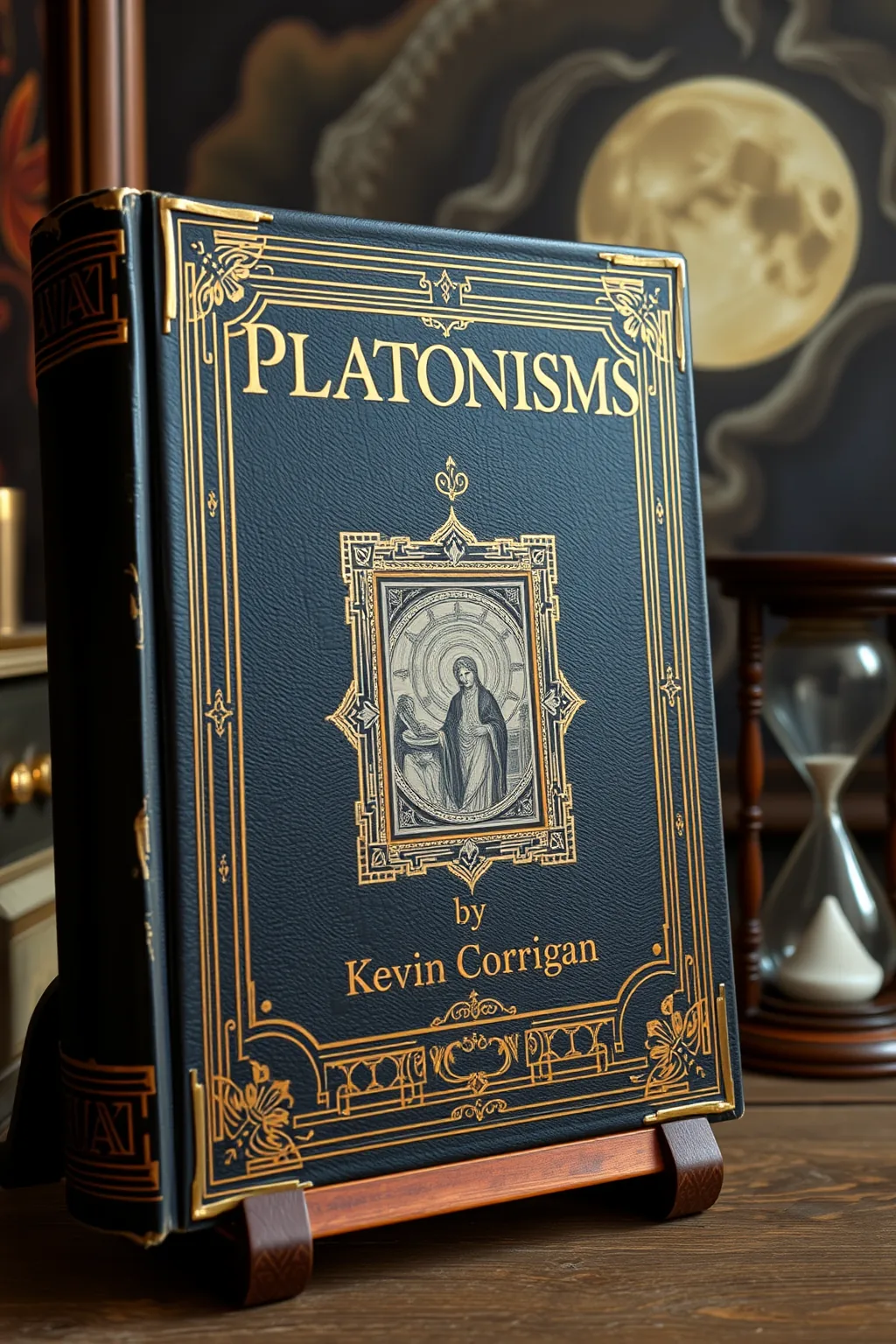
Platonisms
 77
77

Platonisms
Corrigan and Turner's "Platonisms" offers a lucid, if dense, exposition of a philosophical lineage that has echoed through millennia. The strength lies in its systematic approach, carefully dissecting concepts like the Forms and the Demiurge with an academic rigor that avoids hagiography. A particular passage discussing the influence of Plato on Neoplatonism, while not groundbreaking in its findings, is exceptionally well-articulated. The limitation, however, is the sheer density of the prose, which at times can feel like a specialized monograph rather than an accessible overview. It demands significant prior engagement with classical philosophy. Ultimately, "Platonisms" serves as a valuable, albeit demanding, scholarly resource for understanding a foundational Western philosophy.
📝 Description
77
Published in 2007, Platonisms examines Plato's philosophy and its historical development.
Kevin Corrigan and John D. Turner's 2007 book, Platonisms, provides a thorough study of the philosophical system that began with Plato. The authors break down the main ideas of Platonism, following how they changed and affected later thought over many years. The book goes past simple explanations to look at the complex ideas about reality and knowledge that were central to Plato's thinking and how these ideas were later treated.
This book is a valuable resource for academics, graduate students, and dedicated students of philosophy, comparative religion, and esoteric studies. It is for people who want a detailed, scholarly grasp of Platonism's important place in Western thought. To fully understand the detailed analysis, readers should already know some basic philosophical ideas. The authors carefully explain the difficult arguments and how they were received historically, showing how these concepts were understood and given new meanings.
Platonism has always been a significant current within Western esotericism. Its ideas about a higher, non-material reality, the soul's journey, and the pursuit of divine knowledge resonated deeply with mystical and occult traditions. This book analyzes those core Platonic doctrines and their historical reception, showing how they shaped later esoteric movements. It places the study of Plato's philosophy within the context of historical interest in the roots of Western esotericism and mystical traditions.
💡 Why Read This Book?
• Gain a precise understanding of the Theory of Forms, as presented in the original Platonic dialogues and their subsequent interpretations, offering a foundation for grasping abstract metaphysical concepts. • Explore the concept of the soul's immortality and its implications for ethics and cosmology, providing a distinct perspective on consciousness beyond purely materialist viewpoints. • Analyze the historical trajectory of Platonic thought from ancient Greece through key philosophical movements, understanding how figures like Plotinus engaged with Plato's initial ideas.
⭐ Reader Reviews
Honest opinions from readers who have explored this book.
❓ Frequently Asked Questions
What is the primary focus of Kevin Corrigan and John D. Turner's "Platonisms"?
The book provides a rigorous academic examination of Plato's philosophical system, tracing its core doctrines, evolution, and influence across Western thought. It delves into concepts like the Theory of Forms and the soul's immortality, offering a structured analysis for scholars and students.
When was "Platonisms" first published, and by whom?
"Platonisms" was first published in 2007. The authors are Kevin Corrigan and John D. Turner, who brought their scholarly expertise to bear on this seminal work of philosophy.
Is "Platonisms" suitable for beginners in philosophy?
While comprehensive, the book is dense and assumes a foundational knowledge of philosophical concepts. It is best suited for graduate students, academics, and serious practitioners of philosophy or related esoteric studies.
What are some of the key Platonic concepts discussed in the book?
The book extensively discusses Plato's Theory of Forms, the immortality of the soul, the concept of the Good, the nature of the intelligible realm versus the sensible world, and the method of dialectic.
How does "Platonisms" relate to esoteric traditions?
The book provides the philosophical underpinnings that have significantly influenced various esoteric traditions, including Neoplatonism and later Hermetic and Gnostic movements. Understanding its core ideas is crucial for grasping these subsequent developments.
What is the academic value of "Platonisms"?
It offers a scholarly, in-depth analysis of a foundational Western philosophical system, contributing to academic discourse on classical philosophy, metaphysics, and the history of ideas. Its detailed exposition is valuable for research.
🔮 Key Themes & Symbolism
The Theory of Forms
At the heart of "Platonisms" lies the meticulous exposition of Plato's Theory of Forms. This concept posits that the physical world we perceive is merely an imperfect shadow of a higher, eternal, and unchanging field of perfect Forms or Ideas. The book examines how this dualistic framework, distinguishing between the sensible and the intelligible, became a reference for subsequent metaphysical and epistemological inquiry. Understanding the Forms is presented as crucial for grasping the nature of true knowledge and reality, influencing countless philosophical and mystical traditions.
Soul and Immortality
The exploration of the soul's nature and its inherent immortality is a central theme in "Platonisms." The authors detail Plato's arguments for the soul's pre-existence and its eventual return to the field of Forms. This doctrine has wide implications for ethics, personal identity, and the understanding of consciousness within philosophical and esoteric contexts. The book scrutinizes the various dialogues where these ideas are presented, highlighting their significance in shaping Western notions of the afterlife and the spiritual self.
The Good and the Intelligible Realm
Central to Platonic philosophy, as analyzed in "Platonisms," is the concept of the Good, often described as the highest Form from which all other Forms derive their existence and intelligibility. The book elucidates the structure of the intelligible realm, a domain accessible only through reason and philosophical contemplation, contrasting it sharply with the transient, material world. This hierarchical understanding of reality has been a foundational element for many mystical and Gnostic systems seeking to apprehend divine or ultimate truth.
Platonic Influence on Neoplatonism
The work traces the lineage of Platonic thought, particularly its transformation through Neoplatonism. Figures like Plotinus, who built extensively upon Plato's foundations, are discussed in relation to their development of concepts such as emanation and the One. "Platonisms" illustrates how these later interpretations amplified and recontextualized Plato's ideas, making them central to many later esoteric schools and mystical philosophies that sought to systematize spiritual ascent and divine union.
💬 Memorable Quotes
Direct passages from the work, attributed to the author.
“The sensible world is a field of becoming, while the intelligible realm is a field of being.”
— This captures the fundamental Platonic dualism. It asserts that our physical experience is transient and imperfect, in contrast to the eternal, perfect, and unchanging nature of the Forms that constitute true reality, accessible only through intellect.
“Knowledge is recollection of the Forms by the immortal soul.”
— This interpretation of epistemology, central to Plato's theory, suggests that learning is not acquiring new information but remembering truths the soul knew before its incarnation. It links the soul's immortality directly to its capacity for genuine understanding.
“The Good is the ultimate source of all reality and intelligibility.”
— This highlights the supreme position of the Form of the Good in Plato's hierarchy. It is not just another Form but the ultimate principle that illuminates all other Forms and gives existence to the entire intelligible realm.
“Dialectic is the highest form of philosophical inquiry.”
— This emphasizes Plato's method for attaining knowledge. Dialectic involves rigorous question-and-answer to ascend from particulars to universals, ultimately leading to an apprehension of the Forms and the Good, bypassing mere opinion.
“The physical body is a prison for the soul.”
— This expresses a common Platonic sentiment regarding the soul's relationship to the body. It suggests that the material form hinders the soul's true nature and its potential for philosophical enlightenment and liberation.
🌙 Esoteric Significance
Tradition
Platonism serves as a primary bedrock for much of Western Esotericism, particularly Neoplatonism, Gnosticism, and Hermeticism. These traditions directly adopted and adapted Plato's metaphysical framework, including the dualism of the sensible and intelligible realms, the concept of divine intellect (Nous), and the soul's yearning for return to its divine source. "Platonisms" offers the essential philosophical vocabulary and conceptual architecture that these later esoteric systems built upon, providing the intellectual scaffolding for their mystical practices and cosmologies.
Symbolism
Key Platonic symbols explored include the Allegory of the Cave, representing the soul's journey from ignorance (shadows) to enlightenment (the sun/Good). The Divided Line symbolizes the different levels of reality and cognition, from mere images to the Forms. The Demiurge, a divine craftsman, represents the ordering principle that shapes the material world according to the eternal Forms, a concept that appeals to creator deities in various esoteric cosmologies.
Modern Relevance
Contemporary esoteric practitioners and scholars of mysticism continue to draw heavily from Platonic thought. Modern interpretations of consciousness, the nature of reality, and spiritual development often echo Platonic ideas about the soul's origin and destiny. Thinkers and movements focused on consciousness studies, perennial philosophy, and integral spirituality frequently engage with Platonic concepts to articulate their own frameworks, underscoring its persistent relevance in understanding the human condition and the search for transcendent truth.
👥 Who Should Read This Book
• Advanced students and academics specializing in classical philosophy or the history of Western Esotericism, who require a detailed and authoritative examination of Platonic doctrines. • Practitioners of Neoplatonic or Hermetic traditions seeking to deepen their understanding of the philosophical foundations upon which their practices are built. • Comparative religion scholars investigating the roots of dualistic metaphysics and the concept of transcendent realms in Western thought.
📜 Historical Context
Published in 2007, Kevin Corrigan and John D. Turner's "Platonisms" entered a scholarly field with a long-established engagement with Plato's work. The late 20th and early 21st centuries saw continued vigorous debate regarding the interpretation of Plato's dialogues, the authenticity of certain texts, and his relationship to later philosophical and mystical movements. This period also witnessed a significant resurgence of interest in the history of Western Esotericism, prompting scholars to re-examine philosophical systems like Platonism for their foundational role. Contemporaries like Pierre Hadot were re-evaluating ancient philosophy as a way of life, offering a different lens than purely textual analysis. "Platonisms" contributes to this milieu by providing a structured and critical overview of Plato's enduring system, situating it within its ancient context while acknowledging its perennial influence.
📔 Journal Prompts
The Allegory of the Cave and its depiction of prisoner liberation.
The concept of the soul's pre-existence and its implications for learning.
The hierarchy of the Forms, with the Good at its apex.
The role of dialectic in ascending towards the intelligible realm.
The contrast between the mutable sensible world and the immutable Forms.
🗂️ Glossary
Theory of Forms
Plato's central metaphysical doctrine positing that the physical world is not the 'real' world; instead, ultimate reality exists beyond our physical world in the field of perfect, eternal, and unchanging Forms or Ideas.
Intelligible Realm
The non-physical, eternal, and perfect field of the Forms, accessible only through reason and intellect, contrasted with the sensible, physical world.
Sensible World
The physical, material world perceived through the senses, considered by Plato to be a flawed and transient imitation of the true reality found in the Intelligible Realm.
Dialectic
Plato's method of philosophical inquiry, involving rigorous questioning and reasoned argument to ascend from particulars to universal concepts and ultimately to the apprehension of the Forms.
The Good
In Plato's philosophy, the supreme Form, analogous to the sun, which illuminates all other Forms and is the ultimate source of reality, truth, and goodness.
Demiurge
The craftsman or divine artisan in Plato's Timaeus, who fashions the physical universe according to the eternal model of the Forms.
Recollection (Anamnesis)
The Platonic theory of knowledge, suggesting that learning is a process of remembering truths the immortal soul possessed before its embodiment.
🔮 Readers Also Liked
Browse all →









More Free Occult Philosophy Books
View all →