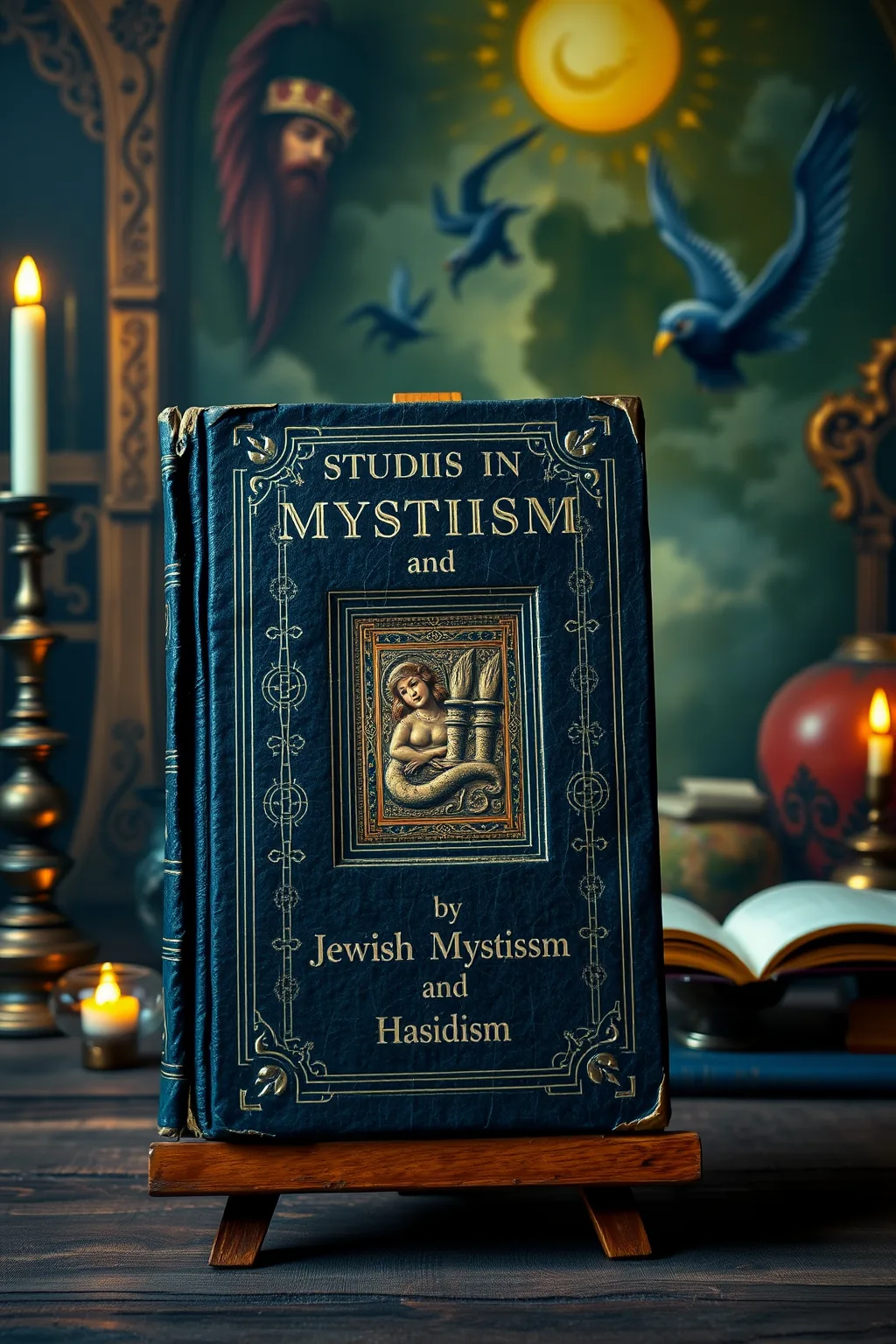
Studies in Jewish Mysticism, Esotericism and Hasidism
 61
61

Studies in Jewish Mysticism, Esotericism and Hasidism


Review by Lorelei Sage (Contemplative Literature Editor) — This anonymous collection is a treasure trove for anyone serious about the esoteric traditions of Judaism. 'Studies in Jewish Mysticism, Esotericism and Hasidism' meticulously navigates the labyrinthine corridors of Kabbalah, offering lucid explanations of complex concepts often obscured by dense commentary. The exploration of Hasidic thought is particularly illuminating, revealing its deep roots in earlier mystical currents. While demanding intellectual engagement, the rewards are immense, providing a rich understanding of Jewish spiritual practices and philosophies. Essential reading for scholars and dedicated practitioners seeking authentic esoteric knowledge.
📝 Description
61
This anonymous 1980s study examines Kabbalistic thought and Hasidic devotion.
Published anonymously, this collection of essays investigates the esoteric dimensions of Jewish tradition. It focuses on Kabbalistic concepts, such as the divine emanations and the soul's path towards unity, presenting them through symbolic interpretation and contemplative methods. The work also considers the devotional practices and spiritual fervor characteristic of Hasidism.
The author approaches these subjects with both intellectual rigor and spiritual insight, aiming to make complex mystical ideas accessible. The text does not simply recount historical developments but engages directly with the spiritual and philosophical questions at the heart of Jewish mysticism. It offers a framework for understanding the relationship between the human and the divine, as expressed through centuries of Jewish spiritual inquiry.
This book sits within the broader field of esoteric studies, specifically focusing on traditions that emphasize hidden knowledge and mystical experience within Judaism. It engages with the Kabbalistic concept of *sefirot* (divine emanations) and the Hasidic emphasis on *devekut* (cleaving to God). The author's method, which combines textual analysis with an understanding of contemplative practice, reflects a common approach in the study of mysticism across various religious traditions.
💡 Why Read This Book?
Embark on a profound spiritual journey into the heart of Jewish mysticism. 'Studies in Jewish Mysticism, Esotericism and Hasidism' offers a rare glimpse into hidden esoteric teachings, deciphering the symbolic language of Kabbalah and the devotional spirit of Hasidism. Ideal for seekers of ancient wisdom, scholars of religious studies, and practitioners aiming to deepen their understanding of Jewish contemplative traditions. Uncover secrets that have resonated through generations.
⭐ Reader Reviews
Honest opinions from readers who have explored this book.
❓ Frequently Asked Questions
What is Kabbalah?
Kabbalah is the esoteric tradition of Jewish mysticism, aiming to understand the divine nature and the creation of the universe through symbolic interpretation of scripture and contemplation of divine emanations.
What is Hasidism?
Hasidism is a spiritual movement within Judaism that emphasizes joyous worship, mystical experience, and the presence of God in all aspects of life, often expressed through charismatic leaders and devotional practices.
Is prior knowledge of Judaism required to understand this book?
While some familiarity with Jewish concepts can be helpful, the book's comprehensive nature aims to guide readers through complex ideas, making it accessible to dedicated newcomers as well as those with existing knowledge.
What makes this book 'esoteric'?
The book focuses on the hidden, inner dimensions of Jewish tradition, exploring symbolic meanings, mystical experiences, and secret teachings not readily apparent in exoteric religious practice.
Who is the intended audience for this work?
This work is intended for serious students of mysticism, scholars of comparative religion, spiritual seekers interested in Jewish contemplative traditions, and practitioners looking to deepen their esoteric understanding.
🔮 Key Themes & Symbolism
The Sephirotic Tree and Divine Emanation
This theme looks at the Kabbalistic concept of the Sephiroth, the ten divine emanations that form the structure of creation and the pathway to understanding God's infinite nature. It explores how these emanations manifest in the cosmos and within the human soul, offering a framework for mystical ascent and contemplation. The intricate symbolism of the Tree of Life serves as a map for reading through the spiritual realms, revealing the interconnectedness of all existence and the divine blueprint underlying reality.
The Soul's Journey and Tikkun Olam
Central to Jewish mysticism is the concept of the soul's intricate journey through life and beyond, and its ultimate role in 'Tikkun Olam' – the mending of the world. This theme examines the spiritual challenges and opportunities for growth, purification, and rectification that individuals encounter. It highlights how personal spiritual development is intrinsically linked to the cosmic process of healing and redemption, emphasizing the profound responsibility each soul bears in the ongoing work of divine restoration.
Hasidic Devotion and Divine Presence
This theme illuminates the vibrant spiritual range of Hasidism, focusing on its unique emphasis on ecstatic devotion, the immanence of God, and the pursuit of divine connection through everyday life. It explores the role of the Tzaddik (righteous leader) and the importance of joy, prayer, and contemplation in experiencing the divine presence. The text reveals how Hasidic teachings, though seemingly simple, are deeply rooted in ancient Kabbalistic principles, offering a path of accessible yet profound spiritual engagement.
💬 Memorable Quotes
Direct passages from the work, attributed to the author.
“The light that returns is the light that has been sent.”
— This aphorism speaks to the reciprocal nature of spiritual endeavor. The effort invested in seeking divine wisdom or performing good deeds returns to the seeker, clear their path and deepening their understanding.
“Within the silence, the echo of the Infinite speaks.”
— This suggests that true divine revelation is not found in external noise but in inner stillness. The profound truths of existence are apprehended through contemplative silence, where the divine voice can be heard.
“Every letter is a vessel for the Divine Name.”
— This highlights the Kabbalistic belief in the sanctity of the Hebrew alphabet and its profound connection to God. Each letter is seen as a conduit for divine energy and meaning, imbued with cosmic significance.
“The path upward begins with the descent into oneself.”
— This emphasizes the introspective nature of spiritual growth. True progress towards higher consciousness and divine union is achieved by first exploring and understanding the inner range of the self.
💡 Key Ideas
Editorial paraphrase of the work's core concepts — not direct quotes.
Joy is the key that unlocks the gates of understanding.
This quote, often associated with Hasidic thought, posits that a state of genuine happiness and spiritual exuberance is essential for clear insights and connection with the divine.
🌙 Esoteric Significance
Tradition
This work is fundamentally rooted in the Kabbalistic tradition, the esoteric mystical branch of Judaism. It explores its core concepts, including the divine emanations (Sephiroth), the nature of God, the structure of the cosmos, and the human soul's relationship to the divine. Furthermore, it looks at the devotional and mystical practices of Hasidism, a significant offshoot that synthesized and popularized Kabbalistic ideas, emphasizing ecstatic prayer, the immanence of God, and the spiritual leadership of the Tzaddik.
Symbolism
The book is rich with esoteric symbolism, drawing heavily from the Hebrew alphabet, gematria (numerical interpretation of Hebrew letters), and the visual language of the Kabbalistic Tree of Life. These symbols are not merely decorative but are understood as keys to unlocking deeper spiritual realities, representing divine attributes, cosmic forces, and the pathways of spiritual ascent. The interpretation of biblical narratives through a mystical lens also employs rich symbolic layers, revealing hidden meanings beyond the literal.
Modern Relevance
In an era often characterized by materialism and spiritual searching, these studies offer timeless wisdom for reading through the complexities of existence. The exploration of the soul's journey, the pursuit of divine connection, and the understanding of interconnectedness resonate deeply with contemporary individuals seeking meaning and purpose. The contemplative practices and philosophical insights provide tools for inner peace, ethical living, and a profound appreciation for the sacredness of life, bridging ancient esoteric knowledge with modern spiritual aspirations.
👥 Who Should Read This Book
This invaluable collection is tailored for a diverse audience. Aspiring spiritual seekers will find a compelling introduction to the profound depths of Jewish mystical thought, offering a roadmap for personal growth and divine connection. Scholars of religious studies and comparative mysticism will appreciate the rigorous analysis and insightful interpretations of complex Kabbalistic and Hasidic concepts. Dedicated practitioners, whether within or outside the Jewish tradition, will discover potent methods for deepening their contemplative practice and expanding their understanding of esoteric principles. Beginners will find lucid explanations, while seasoned practitioners will uncover layers of nuance and wisdom.
📜 Historical Context
This collection emerges from a rich and complex historical milieu, deeply rooted in the intellectual and spiritual ferment of Jewish thought spanning centuries. The Kabbalistic tradition itself flourished particularly from the medieval period onwards, with seminal texts like the Zohar appearing in the late 13th century. The subsequent development and diversification of Kabbalistic thought, including Lurianic Kabbalah in the 16th century, laid the groundwork for later movements. The rise of Hasidism in the 18th century, as a popular spiritual revival, sought to democratize mystical experience, drawing heavily on established Kabbalistic concepts but infusing them with fervent emotion and accessible practice. This compilation likely reflects a period of scholarly synthesis and preservation, seeking to articulate the enduring mystical currents that have shaped Jewish identity and spirituality, offering a bridge between ancient wisdom and contemporary seekers.
📔 Journal Prompts
Reflect on a moment when you felt a profound sense of divine presence. How did this experience align with the concepts of immanence discussed in the text?
Consider the concept of the 'Tikkun Olam.' How can personal spiritual work contribute to the healing and mending of the world around you?
Explore the symbolism of a specific Sephirah or Hebrew letter as presented in the studies. What personal insights or connections does this symbol evoke?
If joy is a key to understanding, what practices can you incorporate to cultivate more spiritual joy in your daily life?
How does the idea of the soul's journey resonate with your own life experiences and spiritual aspirations?
🗂️ Glossary
Sephiroth
The ten divine emanations or attributes of God in Kabbalistic cosmology, forming the structure of the Tree of Life and representing the stages of creation and divine manifestation.
Tzimtzum
The Kabbalistic concept of divine self-contraction or withdrawal, creating a 'space' for creation to exist, representing God's humility and capacity for existence beyond the divine essence.
Ein Sof
The Kabbalistic term for the Infinite or the Godhead in its absolute, unknowable, and unmanifested state, preceding all creation and emanations.
Gematria
A system of Jewish numerology that assigns numerical values to Hebrew letters, used to interpret the mystical significance of words and phrases in sacred texts.
Tzaddik
In Hasidism, a spiritual leader or 'righteous one' who serves as a conduit between God and the community, embodying divine wisdom and guiding the flock.
This book appears in 1 collection
🔮 Readers Also Liked
Browse all →







From the “Kabbalah” Collection
View all →![EBOOK COLLECTION ( PART 8) [ CSI][h 33t]](/img/thumb/ebook-collection-part-8-csi-h-33t.webp)






More Free Kabbalah & Jewish Mysticism Books
View all →