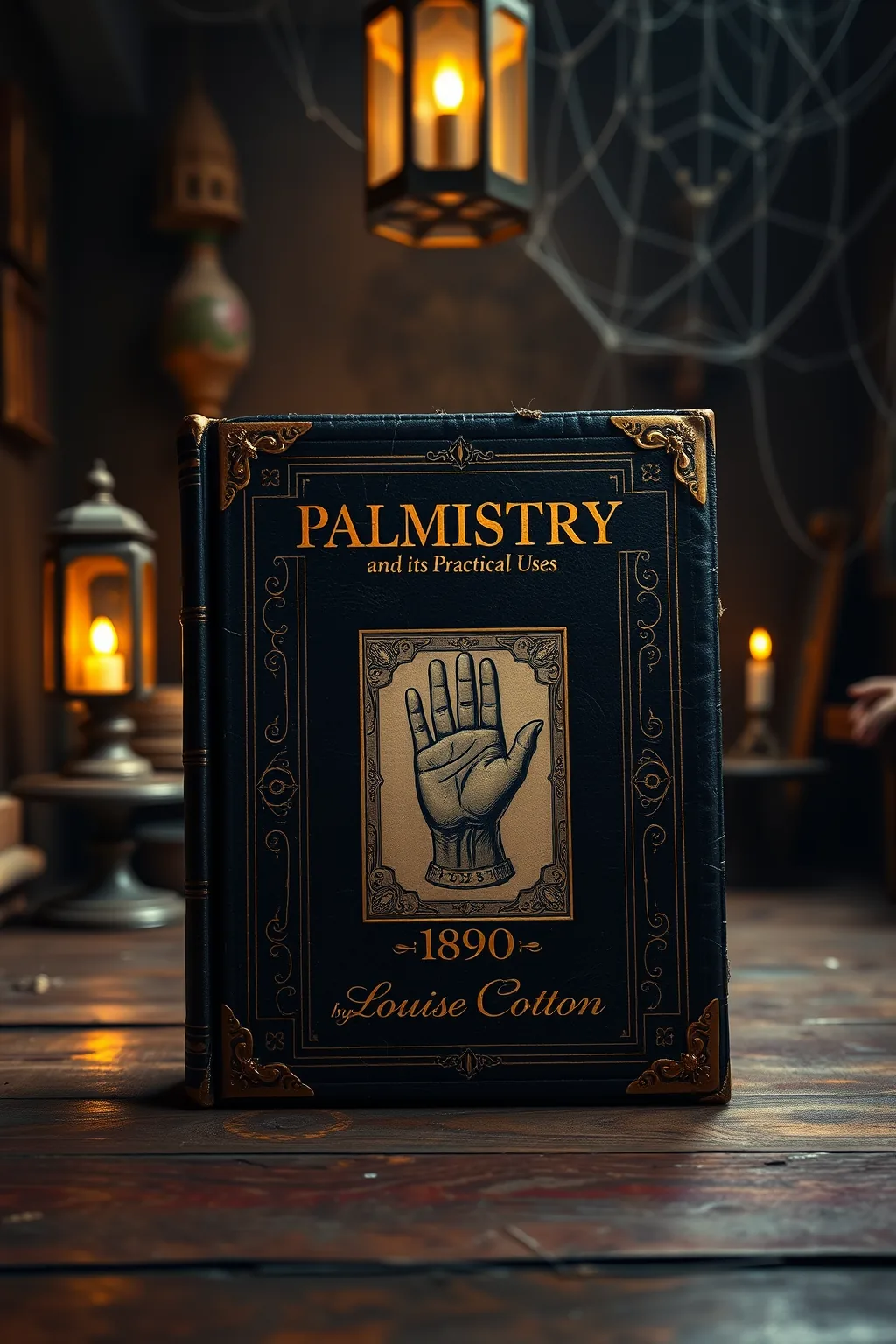
Palmistry and Its Practical Uses 1890
 62
62

Palmistry and Its Practical Uses 1890



Sophia Crane (Associate Editor) — Louise Cotton's "Palmistry and Its Practical Uses" stands as a beacon of clarity and practical application within the esoteric literature of palmistry. Published in 1890, this text masterfully distills complex astrological and karmic principles into an accessible guide for personal delineation. Cotton’s system, honed through extensive personal interviews, offers a nuanced approach to understanding the hand as a living manuscript of the soul. It eschews mere fortune-telling, instead emphasizing the profound psychological and spiritual insights attainable through its practice. This work is indispensable for serious students of divination seeking a solid, foundational understanding of cheiromancy beyond superficial interpretations.
📝 Description
62
Louise Cotton published 'Palmistry and Its Practical Uses' in 1890, detailing hand interpretation.
This 1890 book by Louise Cotton presents a methodical approach to palmistry. Cotton, an experienced practitioner, instructs readers on how to read the lines, mounts, and shapes of the hand. She views these physical characteristics not as simple biological traits, but as symbols that reflect an individual's inner life and destiny. The text aims to help readers understand their potential, past experiences, and the forces influencing their lives.
Cotton's work serves as a guide for those seeking self-understanding through the study of chiromancy. It connects the physical markings on the hand to broader concepts of fate, personal growth, and universal connections. The book encourages a thoughtful engagement with these interpretations, fostering a sense of personal insight and cosmic awareness.
Published in 1890, 'Palmistry and Its Practical Uses' emerged during a period of renewed interest in occultism and spiritualism in the late Victorian era. This tradition often sought to find correspondences between the physical world and hidden spiritual truths. Palmistry, as practiced by Cotton, fit within this framework by suggesting that the human hand held a symbolic language reflecting divine order, individual destiny, and the soul's trajectory. It was part of a broader movement to understand the unseen forces shaping human experience through divinatory arts.
💡 Why Read This Book?
Unearth the ancient wisdom encoded within your own hands. This book offers a practical, yet deeply mystical, framework for understanding your life's trajectory, hidden potentials, and karmic blueprint. Ideal for seekers of self-knowledge, students of esoteric arts, and practitioners looking to deepen their divinatory skills with a time-tested, insightful system.
⭐ Reader Reviews
Honest opinions from readers who have explored this book.
❓ Frequently Asked Questions
Is this book suitable for absolute beginners in palmistry?
Yes, Cotton's methodical approach, derived from personal interviews, makes her system accessible to beginners while offering depth for experienced practitioners. It provides a clear pathway into the art of hand reading.
Does this book focus on predicting the future?
While palmistry can offer insights into potential future paths, Cotton emphasizes understanding one's inherent nature, challenges, and strengths, promoting self-awareness and personal growth rather than deterministic prediction.
What is the primary system used in this book?
The book outlines a practical, systematic approach to palmistry developed by Louise Cotton herself, incorporating principles of astrology and occult symbolism for personal interviews and delineations.
How does this book differ from modern palmistry guides?
"Palmistry and Its Practical Uses" offers a direct connection to the late Victorian era's esoteric thought, providing a rich, historical perspective and a uniquely analog approach to interpretation.
Can palmistry truly reveal personal character?
Absolutely. The lines, mounts, and shapes of the hand are presented as symbolic representations of innate psychological tendencies, talents, and life challenges that contribute to individual character.
🔮 Key Themes & Symbolism
The Hand as a Cosmic Mirror
This theme explores the profound concept of the palm as a microcosm reflecting the macrocosm of the universe and the individual soul. Cotton posits that the lines and formations on the hand are not arbitrary but are imbued with celestial significance, directly correlating with astrological influences and karmic patterns. It looks at how the hand acts as a living, ever-changing map of one's spiritual evolution, offering insights into inherited traits, life lessons, and the subtle energetic currents that shape destiny. This perspective elevates palmistry from mere fortune-telling to a sacred dialogue with the self and the divine.
Practical Application and Personal Delineation
Central to Cotton's work is the emphasis on the 'practical uses' of palmistry, moving beyond theoretical knowledge to actionable understanding. The book details a systematic method for personal interviews and delineations, equipping readers with the tools to interpret the hands of themselves and others with accuracy and insight. This theme focuses on the methodical analysis of lines (life, head, heart), mounts, finger shapes, and palm contours, illustrating how these elements interrelate to paint a comprehensive picture of an individual's character, aptitudes, and life path. It's a guide to becoming a skilled interpreter of this ancient language.
The Interplay of Fate and Free Will
Cotton's approach to palmistry acknowledges the intricate dance between destiny and individual agency. While the lines on the hand may indicate predispositions, inherent challenges, and potential fated events, the system also empowers the reader to understand how their choices and consciousness can influence and even alter their path. This theme highlights the philosophical underpinnings of her work, suggesting that knowledge of one's palmistic map is not a sentence but an opportunity for conscious evolution. It encourages readers to use this understanding to navigate life's currents with greater wisdom and intention, ultimately shaping their own destiny through informed action.
💬 Memorable Quotes
Direct passages from the work, attributed to the author.
“Lines are but the elements of thoughts.”
— Suggests that the markings on the palm are not fixed but are manifestations of the individual's mental patterns, beliefs, and the energetic imprints left by their thoughts over time.
“Each mount tells a story of desire and capacity.”
— Highlights the symbolic role of the fleshy elevations on the palm (mounts), correlating them with specific human desires, inherent talents, and the potential to manifest them in life.
“The thumb reveals the strength of the will.”
— Focuses on a specific anatomical feature, the thumb, as a direct indicator of an individual's willpower, determination, and their capacity to assert themselves in the world.
“True palmistry is a science of self-knowledge.”
— Positions palmistry not as mere superstition, but as a rigorous discipline dedicated to uncovering clear insights about one's own nature, motivations, and life purpose.
💡 Key Ideas
Editorial paraphrase of the work's core concepts — not direct quotes.
The hand is the language of the soul.
This quote expresses the core belief that the physical form, specifically the hand, serves as a direct conduit for expressing the deepest aspects of one's inner being and spiritual journey.
🌙 Esoteric Significance
Tradition
This work is deeply rooted in the Western Esoteric Tradition, drawing upon astrological correspondences, Hermetic principles, and the ancient art of Cheiromancy. It aligns with the hermetic axiom 'As Above, So Below,' viewing the hand as a reflection of celestial energies and cosmic order. The system presented by Cotton can also be seen as a practical application of Gnostic ideas about the soul's journey and the unveiling of hidden knowledge within the material form. It emphasizes the interconnectedness of the physical, mental, and spiritual realms.
Symbolism
The book meticulously decodes the strong symbolism embedded within the palm. Lines represent the flow of life force and energetic pathways (e.g., the Life Line for vitality, the Heart Line for emotional capacity, the Head Line for intellect). Mounts symbolize different divine energies and human faculties (e.g., Mount of Venus for love and passion, Mount of Jupiter for ambition and leadership). Finger shapes and lengths add further layers of meaning, indicating personality traits and innate talents. Each element is presented as a symbolic key to understanding the intricate range of an individual's existence.
Modern Relevance
Despite its Victorian origins, Cotton's "Palmistry and Its Practical Uses" remains remarkably relevant for the modern seeker. In an age of constant digital distraction, the book offers a grounded, analog path to profound self-reflection and understanding. Its emphasis on character analysis, potential, and life lessons resonates deeply with contemporary interest in personal development, mindfulness, and finding one's authentic path. The systematic approach provides a valuable framework for those interested in divination as a tool for psychological insight and spiritual growth, bridging the gap between ancient wisdom and contemporary needs.
👥 Who Should Read This Book
This profound text is a treasure for a diverse audience. For the **Beginner**, it offers a clear, step-by-step introduction to the art of palmistry, clarifying its symbols and techniques. **Scholars** of esoteric history and divination will find it an invaluable primary source, revealing the state of palmistic thought in the late 19th century. **Seekers** of self-knowledge will discover a powerful tool for introspection, unlocking latent potentials and understanding life's challenges. **Practitioners** of occult arts will find a robust, systematic approach to enhance their divinatory skills and deepen their interpretive abilities, moving beyond superficial readings to clear insights.
📜 Historical Context
Published in 1890, "Palmistry and Its Practical Uses" emerged during the late Victorian era, a period marked by a resurgence of interest in spiritualism, occultism, and esoteric knowledge. This era saw a fascination with unlocking hidden truths and exploring alternative ways of understanding the self and the universe, often fueled by a reaction against the perceived materialism of the industrial age. Palmistry, alongside other divinatory arts, experienced a revival, with practitioners seeking to systematize and legitimize its practice. Louise Cotton's work reflects this intellectual climate, aiming to present palmistry as a serious, practical system rather than mere parlor trickery, drawing upon existing occult traditions and contemporary psychological understandings to offer a comprehensive guide for the discerning reader.
📔 Journal Prompts
Reflect on the primary lines of your dominant hand. What do they reveal about your core vitality, intellect, and emotional landscape?
Examine the mounts on your palm. Which are most prominent, and how do they manifest in your daily life and aspirations?
Consider a specific line or marking that seems challenging. How can understanding its meaning empower you to navigate this aspect of your life more consciously?
If you were to perform a personal delineation using Cotton's system, what would be the most striking revelation about yourself?
How does the concept of the hand as a 'language of the soul' challenge or affirm your current understanding of self?
🗂️ Glossary
Cheiromancy
The ancient art and practice of foretelling the future or discovering character by studying the lines and other characteristics of the palm of the hand. It is synonymous with palmistry.
Lines
The distinct grooves or furrows on the palm of the hand, each carrying symbolic meaning related to vital energy, intellect, emotions, and destiny, such as the Life Line, Head Line, and Heart Line.
Mounts
The fleshy, raised pads on the palm, located at the base of the fingers and on the palm itself, each associated with a specific planet and corresponding human faculty or desire (e.g., Mount of Venus, Mount of Jupiter).
Delineation
The process of interpreting the markings on the palm of a hand to gain insights into a person's character, potential, life experiences, and future possibilities.
Karmic Lesson
In esoteric traditions, a challenge or pattern that an individual is meant to learn from and overcome in their current life, often indicated by specific markings or configurations on the palm.
This book appears in 2 collections
🔮 Readers Also Liked
Browse all →








More by Louise Cotton
All books →
From the “Palmistry” Collection
View all →









More Free Divination & Tarot Books
View all →