Pagan & Christian creeds

 79
79

Pagan & Christian creeds
Edward Carpenter's Pagan & Christian Creeds offers a fascinating, if sometimes uneven, exploration of the common threads binding ancient faiths and nascent Christianity. Carpenter's strength lies in his earnest attempt to uncover a universal spiritual language, moving past sectarian divisions. He compellingly argues, for instance, that the imagery of the 'dying and rising god' is not unique to Christ but a recurring motif in older mystery cults. However, the book occasionally suffers from a lack of rigorous academic sourcing by modern standards, presenting interpretations as established fact. The prose, while earnest, can feel somewhat dated. Despite these limitations, Carpenter's vision of a shared human spiritual heritage remains a potent and valuable perspective for anyone examining religious history.
📝 Description
79
Edward Carpenter's 1920 book, Pagan & Christian Creeds, argues for shared spiritual roots between ancient paganism and early Christianity.
Published in 1920, Edward Carpenter's Pagan & Christian Creeds examines the common myths and spiritual impulses found in ancient pagan traditions and early Christianity. Carpenter moves beyond surface-level doctrinal distinctions to highlight the universal human need for meaning, ritual, and a connection to the divine. He suggests that many Christian narratives and symbols draw from older, pre-Christian cults, particularly those from the Mediterranean and Near East.
The book is suited for readers interested in the historical development of religious thought, especially those who value comparative mythology and the study of ancient spiritual practices. It appeals to individuals seeking to understand the underlying unity of human religious experience, regardless of specific dogma. Students of comparative religion, mythology, and early church history will find its approach illuminating.
Carpenter's work emerged during a period of significant intellectual and spiritual change in Britain, engaging with new fields like anthropology, comparative religion, and psychology. It coincided with movements like Theosophy and a resurgence of interest in pagan antiquity, questioning established Victorian religious views. His examination of pre-Christian motifs in Christianity parallels sentiments in the work of contemporaries like Sir James Frazer, though Carpenter's focus was more spiritual than purely anthropological.
Carpenter's study belongs to a tradition of comparative religious scholarship that sought universal truths beneath diverse faiths. Emerging from a context of spiritual ferment and interest in ancient wisdom, it engages with ideas about archetypal psychology and the perennial philosophy. The book reflects a turn towards understanding religion not just as dogma, but as an expression of fundamental human psychological and cosmic interaction, aligning with a broader esoteric current interested in the underlying unity of spiritual experience across cultures and eras.
💡 Why Read This Book?
• Understand the recurring 'dying and rising god' motif that Carpenter traces from ancient Near Eastern cults to Christian theology, offering a comparative religious perspective not found in purely dogmatic texts. • Gain insight into Carpenter's exploration of the evolution of communal versus individualistic ethics, a concept he details in his discussion of early Christian social structures versus pagan communal life. • Discover Carpenter's perspective on the spiritual resonance of the Eleusinian Mysteries and their potential connections to Christian symbolism, a specific comparison that highlights the book's unique approach to religious parallels.
⭐ Reader Reviews
Honest opinions from readers who have explored this book.
❓ Frequently Asked Questions
What is the main argument of Edward Carpenter's Pagan & Christian Creeds?
The book argues that many core elements, symbols, and spiritual impulses found in early Christianity have deep roots in pre-Christian pagan traditions, suggesting a shared human spiritual heritage across diverse faiths.
When was Pagan & Christian Creeds first published?
Pagan & Christian Creeds was first published in 1920, during a period of significant intellectual and spiritual inquiry into comparative religion and mythology.
What pagan traditions does Carpenter compare to Christianity?
Carpenter discusses various pagan traditions, including those associated with the mystery cults of the Mediterranean and Near East, referencing figures and concepts from these older systems.
Does Carpenter dismiss Christianity in favor of paganism?
No, Carpenter's aim is not to dismiss Christianity but to show its continuity with older spiritual streams, seeking to understand the universal human quest for meaning that underlies all religious expression.
What are some key symbols Carpenter examines?
Key symbols include the 'dying and rising god' motif, the sacred marriage, and the divine child, which Carpenter sees as archetypal expressions of spiritual and natural cycles.
Is this book suitable for beginners in religious studies?
Yes, while intellectually rigorous, the book's comparative approach makes it accessible for beginners interested in understanding the historical and mythological roots of religious ideas beyond their current doctrinal forms.
🔮 Key Themes & Symbolism
Shared Spiritual Archetypes
Carpenter posits that fundamental human spiritual experiences manifest in recurring archetypal figures and narratives across cultures. He identifies the 'dying and rising god' as a prime example, tracing its presence in ancient Near Eastern religions and mystery cults long before its association with Christ. This theme suggests that religious expression taps into a universal psychic landscape, with similar symbolic languages emerging independently to address fundamental human concerns about life, death, and renewal.
Evolution of Morality
The work examines how moral and ethical frameworks evolve from communal, nature-integrated systems in pagan societies to the more individualized and abstract doctrines of Christianity. Carpenter explores the shift from a focus on collective well-being and natural law to emphasis on personal salvation and divine commandments. This transition is analyzed through the lens of social and spiritual development, highlighting how changing societal structures influence religious thought.
Continuity of Mystery Traditions
A significant focus is placed on the continuity between the ancient mystery religions, such as the Eleusinian or Mithraic cults, and early Christian practices. Carpenter suggests that Christian ritual and symbolism may have absorbed or reinterpreted elements from these older traditions, particularly concerning initiation, death, and rebirth. This perspective views Christianity not as a radical break, but as a development within a longer spiritual lineage.
The Human Quest for the Divine
Underlying all discussions is the theme of humanity's innate drive to connect with something greater than itself. Carpenter views different religious creeds as diverse expressions of this singular, persistent quest. The book emphasizes the emotional and spiritual impulses behind worship and ritual, arguing that these fundamental human needs provide the fertile ground from which diverse religious forms emerge.
💬 Memorable Quotes
Direct passages from the work, attributed to the author.
“The fundamental impulse of the human heart towards the divine is one and the same, whether expressed in the rites of Eleusis or in the sacraments of the Christian Church.”
— This statement captures Carpenter's core thesis: that beneath doctrinal differences lies a unified human spiritual yearning. He suggests that the emotional and psychological experiences sought in ancient pagan rituals are mirrored in Christian practices, highlighting a continuity of human spiritual needs.
“The story of the god who dies and is born again is found repeated in many lands and ages.”
— This highlights Carpenter's focus on recurring mythological patterns. He uses the 'dying and rising god' archetype to illustrate how similar narratives of sacrifice, death, and resurrection appear across various ancient cultures, predating and potentially influencing Christian accounts.
“The sacred marriage, a union symbolizing cosmic fertility and order, appears in various forms in pagan traditions.”
— This refers to Carpenter's exploration of another key motif. The 'hieros gamos' or sacred marriage, representing the union of divine principles and the creation of cosmic harmony, is presented as a symbol with deep roots in ancient religious thought.
“We must look for the underlying spiritual unity, not merely the surface distinctions between faiths.”
— This interpretation emphasizes Carpenter's methodological approach. He urges readers to penetrate the superficial differences in dogma and ritual to perceive the common spiritual impulses and shared human experiences that bind different religious traditions together.
💡 Key Ideas
Editorial paraphrase of the work's core concepts — not direct quotes.
Christian ethics, with its emphasis on the individual soul, represents a significant departure from the more communal morality of earlier societies.
This paraphrase points to Carpenter's analysis of ethical shifts. He observes a move from a collective, nature-oriented moral sense in paganism to a more introspective, salvation-focused ethical system within Christianity, reflecting societal changes.
🌙 Esoteric Significance
Tradition
Carpenter's work aligns with the broader esoteric current of the late 19th and early 20th centuries, particularly its interest in comparative religion and the search for universal spiritual truths beneath exoteric doctrines. While not strictly Gnostic or Kabbalistic, it shares the Gnostic impulse to uncover hidden meanings and historical continuities obscured by orthodox interpretations. It also reflects the Theosophical emphasis on ancient wisdom and the idea of a perennial philosophy, seeking to demonstrate that different faiths are expressions of a single, underlying spiritual reality.
Symbolism
Key symbols explored include the 'dying and rising god,' representing cyclical nature, sacrifice, and spiritual rebirth, a motif Carpenter connects to ancient fertility cults and mystery religions. The 'sacred marriage' (hieros gamos) is another significant symbol, signifying the union of divine principles and the creation of cosmic order, often mirroring the union of the human soul with the divine. The divine child archetype also features prominently, symbolizing new beginnings, innocence, and divine potential emerging from older forms.
Modern Relevance
Contemporary interest in Paganism, Neopaganism, and comparative mythology often draws upon the foundational comparative work done by scholars and esotericists like Carpenter. His ideas about shared archetypes and the historical roots of religious symbolism continue to inform discussions within modern Pagan and New Age spirituality. Thinkers and practitioners exploring Jungian psychology, archetypal studies, and the integration of ancient mythologies into contemporary life find resonance in Carpenter's efforts to bridge historical religious forms with enduring human spiritual needs.
👥 Who Should Read This Book
• Students of comparative religion and mythology seeking to understand the historical and symbolic links between ancient faiths and Christianity, moving beyond purely doctrinal analyses. • Esoteric practitioners interested in the 'perennial philosophy' and the idea that diverse spiritual traditions share common roots and archetypal patterns, particularly those exploring pre-Christian European spirituality. • Readers questioning religious dogma who are looking for historical perspectives that emphasize the continuity of human spiritual impulses across different creeds and cultural expressions.
📜 Historical Context
Edward Carpenter’s Pagan & Christian Creeds (1920) emerged during a period of profound intellectual and spiritual reevaluation in Britain. The late Victorian and Edwardian eras witnessed a surge in interest in comparative mythology, anthropology, and Eastern religions, partly fueled by figures like Sir James Frazer and the Theosophical Society. Carpenter, already known for his critiques of industrial society and his explorations of spiritual and sexual freedom, engaged directly with the idea that Christianity was not a singular revelation but part of a long, evolving spiritual lineage. His work implicitly challenged the prevailing Anglican and Nonconformist orthodoxies, resonating with a growing secular and heterodox intellectual climate. Contemporaries like D.H. Lawrence, who deeply admired Carpenter, were also exploring similar themes of ancient spirituality and its relation to modern life, though often with a more visceral, less academic approach. The book's examination of pre-Christian motifs within Christianity likely met with resistance from traditional religious circles but found an appreciative audience among those seeking alternative spiritual frameworks.
📔 Journal Prompts
The concept of the 'dying and rising god' motif: How might this archetype reflect cycles in nature or personal transformation?
Carpenter's view on the shift from communal pagan morality to individual Christian ethics: What are the implications for modern social values?
Reflect on the 'sacred marriage' symbol: What union, literal or metaphorical, represents cosmic order or spiritual integration in your understanding?
Consider the Eleusinian Mysteries: How might their ancient rituals inform modern searches for spiritual meaning and connection?
Edward Carpenter's argument for underlying spiritual unity: Where do you see commonalities between seemingly disparate belief systems in contemporary society?
🗂️ Glossary
Pagan Creeds
Refers to the religious beliefs, myths, and rituals of ancient non-Abrahamic peoples, particularly those of classical antiquity and indigenous European traditions, often characterized by nature worship and polytheism.
Mystery Religions
Ancient Hellenistic cults (e.g., Eleusinian, Mithraic, Dionysian) characterized by secret rites, initiation ceremonies, and often promising salvation or a blessed afterlife to adherents.
Dying and Rising God
A recurring mythological archetype found in various ancient cultures, depicting a deity who undergoes death and subsequent resurrection or rebirth, symbolizing natural cycles, sacrifice, and renewal.
Sacred Marriage (Hieros Gamos)
A ritualistic or symbolic union, often between divine figures or between a ruler and a deity/priestess, representing cosmic fertility, order, and the integration of divine principles.
Archetype
In a psychological or mythological context, a fundamental, primal pattern or image that is part of the collective unconscious, manifesting in myths, dreams, and symbols across cultures.
Exoteric vs. Esoteric
Exoteric refers to teachings or beliefs publicly known and accepted, while esoteric refers to hidden, inner, or secret knowledge accessible only to initiates or those with deeper understanding.
Perennial Philosophy
The concept, popularized by Aldous Huxley, that all religions share a common, underlying spiritual truth or wisdom, despite their diverse outward forms and doctrines.
🔮 Readers Also Liked
Browse all →








More by Edward Carpenter
All books →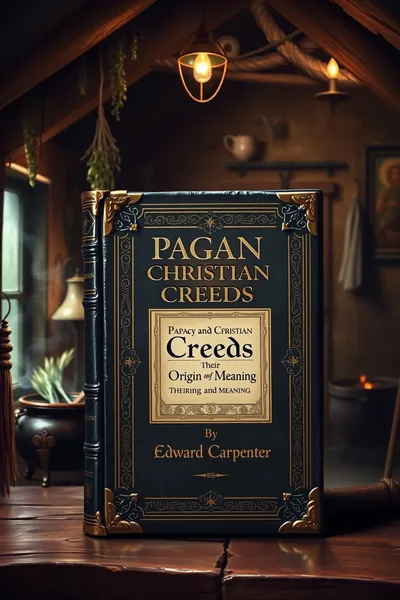

More Free Witchcraft & Paganism Books
View all →








![Histoire de M. Oufle, par abbé Bordelon Cretouchée et réduite par M. G.] et la Description du sabbat. ... 1793: Iss 140](/img/thumb/histoire-de-m-oufle-par-abb-bordelon-cretouch-e-et-r-duite-par-m-g-et-la-description-du-sabbat-1793-iss-140-bordelon-laurent-1653-1730.webp)

