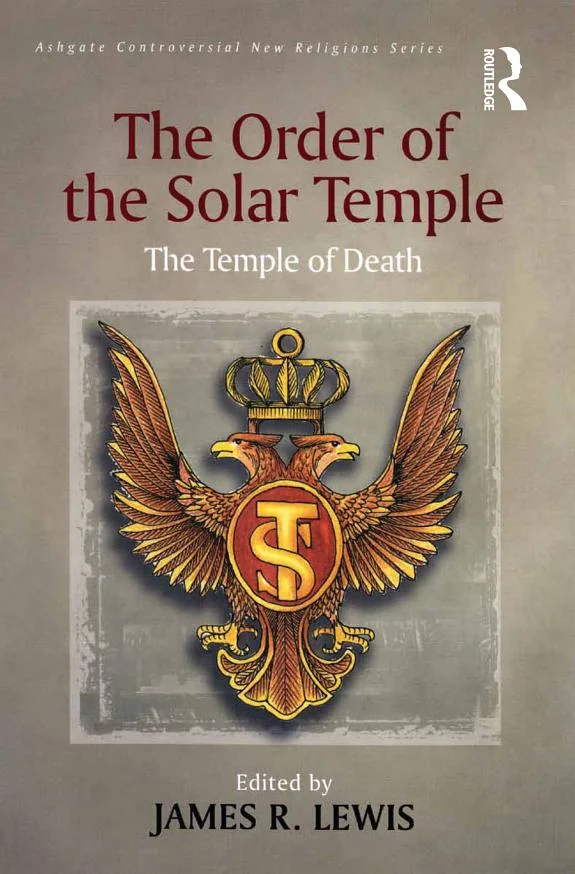
The Order of the Solar Temple
 83
83

The Order of the Solar Temple
James R. Lewis's "The Order of the Solar Temple" offers a much-needed academic grounding to a subject frequently obscured by sensationalism. Lewis’s strength lies in his meticulous adherence to sociological frameworks, presenting the OST not as a mere 'cult' but as a complex social phenomenon. He carefully dissects the group’s syncretic doctrines, which drew from a peculiar mix of Templar lore, Christian eschatology, and New Age ideas. A particularly illuminating section details the internal organizational structure and the psychological pressures that may have contributed to the members’ radical decisions. However, the book’s academic tone, while a strength for scholars, might prove dry for general readers seeking a more narrative approach. The detailed examination of theological minutiae, while important for context, occasionally bogs down the broader sociological analysis. Despite this, Lewis provides an indispensable resource for understanding the group's trajectory from esoteric society to its tragic conclusion.
📝 Description
83
James R. Lewis's 1995 book offers an academic perspective on the Order of the Solar Temple.
James R. Lewis, a sociologist, examines the history and beliefs of the Order of the Solar Temple (OST). This work moves beyond sensationalized accounts to provide a scholarly analysis of the group's origins, doctrines, and its eventual dissolution.
Lewis's study is for scholars of religion, students of esotericism, and anyone wanting a dispassionate look at the OST. It appeals to readers interested in cult dynamics, the sociology of religion, and the connection between spiritual beliefs and catastrophic events. The book favors empirical research over speculation.
The Order of the Solar Temple appeared in the late 20th century. Founded by Luc Jouret and Joseph Di Mambro, the group claimed a spiritual lineage from groups like the Knights Templar and other esoteric traditions. Its end, marked by public deaths starting in 1994, brought intense scrutiny from both media and academics.
The Order of the Solar Temple presented itself as a continuation of Western esoteric traditions, specifically referencing the Knights Templar and Rosicrucianism. Its syncretic blend of Freemasonry, Christian theology, and other mystical elements reflects a broader trend within late 20th-century esotericism. This book situates such movements within the larger study of religious innovation and the reinterpretation of historical esoteric lineages.
💡 Why Read This Book?
• Understand the syncretic doctrines of the Order of the Solar Temple, which blended elements from Rosicrucianism and Templar lore, providing a unique lens into esoteric belief systems. • Gain insight into the sociological factors contributing to the movement's radicalization, referencing the specific events and leadership dynamics that culminated in the 1994 tragedies. • Appreciate the academic methodology applied to new religious movements, learning how scholars like Lewis analyze groups beyond sensationalist headlines.
⭐ Reader Reviews
Honest opinions from readers who have explored this book.
❓ Frequently Asked Questions
What is the primary focus of James R. Lewis's book on The Order of the Solar Temple?
The book offers a sociological and academic analysis of the Order of the Solar Temple (OST), examining its origins, beliefs, leadership, and its eventual tragic end, aiming for a dispassionate understanding beyond sensational media portrayals.
When was the Order of the Solar Temple founded and by whom?
The Order of the Solar Temple was co-founded by Luc Jouret and Joseph Di Mambro in the late 20th century, though its roots and ideological development spanned several years prior to public emergence.
What esoteric traditions influenced the Order of the Solar Temple?
The OST's teachings were a syncretic blend, drawing significantly from the mythology of the Knights Templar, Rosicrucianism, Freemasonry, and various Christian and Gnostic elements, alongside New Age spiritual concepts.
What were the key events that led to the downfall of the Order of the Solar Temple?
The group's decline was marked by a series of highly publicized deaths, beginning in 1994 with incidents in Switzerland and Canada, which brought the organization under intense global scrutiny.
Is this book suitable for someone new to the study of new religious movements?
Yes, while academic, Lewis's work provides a solid foundation for understanding the complexities of new religious movements by dissecting a prominent and tragic example with detailed research.
Does the book offer an interpretation of the motivations behind the OST's actions?
The book explores potential motivations through sociological and psychological lenses, examining leadership dynamics, belief systems, and external pressures rather than providing definitive pronouncements on individual intent.
🔮 Key Themes & Symbolism
Syncretic Esotericism
The Order of the Solar Temple is presented as a prime example of syncretic esotericism, where disparate spiritual and historical traditions are fused into a novel belief system. Lewis details how the group’s founders, Luc Jouret and Joseph Di Mambro, drew heavily from the mythology of the Knights Templar, intertwining it with elements of Rosicrucianism, Freemasonry, and Christian apocalypticism. This fusion created a unique cosmology that positioned the OST as a spiritual successor to ancient chivalric orders, offering members a sense of historical continuity and profound purpose. The analysis highlights how such syncretism can both attract adherents seeking a grand narrative and, in extreme cases, foster a sense of detachment from conventional reality.
Apocalypticism and Millenarianism
A significant theme explored is the role of apocalyptic and millenarian beliefs within the OST. The movement's doctrine posited an impending spiritual transition and a physical 'Second Coming' of Christ, which the leadership claimed to be instrumental in facilitating. Lewis examines how these end-times prophecies, coupled with the group’s esoteric interpretations of historical cycles, created a framework for radical action. The book analyzes the psychological impact of living under the constant expectation of a world-altering event, and how this eschatological fervor contributed to the group's isolation and eventual tragic outcomes, particularly the highly publicized events of 1994.
Sociology of New Religious Movements
Beyond the specific doctrines of the OST, the work serves as a case study in the sociology of new religious movements (NRMs). Lewis employs established academic frameworks to dissect the group's formation, leadership structure, recruitment strategies, and internal dynamics. He scrutinizes the influence of charismatic leaders like Jouret and Di Mambro, the development of group cohesion, and the factors that can lead to deviation from societal norms, including radicalization. The book offers a method for understanding such groups objectively, distinguishing between genuine spiritual seeking and potentially destructive organizational dynamics, thereby contributing to a more nuanced public and academic discourse.
Leadership and Charisma
The potent role of leadership, particularly charismatic authority, is a central focus. Lewis investigates how Luc Jouret and Joseph Di Mambro cultivated an aura of divine authority, positioning themselves as key figures in a cosmic drama. Their ability to articulate a compelling, albeit esoteric, vision and to foster intense personal loyalty among followers was crucial to the OST's rise. The book explores the psychological mechanisms through which followers become deeply committed to such leaders, even when faced with increasingly extreme demands or beliefs. This analysis provides critical insight into the dynamics of cultic influence and the power of personality in shaping collective behavior.
💬 Memorable Quotes
Direct passages from the work, attributed to the author.
“The Order of the Solar Temple presented itself as a spiritual heir to the Knights Templar.”
— This statement highlights the OST's deliberate attempt to link its identity and purpose to a historically significant and mystically charged order, leveraging the Templar mystique to lend legitimacy and gravitas to its own esoteric claims.
“Luc Jouret and Joseph Di Mambro were the primary architects of the OST's syncretic theology.”
— This points to the founders' central role in synthesizing diverse esoteric traditions—such as Rosicrucianism and Templar lore—into the unique, and ultimately problematic, belief system that defined the Order of the Solar Temple.
“Apocalyptic prophecies played a significant role in the movement's radicalization.”
— This interpretation underscores how the anticipation of a world-ending or transformative event, deeply embedded in the OST's doctrine, created a psychological environment conducive to extreme actions and detachment from mainstream society.
“The group's dissolution was marked by highly publicized violent events.”
— This refers to the tragic events beginning in 1994, which brought the Order of the Solar Temple into global infamy and led to intense scrutiny from both the media and academic researchers studying new religious movements.
“Lewis employs sociological frameworks to analyze the OST.”
— This indicates the author's methodological approach, utilizing established theories and concepts from the study of religion and social groups to provide an objective and analytical perspective on the movement.
🌙 Esoteric Significance
Tradition
The Order of the Solar Temple fits within the broad spectrum of Western Esotericism, specifically drawing from esoteric Christian and Templar traditions, blended with New Age sensibilities. Its syncretic nature is a hallmark of late 20th-century esoteric movements, which often sought to synthesize disparate historical and spiritual lineages. While claiming a lineage to ancient orders, its specific doctrines and organizational structure represent a modern interpretation and adaptation of these traditions, aiming to provide a framework for spiritual transformation in contemporary times.
Symbolism
Key symbols for the OST included overt references to the Knights Templar, such as crosses and chivalric imagery, which were used to evoke a sense of historical continuity and spiritual authority. The concept of the 'Solar Temple' itself suggests a focus on solar symbolism, often associated with divine light, spiritual enlightenment, and cosmic order in various esoteric traditions. The movement likely employed these symbols to imbue their followers with a sense of belonging to an elite, divinely sanctioned group tasked with a crucial spiritual mission.
Modern Relevance
Contemporary scholars and researchers of new religious movements continue to reference The Order of the Solar Temple as a critical case study. Its trajectory offers enduring lessons regarding the dynamics of charismatic leadership, the power of apocalyptic belief systems, and the potential for esoteric ideas to manifest in radical social and personal outcomes. Thinkers examining cultic behavior, the sociology of belief, and the intersection of spirituality and violence often cite Lewis's work as foundational for understanding such phenomena.
👥 Who Should Read This Book
• Scholars and students of comparative religion and new religious movements will find Lewis's sociological approach useful for understanding group dynamics and belief formation. • Individuals interested in the history of Western Esotericism will gain insight into how ancient traditions are reinterpreted and synthesized into modern movements. • Researchers examining the psychology of cults and charismatic leadership can use this book to analyze the factors contributing to group radicalization and member commitment.
📜 Historical Context
Emerging in the late 20th century, The Order of the Solar Temple (OST) appeared during a period of heightened public and academic interest in new religious movements, often accompanied by significant apprehension. The 1980s and early 1990s saw numerous groups like the OST, which often blended esoteric traditions with contemporary spiritual currents. The OST's founders, Luc Jouret and Joseph Di Mambro, deliberately constructed a narrative linking their group to the ancient Knights Templar and other Western esoteric traditions, such as Rosicrucianism. This historical appropriation was not uncommon among esoteric groups seeking lineage and authority. The movement's dramatic collapse, beginning with the widely reported deaths in Switzerland and Canada in 1994, immediately drew the attention of scholars like James R. Lewis, who sought to understand the group's trajectory through rigorous sociological analysis, distinguishing it from sensationalist media accounts.
📔 Journal Prompts
Reflect on the syncretic blend of Templar lore and Christian eschatology within the OST.
Consider the impact of charismatic leadership, as exemplified by Luc Jouret, on group cohesion.
Analyze the role of apocalyptic prophecies in shaping the members' worldview.
Examine the sociological factors that might lead individuals to join and remain within a movement like the OST.
Consider how historical esoteric traditions are adapted by contemporary groups.
🗂️ Glossary
Syncretism
The merging or attempted merging of different religions, cultures, or schools of thought. In the context of the OST, it refers to the blending of elements from Templar mythology, Rosicrucianism, and Christian theology.
Esotericism
Belief systems and practices that are concerned with the inner, hidden, or secret aspects of reality, often involving mystical or occult knowledge accessible only to initiates.
New Religious Movement (NRM)
A term used in religious studies to describe a religious or spiritual group that has emerged relatively recently and is often viewed with suspicion by mainstream society.
Apocalypticism
Belief in an imminent, dramatic, and transformative end to the current world or age, often involving divine intervention and a final judgment.
Charismatic Leadership
A form of influence based on the personal appeal, perceived exceptional qualities, or perceived divine inspiration of a leader, which inspires devotion and obedience from followers.
Rosicrucianism
A spiritual and cultural movement that claims to draw on the wisdom of the legendary Rosicrucian brotherhood, often associated with alchemy, mysticism, and esoteric philosophy.
Knights Templar
A medieval Catholic military order, prominent in the 12th century, often surrounded by legends and adopted into various esoteric traditions.
🔮 Readers Also Liked
Browse all →








More by James R. Lewis
All books →




More Free Witchcraft & Paganism Books
View all →