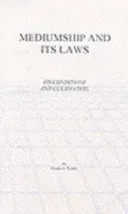
Mediumship and Its Laws
 80
80

Mediumship and Its Laws
Hudson Tuttle's "Mediumship and Its Laws" offers a disarmingly straightforward account of spiritualistic mechanics from a period rife with both fervent belief and rigorous skepticism. The author’s attempt to codify the 'laws' of mediumship is perhaps its most compelling aspect, presenting phenomena not as mere caprice but as operating under discernible principles. One strength lies in its historical perspective; reading Tuttle feels like eavesdropping on a late 19th-century debate. However, the limitation is precisely this historical framing. The scientific understanding and philosophical underpinnings have evolved considerably, making some explanations feel quaint or incomplete to a modern reader. A passage detailing the conditions for successful materialization, while fascinating for its earnestness, highlights this gap between historical assertion and contemporary inquiry. Despite its dated elements, the book serves as a valuable primary source for understanding the intellectual architecture of early spiritualism. It is a clear, if somewhat dated, exposition of spiritualist theory.
📝 Description
80
Hudson Tuttle's 1880 book, "Mediumship and Its Laws," sought to codify spiritualistic phenomena.
Published in 1880, Hudson Tuttle's "Mediumship and Its Laws" examines spiritualistic phenomena and proposes governing principles. Tuttle aimed to demystify how communication with discarnate entities occurs, outlining what he saw as inherent rules and operational dynamics. This work provides a look into early discussions of mediumship during a time of significant public interest in the supernatural.
The book is relevant for those studying the history of spiritualism, parapsychology researchers, and individuals interested in the early frameworks of mediumistic practice. It offers a historical perspective for practitioners and will appeal to anyone interested in late 19th century inquiries into consciousness and existence beyond the physical. Tuttle's approach often favored empirical or law-based explanations for phenomena, attempting to codify events that others might view as miraculous.
Emerging in the late 19th century, a period when spiritualism held considerable cultural sway, "Mediumship and Its Laws" reflects a desire to understand unseen worlds and communication with the deceased. This era saw figures like Madame Blavatsky and the Theosophical Society also exploring spiritual communication, though often with a more overtly mystical or philosophical approach. Tuttle's work distinguished itself by attempting a more systematic, law-based analysis of phenomena, seeking to establish order within what was frequently perceived as arbitrary or supernatural events.
💡 Why Read This Book?
• Gain insight into the foundational 'laws' of spiritualism as articulated by Hudson Tuttle, offering a structured understanding of phenomena that predates modern parapsychology. • Understand the historical context of late 19th-century spiritualism by examining Tuttle's attempt to rationalize mediumship amidst a period of intense spiritual and scientific inquiry. • Explore Tuttle's specific concepts regarding the conditions and ethics of communication with discarnate entities, providing a unique historical perspective on spiritualist practice.
⭐ Reader Reviews
Honest opinions from readers who have explored this book.
❓ Frequently Asked Questions
What is the primary focus of Hudson Tuttle's 'Mediumship and Its Laws'?
The book primarily focuses on examining the principles and purported 'laws' that govern spiritualistic phenomena and the practice of mediumship during the late 19th century.
When was the original edition of 'Mediumship and Its Laws' published?
The original edition of 'Mediumship and Its Laws' by Hudson Tuttle was first published in September 1996, with this being a reissue of the original 1900 edition.
Who is Hudson Tuttle and what is his background?
Hudson Tuttle was an American author and spiritualist prominent in the late 19th century, known for his writings on spiritualism and his attempts to explain its phenomena through logical frameworks.
What kind of phenomena does the book discuss?
The book discusses various spiritualistic phenomena, including communication with spirits, materialization, and the conditions believed to facilitate or impede such interactions.
Is this book suitable for beginners in esoteric studies?
Yes, it is suitable for beginners interested in the historical development of spiritualism and mediumship, offering a foundational perspective from the late 1800s.
What makes this book a 'new release of the original 1900 edition'?
This means the content is a faithful reproduction of the 1900 publication, offering readers access to the text as it was originally presented, rather than a modern interpretation or revision.
🔮 Key Themes & Symbolism
The Nature of Spirit Communication
Tuttle dissects the perceived mechanisms by which spirits communicate with the living. He posits that these interactions are not random but governed by specific laws, akin to natural principles. The work details the conditions necessary for such communication, exploring the role of the medium as a conduit and the environment required to facilitate clear contact. This theme examines the author's attempt to bring order and rational explanation to phenomena often viewed as mystical or unpredictable, framing spirit interaction within a quasi-scientific paradigm of the era.
Codifying Mediumistic Laws
A central objective of the book is to establish a framework of 'laws' that dictate the success and form of mediumistic experiences. Tuttle outlines these principles, which encompass factors influencing the clarity of messages, the possibility of materialization, and the ethical considerations for both the medium and the inquirer. This theme reflects the late 19th-century desire to find order and predictability in spiritual phenomena, moving beyond anecdotal accounts to suggest underlying, discoverable rules for engaging with the spirit world.
The Medium as a Force
The role and capabilities of the medium are explored in depth. Tuttle presents the medium not merely as a passive channel but as an active participant whose state of being, intention, and environment significantly influence the manifestation of spiritualistic phenomena. This includes discussions on the medium's sensitivity, their capacity to attract or repel spiritual influences, and the ethical responsibilities that accompany such a role. The work emphasizes the medium's agency within the 'laws' governing spirit intercourse.
Empirical Approach to the Unseen
Throughout the text, Tuttle strives for an empirical or logical approach to understanding spiritual phenomena. He attempts to move beyond pure faith or superstition by presenting observable 'laws' and conditions. This theme highlights the intellectual climate of the late 1800s, where many sought to reconcile spiritual beliefs with emerging scientific methods. The book is an artifact of this effort, seeking to provide a rational, if speculative, basis for the reality and mechanics of mediumship.
💬 Memorable Quotes
Direct passages from the work, attributed to the author.
“The laws governing mediumship are as immutable as those which govern the stars.”
— This statement underscores Tuttle's core thesis: that spiritualistic phenomena are not chaotic but follow predictable, discoverable principles, akin to the order observed in the physical universe.
“A clear medium is a prerequisite for clear communication.”
— This emphasizes the importance of the medium's own state—mental, emotional, and physical—in facilitating a successful and coherent connection with the spirit world.
“Conditions must be prepared for the manifestation of spiritual forces.”
— This interpretation highlights that spiritual phenomena require a specific environment and conducive circumstances, suggesting that interaction with the unseen is not spontaneous but requires deliberate setup.
“Understanding these laws is key to unlocking greater mediumistic potential.”
— This suggests that the practical application of Tuttle's outlined principles can lead to enhanced abilities and more profound experiences for those practicing mediumship.
💡 Key Ideas
Editorial paraphrase of the work's core concepts — not direct quotes.
The laws of spirit intercourse are not arbitrary.
This paraphrase reinforces the idea that interactions with spirits are governed by a system of rules, implying that understanding these rules allows for more predictable and reliable communication.
🌙 Esoteric Significance
Tradition
While not explicitly aligned with a single esoteric lineage like Hermeticism or Gnosticism, Tuttle's work fits within the broader spiritualist movement that gained prominence in the 19th century. This movement, while often secular in its presentation, drew upon and contributed to a wider esoteric milieu interested in communication with non-physical realms and the nature of consciousness beyond the body. It represents an attempt to systematize spiritual experiences, bridging the gap between folk belief and more formalized metaphysical inquiry.
Symbolism
The primary 'symbols' in Tuttle's work are less visual motifs and more conceptual frameworks. The 'Laws' themselves function as symbolic representations of order in the unseen world. The 'Medium' acts as a symbol of the bridge between physical and spiritual realities, while 'Materialization' symbolizes the tangible proof sought by spiritualists of spirit presence and power.
Modern Relevance
Tuttle's work continues to be relevant for contemporary spiritualists, mediums, and parapsychologists who study the historical development of their field. His attempt to outline 'laws' informs discussions on the underlying principles of consciousness, psychic phenomena, and the ethics of channeling or mediumistic practice. Researchers of esoteric history and the sociology of belief also find value in his methodical approach to a subject often treated with less structure.
👥 Who Should Read This Book
• Students of 19th-century spiritualism seeking primary source material on the mechanics of mediumship. • Researchers of parapsychology interested in historical frameworks for understanding psychic phenomena. • Practicing mediums or spiritualists looking to connect with the foundational theories and ethical considerations of their discipline.
📜 Historical Context
Hudson Tuttle's "Mediumship and Its Laws" emerged in the late 19th century, a period characterized by widespread fascination with spiritualism following the Fox sisters' initial phenomena in the 1840s. This era was a fertile ground for exploring the boundaries between the material and the spiritual, with figures like Helena Blavatsky and the Theosophical Society offering more mystical interpretations of unseen realities. In contrast, Tuttle sought to delineate what he termed 'laws' governing mediumship, attempting to lend a sense of order and predictability to spiritualistic occurrences. This effort paralleled broader attempts across various fields to apply scientific reasoning to previously unexplainable phenomena. While figures like Arthur Conan Doyle championed spiritualism, mainstream scientific and religious institutions often met such claims with skepticism or outright condemnation, leading to debates and sometimes censorship, though specific reception events for Tuttle's work are less documented than for some contemporaries.
📔 Journal Prompts
The 'Laws' of mediumship as presented by Tuttle: what conditions seem most crucial for success?
The role of the medium as a 'force': how does this differ from passive channeling?
Reflect on the concept of spirit communication being governed by immutable laws.
Analyze the ethical responsibilities described for mediums in the 1900s context.
Consider the challenges of establishing an 'empirical approach to the unseen' in the late 19th century.
🗂️ Glossary
Mediumship
The practice or faculty of acting as a channel for communication between the living and the spirits of the dead.
Spiritualism
A religious movement based on the belief that the spirits of the dead can communicate with the living through a medium.
Materialization
In spiritualism, the alleged phenomenon of a spirit forming a physical body or substance visible and tangible to observers.
Spirit World
The presumed realm or dimension inhabited by disembodied spirits or souls after death.
Conduit
A channel through which something (in this context, spiritual influence or communication) passes.
Discarnate Entities
Beings or spirits that are not embodied in a physical form.
Seance
A meeting where people attempt to make contact with the spirit world, typically led by a medium.