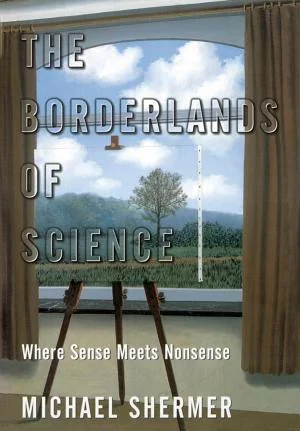
The Borderlands of Science
 80
80

The Borderlands of Science
Michael Shermer’s "The Borderlands of Science" offers a valuable, if somewhat familiar, survey of where accepted science meets the speculative and the spurious. Shermer, a consistent voice for empirical scrutiny, excels at dissecting popular pseudoscientific claims, illustrating how easily minds can stray from evidence-based reasoning. A particular strength lies in his clear explanations of complex scientific ideas, such as the Big Bang, before contrasting them with less substantiated theories. However, the book occasionally feels like a compilation of previous arguments, lacking a truly novel angle for readers already acquainted with Shermer's work. The section on superstring theory, for instance, feels more like a primer than a deep exploration of its borderland status. Ultimately, "The Borderlands of Science" serves as a solid, if not revolutionary, defense of scientific skepticism.
📝 Description
80
Michael Shermer's 2002 book, The Borderlands of Science, examines the space between science and pseudoscience.
Published in 2002, The Borderlands of Science addresses the fuzzy edge where accepted scientific understanding meets speculative ideas and outright falsehoods. Michael Shermer, the founder of Skeptic magazine, scrutinizes claims often found on the periphery of academic and public discussion. The book covers subjects from cosmology to parapsychology, using a critical perspective to separate demonstrable facts from unsupported beliefs.
This work is for individuals interested in the philosophy of science, critical thinking, and the challenge of distinguishing genuine science from pseudoscience. It appeals to those who question extraordinary assertions and want to grasp the psychological and social reasons behind belief in the unproven. The intended audience includes skeptics, science enthusiasts, and anyone curious about the appeal of unusual phenomena.
The book was released during a time of considerable public fascination with both advanced scientific ideas, such as string theory, and persistent pseudoscientific topics, like UFOs and paranormal events. The spread of the internet at that time accelerated the circulation of both accurate and inaccurate information, making Shermer's analytical approach particularly relevant.
While not an esoteric text itself, The Borderlands of Science engages with topics often relegated to esoteric traditions, such as parapsychology and UFO phenomena. It represents a skeptical counterpoint to the uncritical embrace of claims that lie outside mainstream scientific validation. Shermer's work positions itself within a tradition of critical inquiry that seeks to apply scientific methodology to phenomena that often rely on anecdotal evidence, personal testimony, or speculative frameworks, thereby challenging the boundaries of accepted knowledge.
💡 Why Read This Book?
• Learn to distinguish between established scientific theories like the Big Bang and speculative hypotheses, understanding the criteria Shermer uses for evaluation, as discussed in his analysis of cosmological models. • Understand the psychological mechanisms behind belief in phenomena like Bigfoot, examining Shermer's critique of anecdotal evidence and confirmation bias in specific case studies. • Gain clarity on the scientific method by contrasting it with less rigorous approaches, appreciating Shermer's emphasis on falsifiability as presented throughout his examination of pseudoscientific claims.
⭐ Reader Reviews
Honest opinions from readers who have explored this book.
❓ Frequently Asked Questions
What is the main argument Michael Shermer makes in 'The Borderlands of Science'?
Shermer argues for rigorous skepticism, emphasizing the need to distinguish between empirically verifiable science, speculative theories, and outright pseudoscience. He explores the psychological and social reasons why people believe in non-scientific claims.
Which scientific concepts does Shermer discuss in contrast to pseudoscience?
He contrasts established scientific theories like the Big Bang theory and concepts from physics with pseudoscientific subjects such as Bigfoot, psychic phenomena, and conspiracy theories.
What is 'borderland science' as defined in the book?
'Borderland science' refers to theories or fields that are not yet fully accepted by mainstream science but are not entirely dismissed as pseudoscience, often representing speculative but potentially testable ideas.
What role does Skeptic magazine play in relation to this book?
As editor-in-chief of Skeptic magazine, Shermer applies the principles of critical thinking and scientific inquiry championed by the publication to the topics covered in the book.
Does the book offer scientific explanations for paranormal phenomena?
No, rather than offering explanations for paranormal phenomena, the book primarily critiques the evidence presented for them and explores the psychological reasons why people believe in such claims.
What is the publication year of the first edition of 'The Borderlands of Science'?
The first edition of 'The Borderlands of Science' by Michael Shermer was published in 2002.
🔮 Key Themes & Symbolism
The Demarcation Problem
The core of Shermer's work lies in the perennial problem of distinguishing genuine science from non-science and pseudoscience. He provides tools and examples for identifying claims that lack empirical support, often relying on anecdotal evidence or faulty logic. This theme is crucial for understanding how concepts like superstring theory, while speculative, are approached differently than claims about Bigfoot, highlighting the importance of falsifiability and reproducible evidence in scientific discourse.
Cognitive Biases and Belief
Shermer looks at the psychological underpinnings of why people are drawn to extraordinary claims. He discusses common cognitive biases, such as confirmation bias and apophenia (seeing patterns in random data), that make individuals susceptible to believing in paranormal phenomena or conspiracy theories. This exploration is vital for understanding the human element in the 'borderlands,' where personal conviction can override objective data, as seen in the allure of urban legends.
The Nature of Evidence
A central pillar of the book is the examination of what constitutes valid evidence. Shermer contrasts robust scientific evidence, characterized by controlled experiments and peer review, with weaker forms of evidence like personal testimony or misinterpreted data. He uses examples ranging from the Big Bang theory to alleged UFO sightings to illustrate the critical differences, emphasizing that extraordinary claims require extraordinary proof.
The Scientific Method
Shermer champions the scientific method as the most reliable tool for understanding the natural world. He outlines its principles—observation, hypothesis, prediction, experimentation, and verification—and shows how adherence to these principles separates scientific progress from speculative or pseudoscientific endeavors. This theme underscores the importance of critical thinking and intellectual honesty when evaluating claims from the borderlands.
💬 Memorable Quotes
Direct passages from the work, attributed to the author.
“Science is a way of thinking much more than it is a body of knowledge.”
— This highlights Shermer's emphasis on the process and methodology of science rather than just its conclusions. It suggests that the critical, questioning approach is the essence of scientific inquiry.
“The skeptic does not mean him who refuses to believe, but rather him who pauses to doubt.”
— This defines skepticism not as outright denial, but as a considered pause for critical examination and evidence-gathering before acceptance, a core tenet of Shermer's philosophy.
“Extraordinary claims require extraordinary evidence.”
— This principle, often attributed to Carl Sagan, is fundamental to Shermer's critique of pseudoscientific assertions. It means that unusual or unsupported claims must meet a higher standard of proof.
“We are all prone to seeing patterns where none exist.”
— This observation points to the human tendency towards apophenia, a cognitive bias Shermer frequently discusses as a reason for belief in coincidences or paranormal connections.
“Superstring theory is a beautiful mathematical idea, but is it science?”
— This represents a key question the book poses about theories that are mathematically elegant but lack direct empirical testing, placing them in the 'borderlands'.
🌙 Esoteric Significance
Tradition
While not strictly an esoteric text, "The Borderlands of Science" engages with the *periphery* of esoteric thought by critically examining claims that often fall under its umbrella, such as paranormal abilities or fringe interpretations of physics. It functions as a gatekeeper, defining the boundaries of what is considered scientifically plausible versus what resides in the field of belief or speculation, a necessary discourse for any tradition seeking to engage with or differentiate itself from mainstream understanding.
Symbolism
The book's core symbolism lies in the metaphor of the 'borderland' itself – a liminal space between the known and the unknown, the verifiable and the imagined. It also implicitly engages with the symbol of the 'question mark' as representing inquiry, doubt, and the unresolved nature of many claims discussed. The contrast between the clarity of established scientific models (like the Big Bang) and the ambiguity of pseudoscientific assertions serves as a symbolic representation of certainty versus uncertainty.
Modern Relevance
In the age of pervasive misinformation and the rise of AI-generated content, Shermer's insistence on critical evaluation and evidence-based reasoning remains highly relevant. Thinkers and platforms dedicated to digital literacy and combating fake news, as well as researchers in cognitive psychology studying belief formation, continue to draw upon the principles Shermer articulates. His work provides a foundational framework for working through the complex information field of the 21st century.
👥 Who Should Read This Book
['• Aspiring critical thinkers: Individuals seeking to hone their analytical skills and develop a robust framework for evaluating claims, especially those encountered online or in popular media.', '• Science enthusiasts: Readers interested in understanding the demarcation between established science, cutting-edge theories, and pseudoscience, and the historical context of such debates.', '• Students of psychology and sociology: Those examining the cognitive biases and social factors that influence belief systems and the acceptance of extraordinary claims.']
📜 Historical Context
Published in 2002, "The Borderlands of Science" arrived at a moment when the internet was rapidly accelerating the spread of both scientific information and pseudoscientific claims. This era saw a surge in public fascination with topics like alien abductions and conspiracy theories, often fueled by online communities. Shermer's work contributed to the broader skeptical movement, which gained traction in the late 20th and early 21st centuries, with prominent figures like Carl Sagan having already paved the way for critical examination of such phenomena. The book engaged with intellectual currents influenced by the philosophy of science, particularly debates surrounding Karl Popper's concept of falsifiability, which Shermer frequently invokes. While not a direct response, it existed alongside popular works by authors like Richard Dawkins, who also championed scientific rationalism against what they perceived as irrational beliefs.
📔 Journal Prompts
The concept of the 'borderland' between science and pseudoscience: What personal beliefs currently occupy this space for you?
Identify a cognitive bias discussed in the book and reflect on a time it influenced your judgment.
Shermer contrasts the Big Bang theory with less substantiated claims; how do you evaluate the evidence for competing cosmological models?
Analyze a recent 'extraordinary claim' you encountered: what evidence was presented, and did it meet the standard required?
Consider the role of 'Skeptic' magazine's principles in your daily information consumption.
🗂️ Glossary
Pseudoscience
A claim, belief, or practice presented as scientific but lacking adherence to the scientific method and verifiable evidence. It often mimics the language of science without its rigor.
Big Bang Theory
The prevailing cosmological model for the universe's origin, suggesting it began as an extremely hot, dense point that expanded rapidly around 13.8 billion years ago.
Superstring Theory
A theoretical framework in physics that posits fundamental particles are one-dimensional 'strings' vibrating at different frequencies, aiming to unify quantum mechanics and general relativity.
Confirmation Bias
The tendency to search for, interpret, favor, and recall information in a way that confirms or supports one's prior beliefs or hypotheses.
Apophenia
The tendency to perceive meaningful connections between unrelated things; seeing patterns in random data, often leading to superstitious beliefs or conspiracy theories.
Falsifiability
The principle that a scientific hypothesis must be capable of being proven false through observation or experiment. If a claim cannot be disproven, it is not considered scientific.
Anecdotal Evidence
Evidence based on personal accounts rather than on investigation or research. It is often subjective and unreliable for establishing scientific fact.
🔮 Readers Also Liked
Browse all →









More Free Occult Philosophy Books
View all →