One Mind
 78
78

One Mind
Larry Dossey's "One Mind" tackles the ambitious proposition that consciousness transcends individual physical forms. He marshals an impressive array of studies, from telepathic experiences between humans to the synchronized behavior of animal groups, to build his argument. A particular strength is Dossey's careful presentation of scientific research, often from less mainstream but rigorously conducted studies, which lends credibility to his extraordinary claims. However, the sheer volume of evidence presented, while comprehensive, can occasionally feel overwhelming, leading to a slight dilution of the impact of individual examples. The chapter detailing animal consciousness, especially the coordinated actions of flocks and herds, offers a compelling glimpse into the book's central thesis. "One Mind" offers a substantial challenge to the current scientific paradigm, urging readers to consider consciousness as a fundamental aspect of reality, not merely an epiphenomenon of the brain. It is a significant contribution to the literature on non-local consciousness.
📝 Description
78
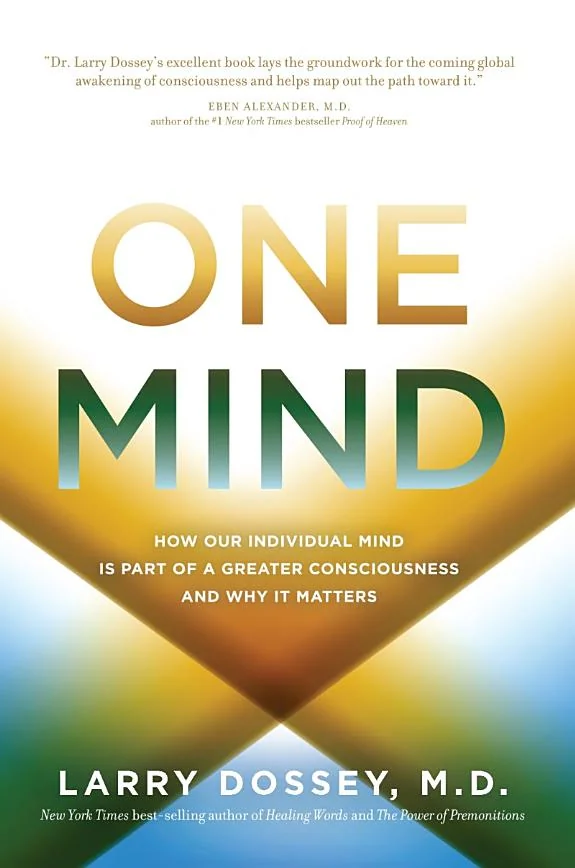
Larry Dossey's 2013 book, One Mind, argues for a universal consciousness beyond individual brains.
In "One Mind," Larry Dossey proposes that consciousness is not solely a product of the physical brain, but rather an expression of a universal, interconnected field. The book draws on a range of evidence, including scientific studies, personal accounts, and philosophical reasoning, to build its case. Dossey challenges the common assumption that minds are isolated entities, suggesting instead that individual awareness is part of a larger mental fabric. This perspective opens up possibilities for understanding phenomena often dismissed by mainstream science.
The author examines concepts like shared awareness and the intelligence found in non-human life. He posits that collective thought processes might be more significant than commonly believed, and that individual minds can tap into this unified field. "One Mind" invites readers to consider consciousness not as a private experience, but as a participation in a vast, shared reality.
Published in 2013, "One Mind" enters a long-standing dialogue within esoteric traditions about the nature of consciousness. It echoes ideas found in various mystical and philosophical systems that posit a unified cosmic mind or spirit underlying material existence. This work engages with concepts explored by thinkers who investigated psychic phenomena and non-ordinary states of awareness, seeking to bridge these explorations with contemporary scientific inquiry.
💡 Why Read This Book?
• Learn about the compelling research that supports the One Mind concept, including studies on telepathy and shared consciousness, as presented in "One Mind" (2013). • Understand the evidence for non-human intelligence and coordinated group behavior in animals, a key area explored by Larry Dossey. • Gain a new perspective on consciousness, moving beyond a strictly materialistic view to consider the interconnectedness of minds as proposed in the book's central thesis.
⭐ Reader Reviews
Honest opinions from readers who have explored this book.
❓ Frequently Asked Questions
What kind of research does Larry Dossey cite in "One Mind"?
Dossey cites a wide range of research, including studies on telepathy, shared emotions, human-animal communication, and the synchronized behavior of large animal groups, drawing from parapsychology and consciousness research.
When was "One Mind" by Larry Dossey first published?
The book "One Mind" by Larry Dossey was first published in 2013.
Does "One Mind" discuss communication with pets?
Yes, "One Mind" explores communication between humans and sentient non-humans, specifically mentioning experiences with pets as evidence for interconnected consciousness.
What is the central argument of Larry Dossey's "One Mind"?
The central argument is that consciousness is not limited to individual brains but exists as a unified, universal reality, the "One Mind," accessible to all beings.
Is "One Mind" a scientific textbook or a philosophical exploration?
It is a blend of both, presenting scientific research and parapsychological studies alongside philosophical reasoning to support its thesis about the nature of consciousness.
What phenomena does "One Mind" use to support the concept of a universal consciousness?
The book uses phenomena like shared thoughts and emotions with distant individuals, communication with animals, and coordinated group behavior in animals to support its thesis.
🔮 Key Themes & Symbolism
Non-Local Consciousness
The core of "One Mind" is the exploration of consciousness as a non-local phenomenon, meaning it is not confined to the physical brain. Dossey presents evidence from studies on telepathy and shared emotional experiences between individuals separated by distance. This challenges the traditional view of consciousness as solely an emergent property of neural activity, suggesting instead a fundamental field of awareness that connects all beings. The work posits that individual minds are points of access to this greater field, rather than isolated generators of consciousness.
Animal Sentience and Collective Intelligence
Dossey dedicates significant attention to the consciousness of non-human animals, arguing for a deeper sentience than often acknowledged. He examines instances of apparent telepathic communication between humans and pets, as well as the remarkable synchronized behaviors observed in large groups of animals like flocks, schools, and herds. These phenomena are presented as evidence that consciousness operates on principles extending beyond individual organisms, hinting at a shared awareness within species or even across kingdoms.
The Unified Field of Mind
The concept of the "One Mind" suggests a unified field of consciousness that underlies all existence. This is not merely a metaphorical idea but a proposed reality supported by anecdotal accounts and research findings. The book implies that by tapping into this universal mind, individuals can access knowledge, experiences, and connections that transcend ordinary perception. This perspective offers a framework for understanding phenomena that defy conventional scientific explanation.
Challenging Materialism
"One Mind" serves as a critique of strict materialism, the philosophical stance that only matter is real. By presenting evidence for consciousness that appears independent of physical matter, Dossey invites readers to reconsider the fundamental nature of reality. The book encourages an open-minded examination of experiences that seem to point to a spiritual or mental dimension of existence, suggesting that our current scientific models may be incomplete in their understanding of consciousness.
💬 Memorable Quotes
Direct passages from the work, attributed to the author.
“The One Mind isn't just an idea; it's a reality.”
— This statement captures the book's central thesis: that universal consciousness is not a philosophical abstraction but an empirically observable phenomenon that can be investigated and understood.
“Experiences of shared thoughts, emotions, and physical sensations with a distant individual.”
— This highlights the parapsychological phenomena Dossey investigates, suggesting a direct, non-local connection between minds that defies conventional explanations of communication.
“Communication between humans and sentient non-humans, such as pets.”
— Dossey uses human-animal interactions to argue for a broader spectrum of consciousness, indicating that non-human beings possess a form of sentience and awareness that can be perceived and possibly communicated.
“Large groups of animals--flocks, schools, herds--behaving in highly coordinated ways.”
— This points to collective intelligence and synchronized action in nature, interpreted as evidence for a shared consciousness or informational field influencing group behavior beyond individual decision-making.
“Acquisition of previously unknown knowledge from a person who...”
— This fragmented quote from the blurb suggests instances of telepathy or a form of collective knowledge acquisition, where information is transmitted or accessed without conventional sensory input or learning.
🌙 Esoteric Significance
Tradition
While not adhering strictly to a single lineage, "One Mind" speaks to Hermetic and Neoplatonic traditions that posit a universal Mind or Nous from which all individual consciousness emanates. It echoes Theosophical ideas of a unified spiritual plane and Gnostic concepts of a divine consciousness pervading all existence. Dossey's work can be seen as a modern, scientifically-informed attempt to validate ancient esoteric assertions about the interconnectedness of all sentient beings.
Symbolism
The "One Mind" itself functions as a primary symbol, representing the undifferentiated source of consciousness. Animal groups acting in unison (flocks, schools, herds) symbolize emergent collective intelligence and the potential for consciousness to operate beyond individual boundaries. The concept of shared thoughts and emotions serves as a symbol for the interconnectedness of sentient beings, demonstrating that individual experiences can be influenced by a larger, non-local mental field.
Modern Relevance
Dossey's work remains highly relevant for contemporary discussions in fields like consciousness studies, integral theory, and the science of well-being. Thinkers and practitioners exploring non-dual philosophies, quantum consciousness theories, and the ethical implications of AI consciousness often reference or are influenced by the ideas presented in "One Mind." It provides a foundational text for those seeking to integrate scientific inquiry with experiential and philosophical understandings of consciousness.
👥 Who Should Read This Book
• Students of consciousness and parapsychology: Those seeking a comprehensive overview of research and arguments supporting non-local consciousness will find "One Mind" invaluable. • Skeptics open to alternative paradigms: Individuals questioning purely materialistic explanations for mind and seeking evidence-based challenges to conventional scientific models will benefit. • Meditators and contemplative practitioners: Readers interested in the scientific validation of subjective experiences like interconnectedness and intuition will find resonance with Dossey's explorations.
📜 Historical Context
Published in 2013, Larry Dossey's "One Mind" emerged within a milieu where consciousness studies were gaining academic and public attention, albeit often on the fringes of mainstream science. The work built upon a lineage of research into psi phenomena initiated by figures like J.B. Rhine at Duke University in the mid-20th century. Dossey's approach integrated findings from parapsychology with broader philosophical discussions about the nature of consciousness, influenced by thinkers like Ken Wilber and the ongoing interpretations of quantum mechanics. While not directly engaging in public debate with specific scientists, Dossey implicitly challenged the dominant materialistic paradigm championed by neuroscientists and cognitive psychologists of the era. The book also appeared in a landscape where New Age thought had normalized concepts of interconnectedness, yet Dossey sought to ground these ideas in scientific inquiry, distinguishing his work from purely speculative or spiritual claims. The reception often placed it within the broader field of transpersonal psychology and consciousness research.
📔 Journal Prompts
The concept of the One Mind and its implications for individual identity.
Evidence for non-human consciousness presented in the book.
Experiences of shared thoughts or emotions and their connection to a universal mind.
The synchronized behavior of animal groups as a manifestation of collective consciousness.
Reconciling the idea of a One Mind with personal feelings of individuality.
🗂️ Glossary
One Mind
The central concept of the book, positing a universal, unified field of consciousness that underlies and connects all individual minds and sentient beings.
Non-local Consciousness
Consciousness that is not confined to a specific physical location, such as the brain, suggesting it can exist and operate independently of physical proximity.
Telepathy
The purported direct communication of thoughts or feelings between individuals without the use of the known senses.
Synchronicity
Meaningful coincidences that seem to have no causal relationship but are experienced as related, often interpreted as evidence of interconnectedness.
Materialism
The philosophical belief that consciousness is solely a product of physical matter and brain activity, with no independent existence.
Parapsychology
The branch of psychology that studies alleged psychic phenomena, such as telepathy, precognition, and psychokinesis.
Collective Intelligence
The shared or group intelligence that emerges from the collaboration, collective efforts, and competition of many individuals.
This book appears in 1 collection
🔮 Readers Also Liked
Browse all →









From the “Extrasensory Perception” Collection
View all →







More Free Occult Philosophy Books
View all →